Shopofkorea guides
How to Choose a Red Butterfly Mother-of-Pearl Jewelry Box That Shows Well in Foreign Influencer Shoots
Official product names are shown in Korean. Product pages are in Korean; prices are in South Korean won (KRW).
When using a mother-of-pearl jewelry box in a foreign influencer's Korean culture, beauty, or lifestyle content, it is better to look beyond the decorative pattern alone and also consider the shooting environment and what happens after the piece is handed over. Because mother-of-pearl luster can appear differently in photos or video than it does in person, it is important to check the piece by varying the lighting direction and camera angle. Even the same jewelry box may require a different shape and size depending on whether it is introduced held in the hand or placed on a table. If the box will be given as a gift after filming, storage space and the burden of transporting it should also be included in the selection criteria.
- In a bright studio: first confirm the angle at which both the background color and the mother-of-pearl pattern are visible together
- Against a dark background: compare the outline and fine detail as they appear on the actual recording screen
- For a hand-held scene: prioritize a shape whose gripping motion and opening-and-closing flow feel natural
- For a table composition: check the size the frame requires and how light plays across the surface
- If giving as a gift after filming: confirm that transport and storage present no difficulty
To Make the Red Butterfly Pattern Register on Screen, Test the Light First
A red butterfly mother-of-pearl jewelry box is a type worth examining when you want to capture Korean decorative character and a narrative subject in a single frame. However, because the beauty of the mother-of-pearl may not come through in a recorded image as fully as it does in person, it is difficult to decide after checking only one angle just before filming. It is better to set up the lighting and background you plan to use, then compare how the background color and pattern look as you gradually shift the camera angle and lighting direction. Even when light appears prominent on the surface, you should adjust the angle and confirm that the pattern is also rendered clearly.
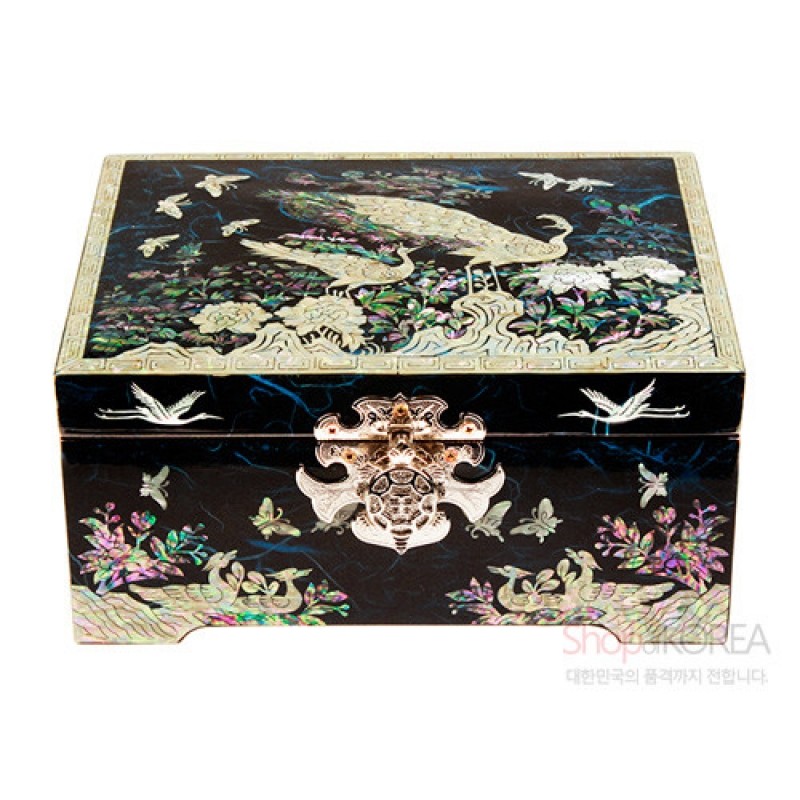
For example, a type such as the 나전칠기 직보석함 '나비 자개위를 날다' 적색 (najeonchilgi straight jewelry box "Butterfly Flying over Mother-of-Pearl," red) — with its butterfly pattern and rectangular form — lends itself well to organizing hand-motion scenes, table scenes, and post-filming handover scenes into a single continuous flow. If you plan to include the action of opening and closing the lid or placing items inside, it is safer to frame the actual shot together with the presenter's hands first. Checking whether the butterfly pattern connects directly to the content's theme can also reduce the risk of the decoration remaining a mere background prop. If you plan to give the box as a gift after filming, look into packaging, transport, and the recipient's storage space as well.

This product is a representative example for understanding red mother-of-pearl jewelry boxes and is not the only option. Even within the same scene, you can compare other types with a similar butterfly-pattern placement, box proportion, and opening-and-closing mechanism. In particular, keep in mind that what you see on screen may differ from the impression the actual object makes, and it is a good idea to record a short test clip before the main shoot. The final choice should be based not on the product name but on whether the intended scene is achieved under the actual lighting and framing conditions.
Placing Mother-of-Pearl Pieces of Different Colors Side by Side Makes the Choice Clearer
If it is difficult to judge whether a red jewelry box connects naturally with the color composition of your content, try comparing mother-of-pearl props in different background colors under the same conditions. A type such as the 한지와 자개 공작보석함 중형 청색 (hanji and mother-of-pearl peacock jewelry box, medium, blue) — hanji (Korean mulberry paper) being the base material — differs from the red butterfly jewelry box in both background color and pattern, making it a comparison candidate for checking how each renders under identical lighting and backdrop. Rather than assuming in advance that a particular color will look better, it is appropriate to confirm each piece's mother-of-pearl luster and pattern in the actual shooting environment. You should also observe which option does not distract from the theme when placed alongside the content's wardrobe or surrounding props.
Recognizable patterns such as a peacock or butterfly can serve as cues for explaining Korean decorative character, but if they do not connect to the content's theme they may simply add decorative elements to the frame. Decide first on the weight of color and pattern you need, depending on whether the scene involves placing beauty products alongside the box or introducing Korean culture itself. If the purpose is color comparison, it is easier to judge by keeping the camera position and lighting conditions fixed and swapping only the candidate piece. The blue peacock jewelry box, too, should be viewed as an example type that aids comparison; in the actual scene, it is better to choose based on the overall composition.
The Atmosphere You Want to Convey Should Read Before the Shimmer Does

For a formal table scene or a shoot that calls for decorative character, a type with a glossy surface and rounded form — such as the 화조기린 유광굴림보석함 (hwajo-girin yugang-gullim jewelry box; a high-gloss, rounded box decorated with flower-and-bird and girin patterns) — also becomes a candidate. Because glossy props may show prominent surface reflections depending on shooting conditions, you need to shift the camera and lighting positions and check the results. It is also worth judging together whether the hwajo (flower-and-bird) and girin (a mythical auspicious creature) patterns are needed in the content's explanatory flow. If you layer multiple patterns in one frame simply to add a Korean atmosphere, the theme can become unclear, so try adjusting the number of surrounding props.
This type can be used as a comparison case that differs from the red butterfly jewelry box in both form and surface texture. Because the appropriate arrangement may change depending on whether the box will be fixed on a table for filming or moved by hand by the presenter, it is better to test the planned actions as well. When the surface light rendering is not to your liking, rather than immediately ruling out the product, you can adjust the lighting direction and camera angle and check again. If even after that the pattern or form registers more strongly than the content itself, it is natural to narrow the range to a type with a simpler design.
When the Box Becomes a Gift After Filming, Size and Storage Method Change
When a larger presence is needed in the frame, you can compare a type such as the 한지와 자개 목단보석함 대형 적색 (hanji and mother-of-pearl peony jewelry box, large, red). However, a large form may feel bigger than expected depending on the framing, and when transporting or storing it after filming you must also consider the recipient's circumstances. Conversely, a candidate with a different form — such as the 나전주합정보석함 쌍학 (najeon juhapjeong jewelry box, twin cranes) — is worth comparing when you are reviewing both a limited shooting space and the storage method after delivery. Do not estimate size from the product name; it is safer to cross-reference the available specifications against the actual shooting space before choosing.
One buyer, while selecting mother-of-pearl pieces to give as gifts to foreigners, shared that they hoped the unique appeal of Korean culture and najeon (mother-of-pearl inlay work) would come through well. As this illustrates, a prop that transitions from a shoot into a gift must be easy for the recipient to understand and store, not only decorative on screen. When handing it over, briefly explaining how the prop was used in the content naturally connects the filmed scene with the meaning of the gift. The related products at the end are not a list presenting the same answers as the examples in the body text; they are candidates to compare alongside those examples in the same shooting and gift-giving situation. If you first establish three criteria — lighting and background, the size needed on screen, and transport and storage after filming — you can make a consistent choice even when the specific product changes.
If You Want to Compare a Wider Range of Products
The pages below link only to product categories that connect directly to the selection criteria in this article.
- 나전칠기-보석함 — Allows broad comparison of najeonchilgi (mother-of-pearl lacquerware) jewelry boxes by form and pattern, directly helping to expand the pool of candidates suited to the filming frame.
- 한지 나전칠기 — Allows separate exploration of hanji-and-mother-of-pearl combinations, supplementing the judgment process for comparing color, surface texture, and the impression made when delivering a gift.