
Shopofkorea guides
Preparing a Songhakdo Najeonchilgi with a Logo Nameplate as a Gift for Foreign Guests
Official product names are shown in Korean. Product pages are in Korean; prices are in South Korean won (KRW).
Event gift orders from institutions usually begin with a similar dilemma. Guests are arriving from abroad, but only one or two people will actually receive a gift. At the same time, because it is an official event, the gift will be placed on the table and photographed. A light souvenir feels insufficient for the occasion, yet from the coordinator's perspective it is also unsatisfying if the hosting institution's name appears nowhere on the gift.

A recent order was exactly like this. A coordinator at a public institution was looking for gifts to give two foreign guests. They had searched in various places using terms such as "traditional gift for foreigners," "najeonchilgi tray gift," "logo engraving souvenir," and "souvenir nameplate production." Two conditions were compared: the gift had to have a clearly Korean feel, and it had to be possible to include the institution's logo and the event name together. What they ultimately chose was a najeonchilgi (mother-of-pearl lacquerware) piece featuring a songhakdo (pine-and-crane) design — mother-of-pearl inlay of pine trees and cranes set against a black lacquer ground.
Why the Songhakdo Design Is Often Chosen for These Occasions
Songhakdo is a traditional Korean auspicious motif (gilsang munyang) depicting pine trees and cranes to represent longevity, integrity, and the dignity of a noble person. It is easy to explain to foreign guests. "The pine tree stays green through all four seasons, and the crane is a bird that lives a long time, so in Korea this image is used when wishing for a lasting, good relationship." That one sentence is enough to keep the moment of presenting the gift from feeling awkward. The fact that the black background does not clash with the design even when a nameplate is attached is also quite important for event use.
The item most frequently sought in this same design is the 나전칠기 쌍합- 송학도 (najeonchilgi ssanghap — songhakdo; mother-of-pearl lacquerware double box with pine-and-crane design). It is a handcrafted piece made by applying multiple coats of lacquer to wood and attaching natural mother-of-pearl, measuring approximately 16.5 cm wide and 8.2 cm tall, which makes it well suited for placement on an event table. It is domestically produced and weighs 550 g. As it is a fragile craft item, it is a good idea to add a word of advice so that guests carry it by hand rather than checking it as luggage when they depart.
Nameplate Work Usually Involves Several Rounds of Drafts
For orders that include a nameplate, it is common for customers to note in the order request field that "the draft will be sent separately by email" and to complete payment first. The layout tends to follow a similar pattern: the logos of the hosting institution and the partner institution are placed on the upper left and right, the project name goes in the center, and the event name goes at the very bottom. Sending the draft as a single PowerPoint slide is sufficient.
There is something that comes up almost every time. An institution's English-language logo often has a long name, and if it is simply scaled down to fit a small nameplate, the text becomes difficult to read. It can even happen that the partner institution's logo ends up looking more prominent than that of the hosting institution. For this reason, it is normal for two or three emails to go back and forth over logo sizing, and we treat that process as a matter of course. Something that looks fine on screen can appear quite different on an actual nameplate. Whether a nameplate can be attached varies by product, so it is safer to ask before placing an order whether it is possible for the specific item you have chosen.
It is also common for customers to use the gift across two separate occasions. One is made right away for the current event, while the other waits until the event name for the next occasion is confirmed. It is not unusual for an official title to be decided only several months later in the case of institutional events. In such situations, the one with the urgent schedule is made and sent out first, and the remaining one is worked on once the wording is finalized.
When You Want the Wrapping Color to Match as Well
We also receive requests from customers who say the atmosphere of the two events differs and would like to change the bojagi (traditional Korean wrapping cloth) color — for example, switching from a blue bojagi to a red one. However, when a bojagi is sent on its own, it is not sent wrapped around the product, so fold marks and creases tend to remain. We inform customers of this in advance, and if they are fine with it, we proceed. It can be ironed once before the event.
On the Table on the Day of the Event
Gifts like these are often placed on the table first rather than handed directly from person to person. The coordinator mentioned adjusting the angle slightly so that the logo and text on the nameplate faced toward the guests. The two guests looked back and forth between the tray and the nameplate and nodded, and when the coordinator brought up the songhakdo design at that moment, the conversation flowed naturally. The remaining piece is wrapped in a red bojagi, waiting for the next event.
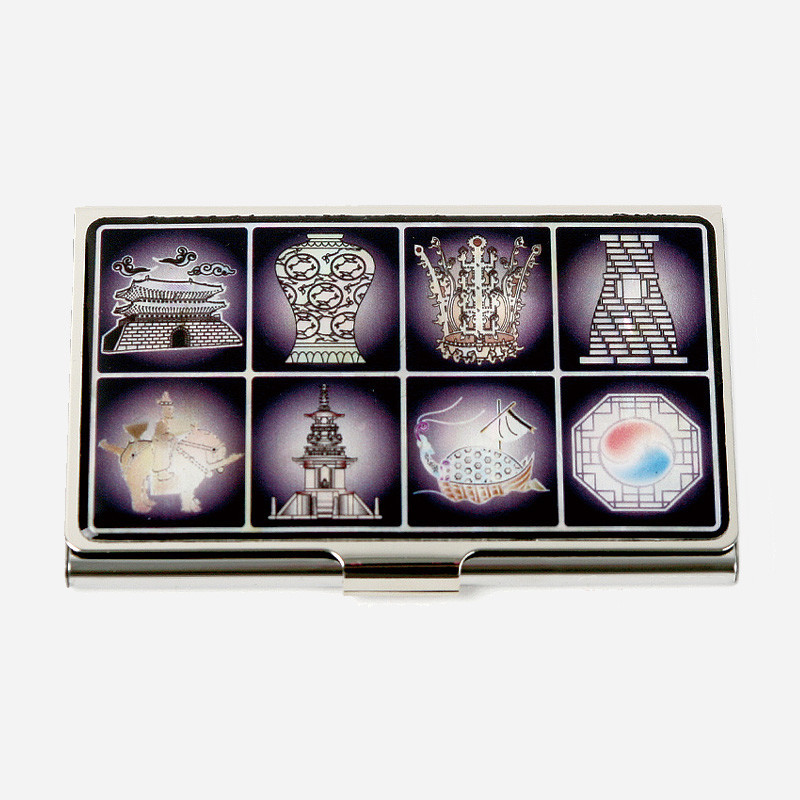
Some customers want to prepare something small for accompanying staff or working-level officials as well. In those cases, the 명함집-국보 (myeonghamjip — gukbo; business card holder with national treasure motifs) is a popular choice. It is a metal business card holder whose surface features mother-of-pearl-style renderings of national treasure motifs such as Sungnyemun, the celadon maebyeong vase, the gold crown, Cheomseongdae, and the turtle ship, making it something that can be taken out and used right away in a business setting.
For those who prefer a more vibrant color to the black ground of the songhakdo, there is also the 나전칠기 한지보석함 대-목단(적색) (najeonchilgi hanji boseokham dae — mokdan (jeoksaek); large mother-of-pearl lacquerware hanji jewelry box — peony, red). It features mother-of-pearl inlay of peony and butterfly motifs — symbolizing wealth and prosperity — on a hanji (traditional Korean paper) ground, and at 24.8 cm wide it is generously sized, giving it a sense of weight as a gift for a distinguished guest.

When choosing a gift for foreign guests where the number of recipients is small and the setting is official, it is better to first decide what to put into a single piece rather than focusing on quantity. The meaning carried by the design, and a nameplate that shows who is giving it and on what occasion — when these two elements come together, simply placing the gift on the table is itself a form of greeting.
This account is based on an actual purchase situation; individuals and institutions have been anonymized and some scenes have been reconstructed.