
Shopofkorea guides
I Gave a Young Foreign Friend a Hangeul Fan as a Gift
Official product names are shown in Korean. Product pages are in Korean; prices are in South Korean won (KRW).
Once the trip to visit an acquaintance living in Europe was scheduled, the first thing that weighed on my mind was the gift. The person is a friend in their twenties. We had occasionally talked about Korean food and dramas, but when it came down to it, I had no real sense of what to bring from Korea that they would actually like.

Something light enough to fit in a bag, with no risk of breaking, and instantly recognizable as a Korean item. Narrowing it down that way, I was left with a fan. But when I searched for "fans as gifts for foreigners," the dilemma only grew. Most of what came up was either elaborately floral fans aimed at women, or fans painted with ink-wash landscape scenes. The landscape fans were dignified enough, but even to my eyes they looked a bit old-fashioned. I couldn't quite picture one sitting in the room of a friend in their twenties.
So I changed my search term: "Hangeul fan." Whenever foreign friends talked about Korea, the thing they always found fascinating was Hangeul. They'd say it was interesting that shapes like circles, short lines, and squares were actually letters.
Deliberating Between Two Hangeul Fans
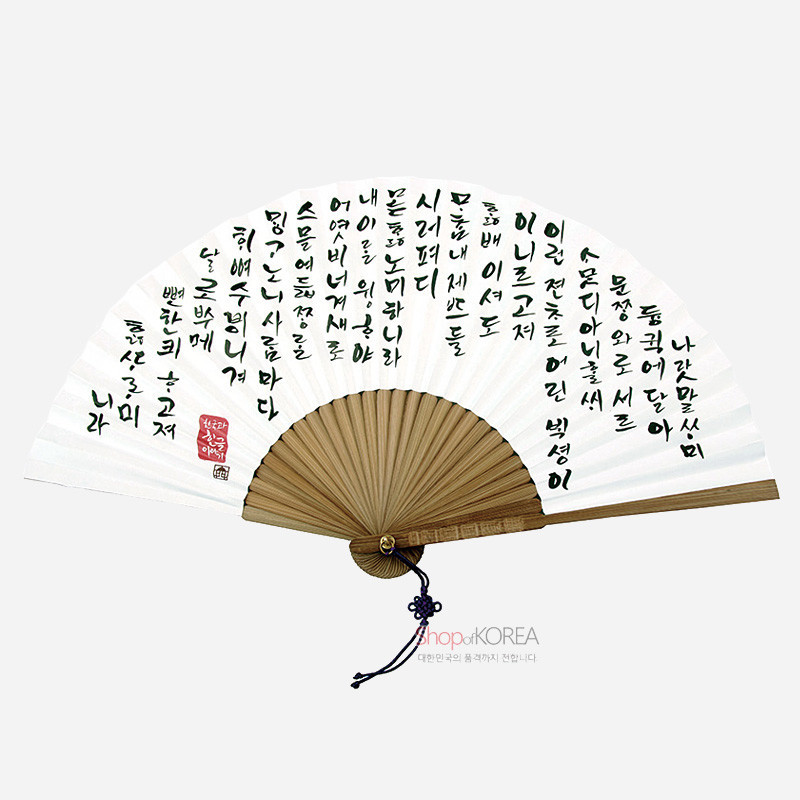
I compared a few Hangeul-themed fans at Shop of Korea. The first one that caught my eye was the 한국의 아침 부채 시리즈-훈민정음[캘리] (Korea Morning Fan Series – Hunminjeongeum [Calli]). It is a traditional fan with bamboo ribs, hanji (Korean mulberry paper), and a decorative maedeup (traditional Korean knotwork) ornament, and what appealed to me was that it carries the Hunminjeongeum in calligraphy and is made in Jeonju. The lettering itself looks like a work of art, so I thought it would make a fine gift for an elder or a business associate.
For a young friend, though, it felt a little weighty. The one I ended up choosing was the 한국의 아침 부채 시리즈-한글[히읗] (Korea Morning Fan Series – Hangeul [Hieut]). It is a fan with the Hangeul letter hieut (ㅎ) as its motif, rendered on hanji. Being from the same series, the bamboo ribs, hanji, and traditional maedeup are all the same, but writing a single letter large, as though it were a picture, completely changes the atmosphere. The color palette is refined, and it has a feeling of tradition and modernity blended together. I felt sure a young friend could receive it without any sense of awkwardness.
Laid Flat Inside the Bag
When the fan arrived, I opened it up once to have a look. Spread out, it measures 52 cm wide and 29 cm tall, so it is more generously large than I had expected. Even so, it weighs 110 g, so there was nothing to worry about in terms of luggage weight. Since it contains no liquids or batteries and is not something that can break, all I had to do was fold it and lay it flat between the clothes inside my travel bag.
The Day I Handed It Over
On the evening we met, I brought it out after dinner. The moment my friend unfolded the fan, they asked whether it was a letter. I explained that it was hieut, a consonant that makes the sound of h in English. The short line at the top, the horizontal stroke below it, and then the circle. My friend slowly traced the shape of the letter with a finger and spent a long time gazing at it, saying, "A letter actually looks like this?"
After that, I didn't need to explain anything further. Another friend who was nearby came over and passed the fan around, and eventually they asked me to write their name in Hangeul, so I wrote them out one by one on napkins. Talking about what a batchim (a consonant placed at the bottom of a syllable block) is, and why letters cluster together inside a square, made the time pass quickly. I had simply handed over one gift, yet half of the conversation that evening was about Hangeul.
Foreign friends really do find the individual letters — the jamo (the consonants and vowels of the Hangeul alphabet) — beautiful and fascinating. It is something we have grown so accustomed to that we tend to forget. Having one written large on a fan means that before any explanation is given, the eye already understands.
A few days later, my friend sent a photo. It showed the fan propped half-open on a desk. They said they were using it as a decorative object for the room rather than for fanning. If I had chosen a landscape fan, I think it probably would have ended up in a drawer.
If you are looking for a Korean fan to give a young foreign friend, it is perfectly fine to think of letters before pictures. Hangeul becomes a conversation starter on its own, and the person who receives it ends up remembering it by tracing the shapes themselves. This time around, I came back from Europe feeling as though I had done a small turn as a Hangeul ambassador.
This account is based on an actual purchase experience; individuals and organizations have been anonymized and some scenes have been reconstructed.