
Shopofkorea guides
Traditional Wall-Hanging Hyang Jumeoni Chosen as Gifts for Foreign Visitors
Official product names are shown in Korean. Product pages are in Korean; prices are in South Korean won (KRW).
I heard that foreign guests would be visiting the company at the very start of autumn. The schedule included a tour of the factory and offices as well as meetings, and the single task that landed on me was this: "Go ahead and prepare some gifts."
The first thing that came to mind was a tal (traditional Korean mask). Thinking of something distinctly Korean, a tal was what I pictured first, and I thought engraving the company logo or the date of the visit on the back would make it a nice memento. So I sent an inquiry to the online shop. The reply that came back was that printing on that product was difficult, and while a sticker could be applied, it peeled off easily and was therefore not recommended.
I was a little disappointed, but it was an honest answer, and it actually helped me sort out my thinking. A gift with a logo stamped on it is really more for the giver's satisfaction; the person receiving it doesn't exactly keep it at home and look at it for years. I changed my mind and decided to leave the company name out entirely and instead give something that made it immediately clear at a glance that it had come from Korea.
For the next month or so I spent every spare moment searching. "Gifts for foreign visitors," "gifts for foreign company guests," "traditional souvenirs for foreigners." Things like ballpoint pens or keychains were too ordinary, and ceramics worried me because the guests would have to pack them in their luggage and board a plane. Something with no risk of breaking, light, and able to give an instant "ah, Korea" feeling. Searching by that standard, I kept coming back to "hyang jumeoni" (향주머니, a traditional Korean scented sachet) again and again.
A Small Pouch Dressed in Hanbok
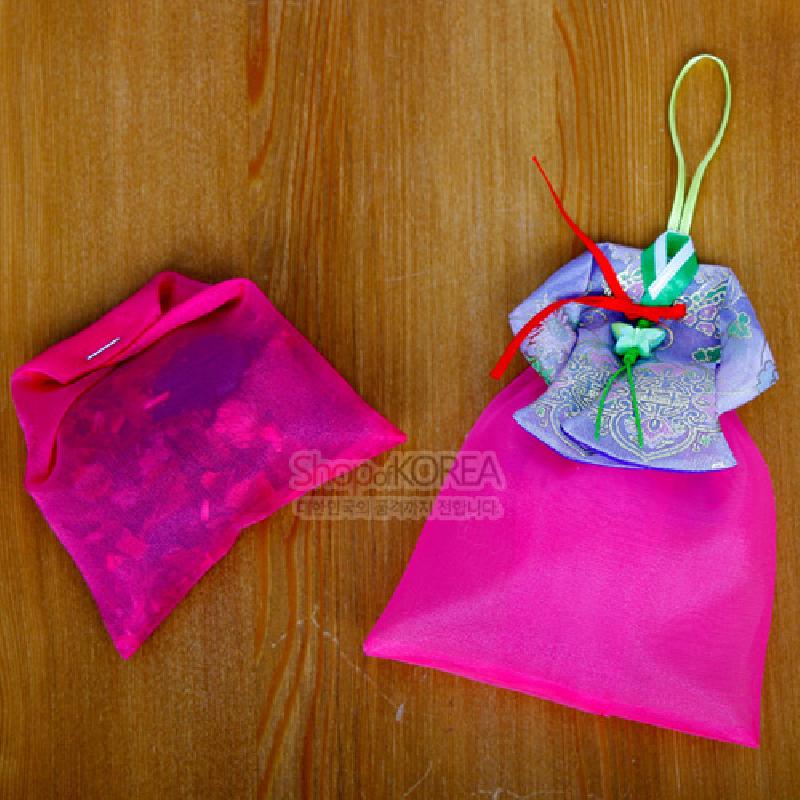
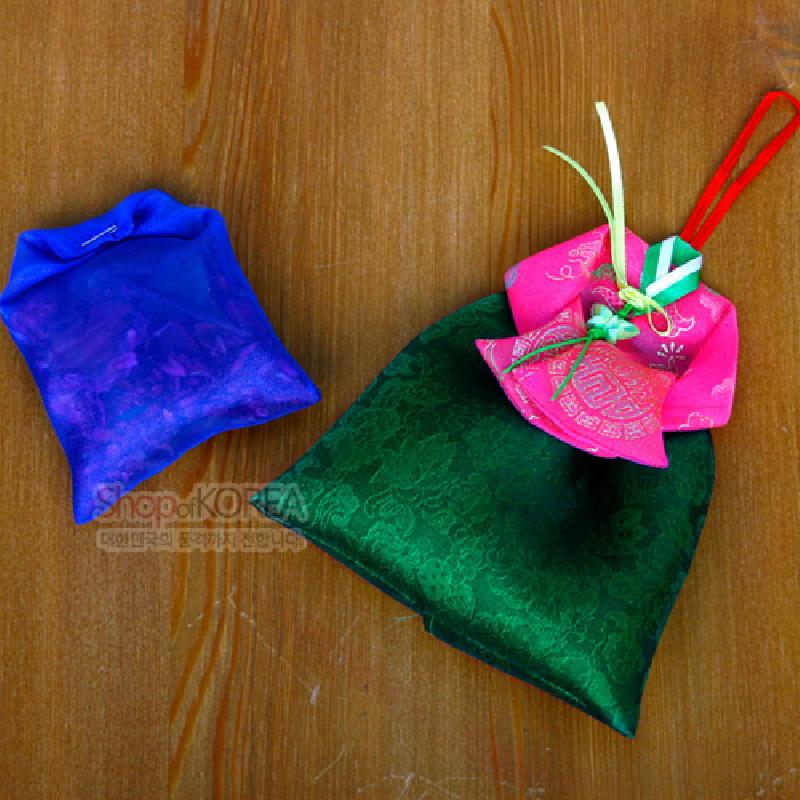
What I settled on was the 전통벽걸이 향(香)주머니-당의 series (Traditional Wall-Hanging Hyang Jumeoni – Dangui; dangui is a short upper garment worn with formal hanbok). These are hanbok-shaped pouches dressed in a dangui top and a skirt, infused with fragrance, so when hung on a wall they serve as decoration while also giving off a subtle scent. They are made 100% by hand within Korea, and the silk-type fabric features gold-thread embroidery and traditional maedeup (매듭, Korean decorative knotwork). Even from photographs alone, you could see how much handwork had gone into them.
There were 4 colors, so rather than choosing just 1 I prepared a mix. First, 전통벽걸이 향(香)주머니-당의(분홍치마) (pink skirt). It has the brightest, softest feel.

전통벽걸이 향(香)주머니-당의(청색치마) (blue skirt) is calm and neat, making it something male guests could choose without any hesitation.
전통벽걸이 향(香)주머니-당의(녹색치마) (green skirt) was a color that made the subok (수복, longevity-and-blessing) motif and embroidery stand out clearly.

And finally, 전통벽걸이 향(香)주머니-당의(적색치마) (red skirt). The red skirt gave off a celebratory atmosphere and felt the most like a "Korean gift" of all.
Midway through, due to circumstances at the office I had to change the delivery address to the building's security desk, but when I got in touch they switched it right away, and I received everything in time for the schedule.
The Choosing Itself Became Part of the Gift
On the last day of the visit, after the meeting wrapped up, I laid the colorful hyang jumeoni side by side on the table. When I said, "Please each pick the color you like," the atmosphere changed completely. Everyone picked one up, held it to their nose, compared the skirt colors, and laughed with each other saying things like "You picked that one?"
One person asked what this garment was, and I explained that it was the upper part of the hanbok that women of the past wore when observing formal etiquette. Then another person asked where you hang the pouch, and just like that, the conversation that had been stiff for three full days flowed most comfortably in those last few dozen minutes. It was the kind of talk that never came out in the conference room.
The guests each said "gamsahamnida" (thank you) in Korean as they left. One person said they would hang it on the bedroom wall when they got home. Since it was neither heavy nor breakable, they simply tucked it into their bags and took it with them.
If I Were to Prepare Again Next Time
Not being able to include the logo bothered me at first, but looking back, that was the right call. Instead of the company name, it was a gift that left behind the memory of "having visited Korea."
Next time I plan to include a short note of thanks alongside it. Writing a few lines in English on a card with a hanbok illustration — like the 전통 한복카드-연인(여) (Traditional Hanbok Card – Couple, Female) — and handing it over together with the hyang jumeoni seems like it would feel more natural, with the pouch and the illustration complementing each other.

If you're at a loss about what to give when foreign guests visit your company, laying out several colors rather than settling on a single color and letting guests choose for themselves is also an option. Those few minutes of handing the gifts over tend to stay in the memory longer than you might expect.
This account is based on an actual purchase experience; individuals and the organization have been anonymized and some scenes have been reconstructed.