
Shopofkorea guides
Chose Hunminjeongeum Bookmarks as Souvenirs for a Foreign School Visit
Official product names are shown in Korean. Product pages are in Korean; prices are in South Korean won (KRW).
In December, just before winter break, I received an official notice in the teachers' office. It said that teachers and students from an elementary school abroad would be visiting our school about a month later. The schedule included observing classes, classroom exchanges, and lunch together — a full day — and I was put in charge of preparing souvenirs for the guests.
At first I thought it would be easy. But when it actually came time to choose, there were more than a few things to consider. The recipients were a mix of teachers and children. It couldn't be too childish for the adults, and it couldn't be too difficult for the kids. Giving everyone in the group the same thing was important so no one would feel left out. Since they were flying home, anything heavy or breakable was out of the question. Above all, since it was a gift from a school, I wanted something that would leave a clear impression of having visited Korea.
The first thing that came to mind was a bookmark. There's nothing more fitting to exchange between schools than something related to books. So I started by searching "bookmark" on Shop of Korea, then broadened my search with terms like "gift," "gift for foreign students," and "school visit souvenir."
Things I Compared
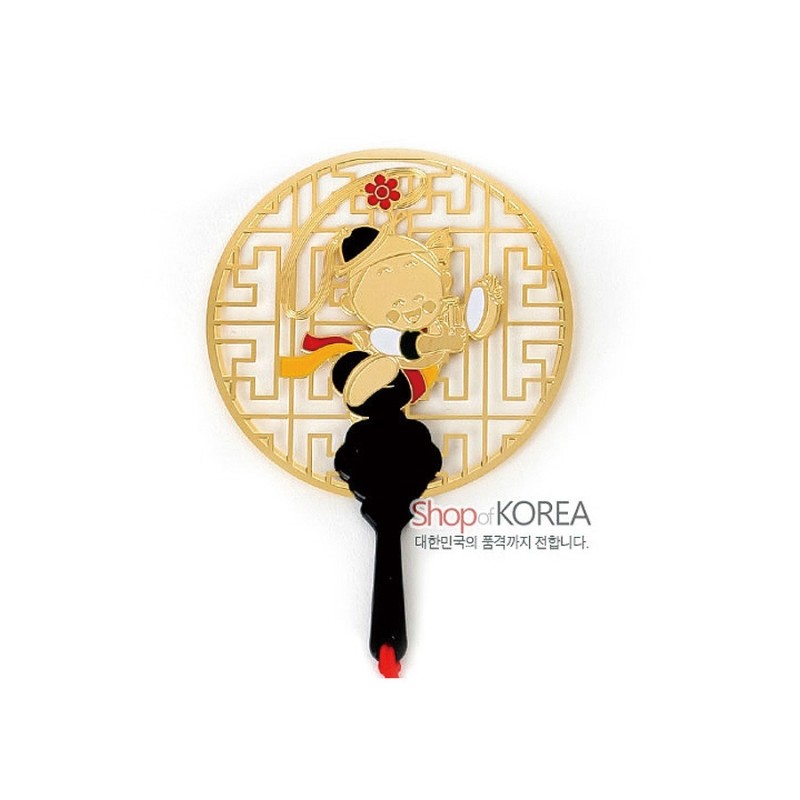
Thinking purely about the children's perspective, the 메모홀더 책갈피-사물놀이 (memo-holder bookmark, Samulnori theme) caught my eye. It's a metal bookmark featuring an illustration of a cute child playing traditional instruments, and I thought elementary school students would love it the moment they saw it.

For the teachers, I thought the 훈민정음 책갈피 볼펜세트 (Hunminjeongeum bookmark and ballpoint pen set) — which includes both a bookmark and a pen — might also be a good option, since it's a set they could take out and use right in the classroom.
But once I started dividing things into adult versions and children's versions, it got complicated. In the end I went back to my original criterion of "one item for everyone," and that's how I settled on the 금장책갈피-훈민정음 (gold-plated bookmark, Hunminjeongeum).
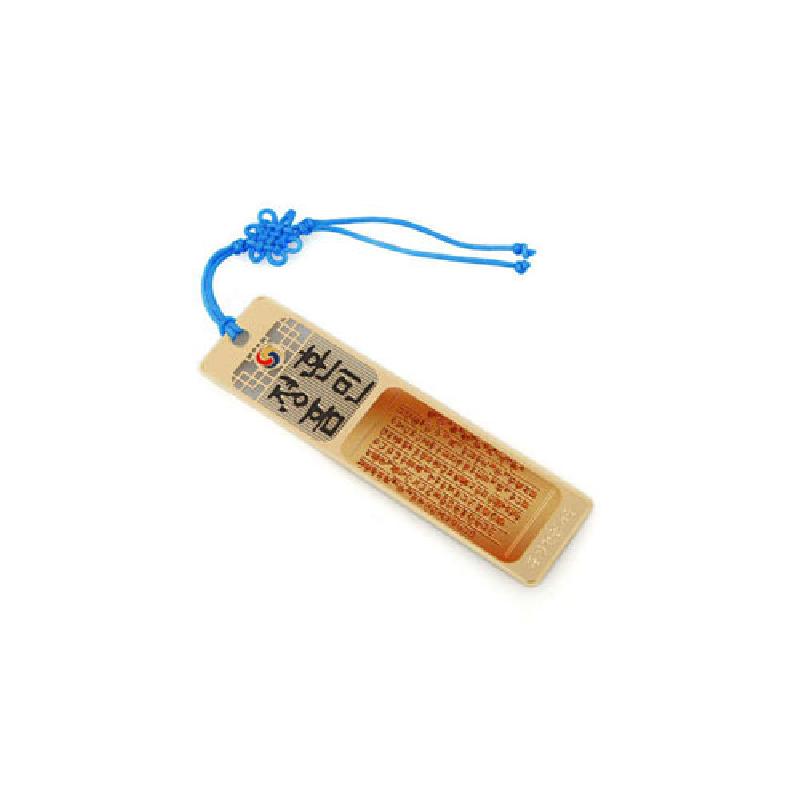
It's a bookmark made on a metal base with gold-plating, engraved with Hunminjeongeum characters in intaglio and relief patterns. A blue traditional decorative knot (maedeup) hangs from the end. At 8.5 cm long, 2.3 cm wide, and about 10 g, it fits anywhere in a travel bag without being a burden, and there's no worry about it breaking. I thought the story of Hangul — the script King Sejong created for the people — would be easy to share with the children as well. What made up my mind was that it doesn't look flimsy even in an adult's hands.
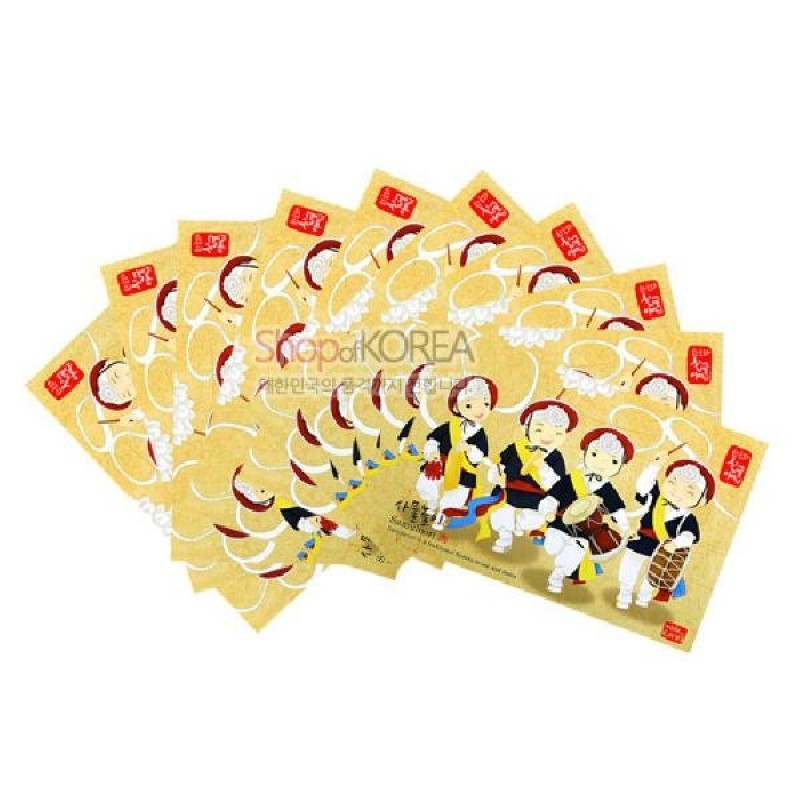
A bookmark alone felt a little sparse, so I separately prepared a thank-you message in English with the school name and the date of the visit, and handed it along with the bookmark. In the same situation, I think it would also be nice to write a line by hand on a postcard like the [10장 묶음] 한국의 아침 엽서 시리즈 - 사물놀이 ([Pack of 10] Morning in Korea Postcard Series – Samulnori) and include it alongside. At 10 × 14.8 cm, the size is just right for slipping into an envelope together with a bookmark.
The Day We Handed Them Out in the Classroom
It was late January, and the wind was still biting. The guests, bundled in thick coats, made their way down the corridor and into the classroom. After the classroom exchange wrapped up, during the closing time, the students in my class placed one bookmark on each desk.
One child set the bookmark on their palm and studied it for a long moment, then traced the gold characters with a finger. The teacher standing nearby asked what the letters were, and one of our students answered in halting English, "Korean letters — a king made them." The teacher nodded and said, "Then I'll use this during reading time in our class." The children were shaking the blue knots and laughing, holding their bookmarks up against each other's to find matching characters.
Before they left, I noticed several children tucking their bookmarks into their passport wallets or between the pages of notebooks. With no weight and no bulk, they slipped in anywhere. Later, in a photo sent over by their school, a blue knot was poking out from between the pages of a picture book.
When guests like those from a foreign school come as a mixed group of adults and children, being able to give everyone the same item turned out to be a bigger advantage than I had expected. Because the story of Hangul travels along with the gift, those few minutes of handing it over didn't just pass by — they stayed with everyone like a brief lesson.
This account is based on an actual purchase experience; individuals and institutions have been anonymized and some scenes have been reconstructed.