
Shopofkorea guides
Why Do the Letters Catch Your Eye First on Hunminjeongeum Gifts?
Official product names are shown in Korean. Product pages are in Korean; prices are in South Korean won (KRW).
On Hunminjeongeum goods, the letters are the first thing you notice. Open a fan or pick up a mug and Hangeul gives the object its character. Reading the letters and taking in their shapes happen at the same moment.
Within that, the spirit behind the creation of Hangeul is also present. That is why Hunminjeongeum gifts carry on as souvenirs that introduce Korea. From fans to ballpoint pens, the uses differ, yet they all share the same written culture.
The Intent Behind Creating Hangeul Is Held in the Object
The word "Hunminjeongeum" used on gifts symbolizes the spirit behind the creation of Hangeul. It also calls to mind the principles and beauty of Hangeul, created by King Sejong. The letters placed on a product are themselves an element that conveys Korea's written culture.
That is why Hunminjeongeum goods are difficult to explain by the shape of the letters alone. The meaning those letters carry in Korea always comes along with them. Giving one to a foreign acquaintance becomes an opportunity to introduce Korea and Hangeul. For Koreans, it becomes an object through which a familiar script is encountered anew in everyday life.
If it is a small accessory the recipient uses every day, the story draws even closer. Each time the object is taken out, the letters catch the eye again, so remembering Korea becomes linked to a small everyday gesture.
Letters That Are Read Turn into Patterns That Are Gazed Upon
Letters convey meaning while also creating a visible shape. Hunminjeongeum goods hold both of these qualities together. Someone who can read Hangeul recalls the meaning contained in the script. For someone to whom Hangeul is unfamiliar, the appearance of the letters comes first.
Even when the same theme is present, the impression differs depending on the object. Calligraphy on hanji (Korean traditional paper) and a typeface motif rendered in metal are examples of this. On a ceramic mug, the letters settle in as the design of an everyday item.
In this context, the name Hunminjeongeum does not imply a particular method of production. There are traditional fans made with bamboo and hanji, and there are also products that apply Hangeul design to modern writing instruments. What they share is not the material but the fact that they carry Korea's written culture.
When You Open the Fan, Hangeul Opens with It
한국의 아침 부채 시리즈-훈민정음[캘리] (Korea's Morning Fan Series – Hunminjeongeum [Calli]) uses bamboo and hanji. It is a traditional fan to which decorative knot work (maedeup) and calligraphy have been added. The act of opening the fan becomes the moment the Hangeul motif is revealed.
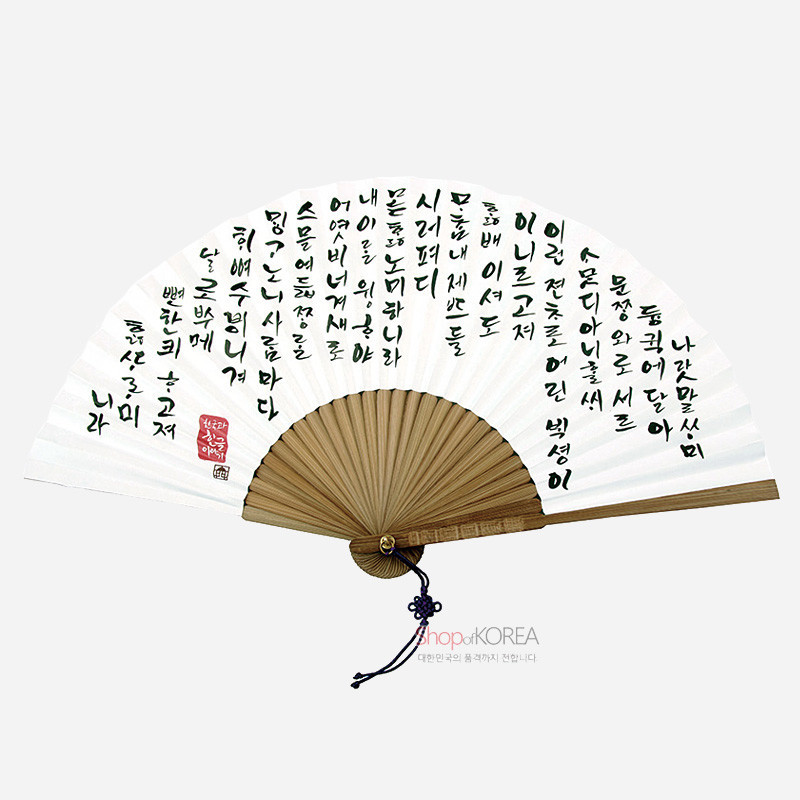
One buyer who purchased this fan left the following review: "Hunminjeongeum is inscribed on a traditional Korean fan, so I think it makes a wonderful gift for foreigners! It is also well suited for promoting Hangeul."
The review holds both the use of the fan and the intent to share Hangeul side by side. What the buyer noticed was the script inscribed on the traditional fan. They received it as a gift that introduces Korean craft and Hangeul at the same time.
How one appreciates it differs depending on how familiar one is with Hangeul. Some enjoy the calligraphy itself, while others feel the traditional beauty of Korea through the fan as an object.
The Ballpoint Pen and Business Card Case Carry Hangeul on the Desk
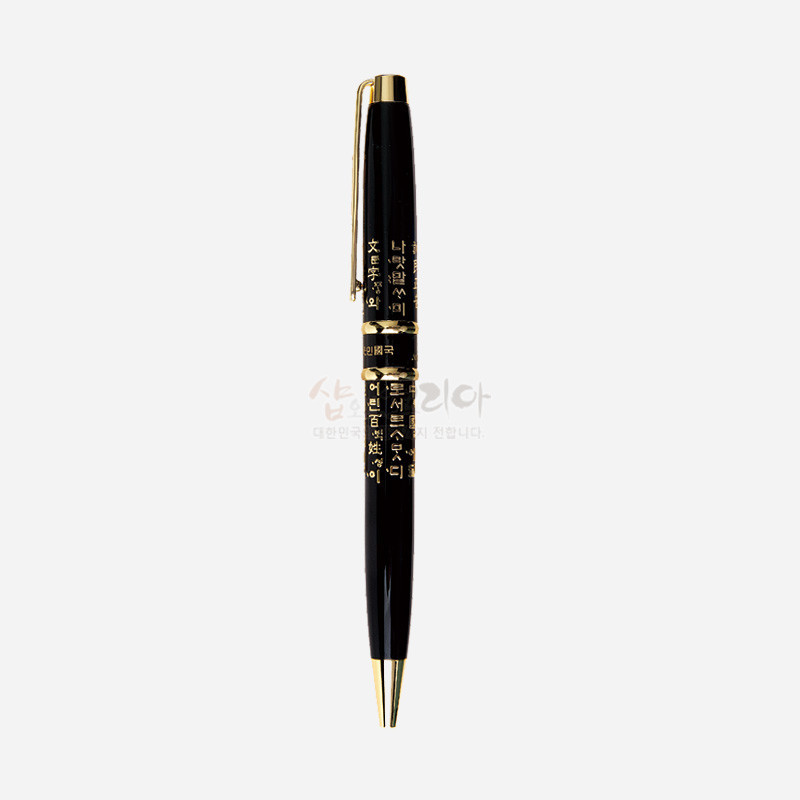
금필 훈민정음 볼펜 (Geumphil Hunminjeongeum Ballpoint Pen) is a writing instrument to which a Hunminjeongeum typeface motif has been applied. Korean cultural design has been placed on an everyday item made of metal and plastic. It is interesting that the symbol of Hangeul's creation sits on a tool for writing.
When looking for Korean stationery gifts, this connection feels natural. It is because a tool for recording also conveys written culture along with it. It is closer to a cultural souvenir made with Hangeul as its theme than to a traditional craft object.
금장명함케이스-훈민정음 (Gold-Inlaid Business Card Case – Hunminjeongeum) also places letters on an object used during work. The design combines the preface of the Hunminjeongeum with cloud and dancheong (traditional Korean decorative coloring)-style patterns. The moment a business card is drawn out, Korea's script and decorative beauty are revealed together. That is why it also suits a commemorative gift for a business partner.
There is also a composition that carries the same theme across a range of stationery. The 훈민정음 3종 세트(오침노트, 금필볼펜, 명함집) (Hunminjeongeum 3-Piece Set — ochim-note, geumphil ballpoint pen, business card case) is one example, bringing together different office items under the theme of Hunminjeongeum.
In the Mug, the Letters Linger in Everyday Life
한국의 아침 머그컵 시리즈 - 훈민정음 (Korea's Morning Mug Series – Hunminjeongeum) is a ceramic mug. It is an example of how objects that carry letters are not confined to stationery. Even in the ordinary moment of lifting and setting down a cup, Hangeul catches the eye.

The meaning held in a gift does not stay only in the moment it is given. An everyday accessory brings the giver to mind each time it is used. The Hunminjeongeum design layers Korea's written culture onto that memory. The use of the object and the meaning of the gift run alongside each other in this way.
These objects can all be found together on the Hangeul and Hunminjeongeum page. The fan, ballpoint pen, mug, and business card case all carry the same theme, so one naturally moves from one to the next to see how the letters have been used across each object.
Hunminjeongeum goods hold both the intent behind the creation of the letters and the beauty of the letters themselves. In every act of opening, writing, and drinking, that meaning is encountered again. The letters that first caught your eye go on to keep Korea in memory throughout every use of the object.