
Shopofkorea guides
Traditional Money Envelopes to Accompany Chuseok Gifts
Official product names are shown in Korean. Product pages are in Korean; prices are in South Korean won (KRW).
As Chuseok approaches, people preparing thank-you gifts and visit gifts also look for traditional envelopes. It is likely a wish to include a holiday greeting even in the envelope that holds pocket money or gift vouchers. Having decided what to put inside, they then think about the appearance of what they will hand over.
The collar of a hanbok, a norigae (traditional Korean ornamental pendant), and peonies embroidered on silk each create a different impression. Some forms are borrowed from clothing, and some feature floral motifs carrying auspicious meanings. Once you know these decorations, even the small effort of handing over an envelope takes on significance.
While Preparing Chuseok Greetings, Packaging Is Also Considered
People preparing Chuseok gifts often ask about packaging and delivery schedules at the same time. They may check traditional designs and packaging all at once. Choosing a gift, in other words, already includes thinking about how it will look when received.
An envelope is the first thing encountered before what is inside is taken out. Lines resembling a collar or floral embroidery create that first impression. While it cannot substitute for words of gratitude, it can express that something was prepared separately for the purpose of greeting.
Traditional envelopes are not used only at Chuseok. Forms once used for yedan (traditional Korean betrothal gifts) or expressions of gratitude can also accompany holiday gifts. Even if the occasion differs, the intention to present something with care carries through.
Peonies Embroidered on Silk Carry an Auspicious Meaning
'정성담은 비단봉투-예단보 목단' (Sincerely Crafted Silk Envelope – Yedan-bo Mokdan; a silk envelope featuring mokdan, the Sino-Korean word for peony, embroidery in the yedan-bo wrapping-cloth tradition) is a product that adds a mokdan motif and embroidery to silk. Mokdan is another word for the peony. In traditional wedding and yedan (betrothal gift) culture, it was used as a flower representing wealth, beauty, and good fortune.

This envelope applies the yedan-bo and bojagi (traditional Korean wrapping cloth) style of packaging in a contemporary way. It can be used to present letters, pocket money, gift vouchers, and similar items. It is an object that carries forward into expressions of gratitude the kind of packaging once used to convey sincerity and propriety at weddings.
Accompanying a Chuseok gift with a mokdan envelope can be understood in the same way. It adds the splendor of the flower while also expressing a wish for good things to come to the recipient. If handed over together with a brief word of thanks, the meaning held in the motif is likely to come through all the more clearly.
Hanbok and Norigae Are Brought Together in a Paper Envelope

'전통한복돈봉투-노리개' (Traditional Hanbok Money Envelope – Norigae) is a product that transfers the silhouette of a hanbok onto a paper envelope. It adds norigae (traditional Korean ornamental pendant) decoration to the jeogori (upper garment of a hanbok) and traditional patterns. Elements taken from wearable clothing are brought into a small item passed by hand.
One buyer wrote: "The hanbok is beautiful, but the norigae is wonderful too." It is a review that paid attention to the norigae decoration alongside the overall appearance of the hanbok. The reviewer noticed even the small decorative details of the envelope.
An envelope modeled on a hanbok carries within it Korean clothing culture. Adding this kind of form to a holiday greeting makes the envelope itself a talking point. A short remark such as "I chose it because it resembles a hanbok" is enough to convey the reason for the choice. It adds to the words of thanks the thought that went into selecting the item.
Words of Gratitude Are Added to the Shape of Clothing
'전통한복돈봉투-한복(女)' (Traditional Hanbok Money Envelope – Hanbok (Female)) is a paper envelope expressing a jeogori and traditional patterns. It comes with individual poly-bag packaging and a memo insert. Words of gratitude thought of while preparing the gift can be written on the insert. The words of the giver are added to the exterior in the shape of a hanbok.
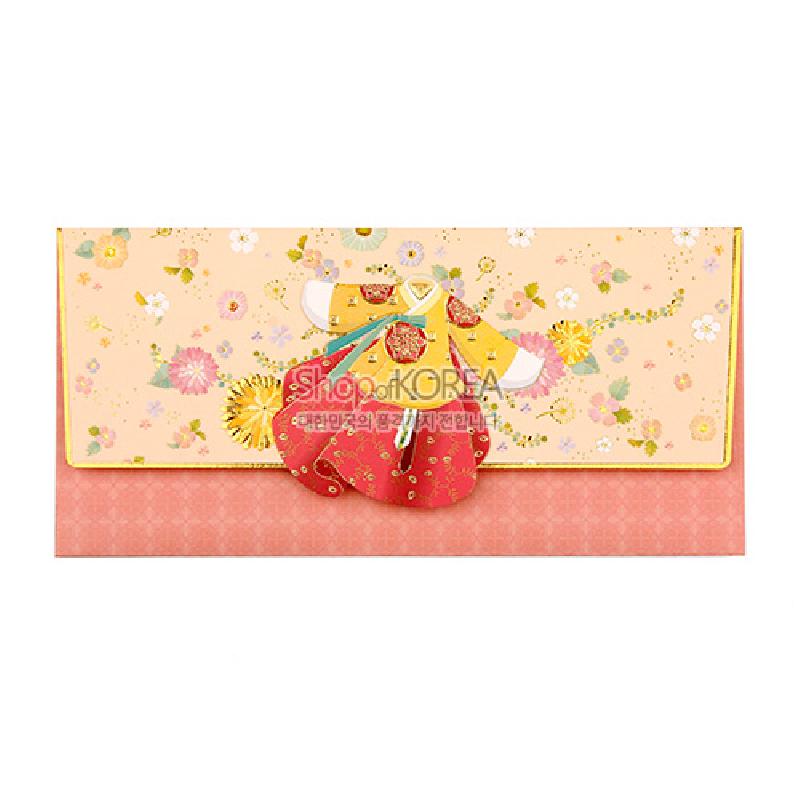
This product has a review that reads: "I bought it to give as a gift to people from other countries. The hanbok is pretty." It is an example of someone choosing the hanbok shape specifically to give as a gift to foreigners. Even though it is not a review mentioning Chuseok, the reason for preparing it as a gift based on the envelope's appearance is clear.
'전통한복돈봉투-한복저고리' (Traditional Hanbok Money Envelope – Hanbok Jeogori) likewise transfers the jeogori form onto paper. Saekdong (multicolored striped fabric), obangsaek (the five traditional Korean colors), and traditional patterns are used in the design. Unlike an envelope with flowers embroidered on silk, it conveys Korean clothing culture through the form and colors of the garment.
Traditional patterns have been used not only on hanbok but also on ceramics, embroidery, and more. Motifs drawn from nature were sometimes imbued with wishes for good fortune or longevity. Today's envelopes connect that decorative culture to objects passed between people in everyday life.
For the memo, writing one specific expression of thanks is enough, rather than an elaborate sentence. Writing a long-felt appreciation alongside a Chuseok greeting makes the intention behind preparing the envelope all the clearer.
The reason for adding a traditional envelope to a Chuseok gift is likely that the appearance of what is handed over is considered just as much as what is placed inside. A brief greeting can be added to the auspicious meaning of the mokdan or the hanbok-inspired shape. Preparing even the outward appearance of a gift with care becomes an expression of gratitude.
For a Broader Comparison of Product Categories
The page below links only to the product categories directly connected to the envelopes covered in this article.
- Postcards / Greeting Cards — This is a category that includes traditional money envelopes and celebratory envelopes together. It extends from holiday greetings presented in an envelope to written expressions of gratitude.