Shopofkorea guides
A Korean Gift Guide for Overseas Fans of K-Culture
Official product names are shown in Korean. Product pages are in Korean; prices are in South Korean won (KRW).
When choosing a distinctly Korean gift for an overseas acquaintance who loves K-culture, "is it Korean?" alone is too broad a criterion. The points that resonate with the recipient differ depending on whether their interest in Korea began with dramas, Hangeul, or traditional patterns, and the appropriate level of formality also differs depending on whether the relationship is a fan exchange or a business greeting.
- If you want to leave a lasting traditional atmosphere: accessories with clear patterns and symbolism
- If you want something they will use casually and often: everyday items such as tumblers or stationery
- If you need to distribute to multiple people: a lightweight, easy-to-explain selection
- If the relationship is formal: a set that combines presentable packaging with practicality
- If there is overseas travel or shipping involved: check the risk of damage and the volume first
A gift that reflects why they came to love Korea is easier to give
The choice becomes easier if you first think about which aspect of Korea drew the recipient in — K-pop, dramas, hanbok (traditional Korean dress), Hangeul, or a trip to Seoul. Accessories with strong traditional patterns convey a "distinctly Korean feel" immediately, while stationery featuring Hangeul or Seoul imagery feels natural for someone interested in language and urban culture. However, items that carry too many symbols or require a long explanation to be understood can feel like a burden the moment they are received. Rather than trying to pack in all the meaning, it is more reliable to connect the gift to the K-culture element the recipient already loves.
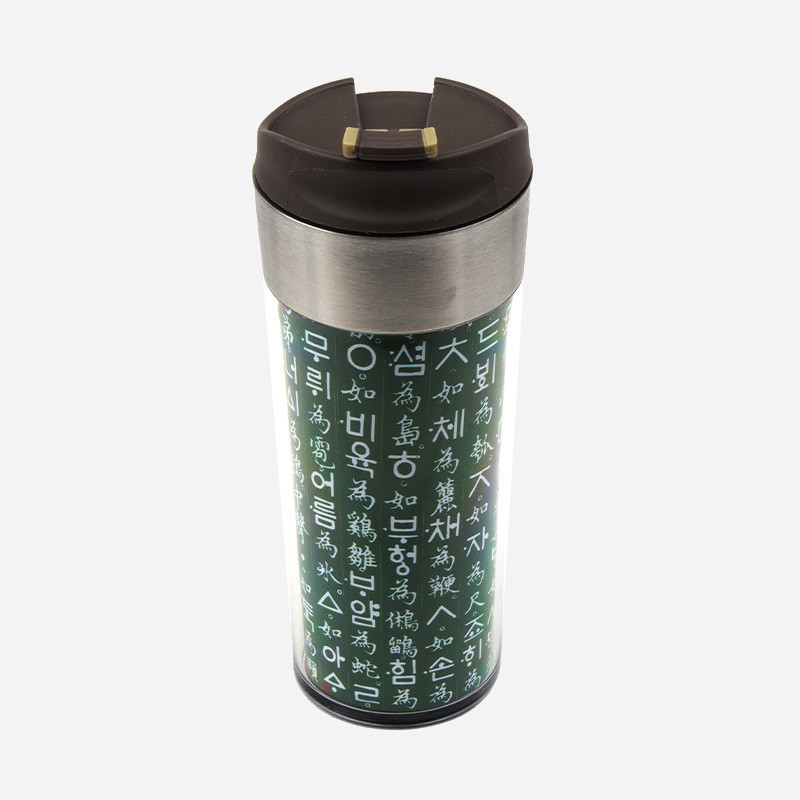
For example, a tumbler type featuring hanbok motifs can bring a traditional image into an everyday item, making it approachable for K-culture fans without feeling heavy. Because it can be taken out whenever someone drinks a beverage — rather than sitting only in a display cabinet — it has the added advantage of keeping the memory of the gift alive repeatedly. It is also visually easy to understand for someone unfamiliar with hanbok imagery, and for someone interested in drama or performance costumes it is easy to connect with. In such cases, the [한국의아침]한복 카페텀블러 - 왕비 (Korean Morning Hanbok Café Tumbler – Queen) can be seen as an example of this type.

When choosing this type, it is also worth thinking about whether the recipient actually lives in an environment where they use a tumbler. For someone who frequently drinks beverages at the office or school, the practicality comes through well, but for someone who travels often and keeps their luggage to a minimum, smaller stationery items may be a better fit. Ultimately, the key question is not the symbolism of hanbok itself, but "does the traditional aesthetic appear naturally in everyday life?"
When distributing to multiple people, a short explanation is what makes it memorable

If you need to hand out gifts to multiple people — at an event, a homestay, a fan exchange, or a school visit — you should look not only at size and quantity but also at the moment of giving. In situations where you cannot spend a long time explaining to each person individually, items where the Korean element is visible the instant they are received and whose use is immediately understood are the most convenient. Lightweight, compact types such as bookmarks, ballpoint pens, postcards, and small keyrings place little burden on overseas travel or on-site distribution. In actual reviews, the context of looking for something practical yet Korean to give to foreigners also appears, and in such cases a selection that can be held in the hand and understood immediately is a much better fit than something overly decorative.
A set that includes both a bookmark and a ballpoint pen shows Korean patterns to someone interested in K-culture while making the occasion for use clear. It feels natural for someone who reads books or writes in notebooks, and when distributed to multiple people the difference in gift size does not feel significant. The 한국문화4종 책갈피+볼펜세트 (Korean Culture 4-Type Bookmark + Ballpoint Pen Set) is a good example to look at for homestay visits, exchange-student meetings, and small-scale cultural exchange gatherings. Its particular strength is that rather than pushing a single Korean image strongly, it lightly presents multiple cultural cues.
However, the more people a group gift is intended for, the easier it is to make the mistake of casting the recipients' age range and usage environment too broadly. Stationery feels natural for students or fan gatherings, but for official guests or business counterparts a slightly more formal selection may be more reliable. For gifts given to multiple people, it is better to apply the standard of "does the Korean reason come through even in a brief moment?" rather than "is it inoffensive to anyone?"
For formal greetings, a sense of stability comes before symbolism
In formal relationships — such as with overseas business partners, invited speakers, or institutional contacts — it is important that the gift does not lean too heavily toward personal taste. In these cases, even if traditional patterns are present, something that is not excessively decorative and can be used in work or daily life is preferable. Items with a clear purpose, such as a business card case, a ballpoint pen, or a keyring, help the other party receive the meaning of the gift without feeling burdened. The balance of packaging and composition must also be considered, and overly casual character-type products may come across as lightweight depending on the relationship.
A set featuring Korean colors and patterns such as jogakbo (pojagi patchwork) is well suited to maintaining formality while leaving a Korean impression. The 명함케이스와 열쇠고리 볼펜 3종세트-조각보 (Business Card Case and Keyring Ballpoint Pen 3-Piece Set – Jogakbo) can be seen as an example for business exchanges or occasions of appreciation. The business card case connects to a work setting, the ballpoint pen has practical everyday use, and the keyring serves as a small commemorative item. Rather than concentrating all the meaning into a single object, this approach distributes formality and commemorative value across the set.

In formal gifts, what matters more than how deeply the other party knows Korean culture is whether the moment of receiving the gift feels awkward or not. A very large decorative item can create a burden of storage, and an item that requires too much traditional explanation can lead to a lengthy conversation. Choosing an accessory whose symbolism is clear but that also has a practical occasion for use therefore makes it easier to strike a balance between a Korean impression and practicality.
Gifts that go into a travel bag leave a lasting impression in a different way
For gifts that must be carried overseas in person or sent by post, the risk of damage, weight, and volume must be considered first. Items that can break, such as ceramics or glass, can make the delivery process uncertain — contrary to good intentions — if the packaging is not sufficient. Bookmarks, postcards, ballpoint pens, keyrings, and card-type items, on the other hand, are small but easy to carry a message in and convenient to distribute to multiple people locally. As seen in reviews describing preparing memorable gifts for people met locally while traveling abroad for an extended period, for gifts that involve travel the key question is "is it light but does its meaning show?"
In such cases, it is worth looking at small accessories that include easily explained elements such as the taeguk (the yin-yang symbol on the Korean flag), Hangeul, Seoul, or traditional patterns. For example, a taeguk-pattern keyring, a Hangeul ballpoint pen, and a bundle of Korean-image postcards each have different strengths: portability, usability, and message delivery respectively. However, if the recipient is already a fan who knows Korean culture well, something connected to their specific interest — such as Hangeul or hanbok — may be more impressive than a generic souvenir. The smaller the gift, the more a short message delivered alongside it compensates for and reinforces the memory, beyond the size of the item itself.
The related products at the end are not simply a list repeating the items described in the body, but candidates to compare side by side in the same situation. When giving Korean gifts to K-culture fans, the choice becomes much easier if you break it down into traditional character, practicality, the formality of the relationship, and the burden of travel. If you decide first what kind of Korea the recipient loves and in what setting they will receive the gift — before thinking about product names — you can choose a gift that is distinctly Korean without being excessive.