
Shopofkorea guides
Why Traditional Gifts for Parents Should Be Practical
Official product names are shown in Korean. Product pages are in Korean; prices are in South Korean won (KRW).
For Parents, 'Used Often' Comes Before 'Looks Good'
A gift chosen for one's parents carries a great deal of the giver's heart. That is why people tend to search for something more elaborate and more special, yet the gifts that are truly cherished over time are, in reality, quieter than expected. Objects that are reached for every day, objects that can be brought out naturally when guests arrive, and objects that do not clash with the atmosphere of the home are the ones that endure. The same holds true for traditional craft gifts. Objects that are used within daily life are remembered by parents far more often than objects that sit only inside a display cabinet.
The parents' generation evaluates objects carefully by durability, finish, and usefulness. A gift that looks pretty but seems fragile, or whose purpose is unclear, may be received with gratitude at first, yet over time it will go untouched. By contrast, objects with a clear moment of use — such as a mother-of-pearl hand mirror, tea accessories, a jewelry box, a business-card holder, or a paperweight — bring the giver to mind frequently. What matters is not the explanation that something is "traditional," but rather "where this can be placed and how it can be used."
Choosing by the Colors and Traffic Patterns Inside the Home
When visiting your parents' home, try to picture the living-room cabinet, the dressing table, the entryway, and the area around the desk. Imagining the spot where the gift will be placed first makes the choice much easier. For something to sit on the dressing table, a not-too-large hand mirror or jewelry box works well; for the entryway or the top of the living-room cabinet, a decorative yet practical accessory that looks natural even when guests see it is a good fit. If there is a desk or a study, objects with an organizing function — such as a business-card holder, a pen tray, or a paperweight — are also a fine choice.
A product worth looking at alongside this point is 손거울大-단오풍정 (Large Hand Mirror – Dano Pungjung [scene of the Dano festival]). 손거울大-단오풍정 — for overseas buyers and as a gift for parents.

The color must harmonize with the existing furniture in your parents' home. If there is a lot of dark wood furniture, black, mother-of-pearl iridescence, and gold accents pair with it in a stable way. For a brighter interior, white, a soft blue, or a restrained pattern creates less visual pressure. Traditional gifts already carry a strong story through their materials and patterns, so there is no need for the color to be overly bold as well. The longer an object is meant to be kept and looked at, the more important everyday comfort becomes over first-impression brilliance.
A Gift That Solves a 'Daily Inconvenience' Is Better Than One Tied to an Occasion
It is easy to focus on the occasion itself when choosing a Parents' Day or birthday gift. However, the moment parents are truly satisfied is when they actually use the gift. For example, if a mother frequently misplaces small accessories, a jewelry box becomes not merely a decorative object but a gift that solves an organizational problem. If a father has frequent gatherings with acquaintances, a business-card case or desk accessory becomes something he can bring out every time. When a gift resolves a small inconvenience in daily life, the gratitude it generates lasts far longer.
The advantage of traditional craft gifts is that they can offer practicality and refinement at the same time. If something looks too much like a household item, the special quality of an occasion gift diminishes; if it looks too much like a work of art, it can feel burdensome. That is why a "craft object that can be used" is the most reliable choice for a parent's gift. It is enough if the object is easy to use, looks neat when set out, and has a story worth telling when guests see it.

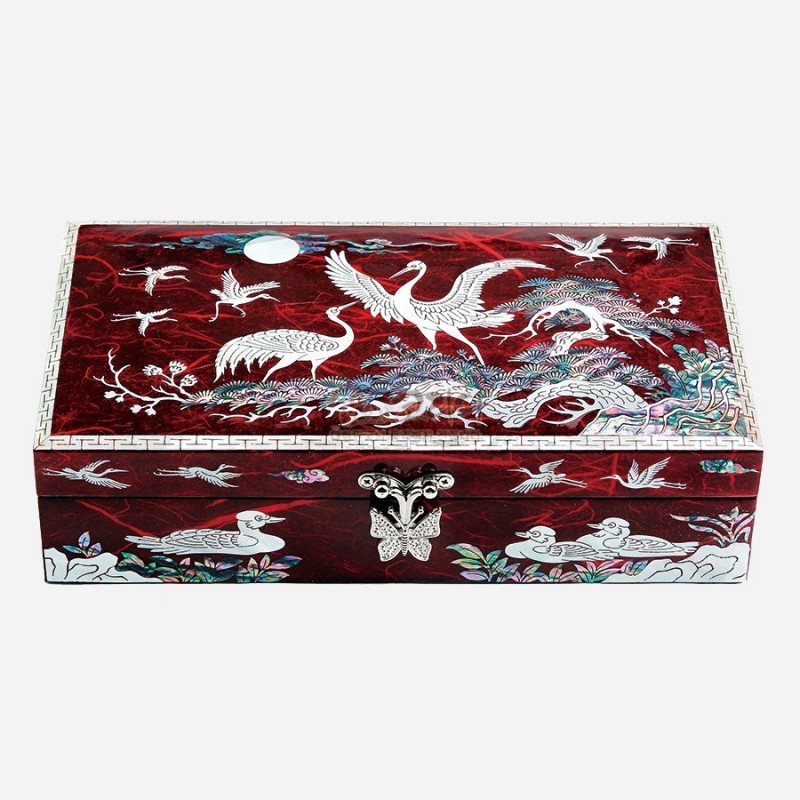
A product worth looking at alongside this point is 화조기린 유광굴림보석함 (Hwajo-girin Yugwang Gullim Jewelry Box [glossy rounded jewelry box with a bird, flower, and girin pattern]). 화조기린 유광굴림보석함 — for protocol gifts and return gifts for overseas buyers.
The More Specific the Words That Accompany the Gift, the Better
The words conveyed along with a gift also matter. A broad wish such as "Please stay healthy" is fine, but saying something like "I thought it would be nice for you to keep it on the dressing table and use it every day," or "I chose it thinking it would look lovely brought out with tea when guests come," makes the intention behind the gift clear. Parents sense not so much the object itself as how their child was thinking of them while choosing it.
In the end, a good gift of filial devotion is not an expensive object but evidence that one has looked carefully at the parents' daily life. If the beauty of traditional craft is combined with practicality, and the place where it will sit in the home has been considered, the gift will naturally be used for a long time. If you find yourself struggling because similar gifts repeat year after year, try this year choosing a traditional gift that can genuinely enter your parents' day, rather than something dazzlingly new.
A product worth looking at alongside this point is 한지 예단보석함 [학] (Hanji Yedan Jewelry Box [Crane] [a hanji-covered ceremonial jewelry box featuring a crane motif]). 한지 예단보석함 [학] — a formal gift for overseas buyers and for yedan (pre-wedding gift exchange) occasions.
The Weight of a Gift Is Different from the Weight of the Heart
When choosing a gift for their parents, children often feel the pressure of "I need to do something better this time." Yet from the parents' perspective, a good gift is not necessarily something large or expensive. On the contrary, a gift that is too costly can create a sense of burden and may end up stored away without being used. With traditional craft gifts, the context of the choice matters more than the price. Why this particular object was chosen, and which aspect of the parents' daily life was pictured while choosing it — these are what give the gift its persuasive power.
For example, a hand mirror is a small yet repeatedly used gift for a mother who looks in the mirror every day before going out. A business-card holder has a clear reason to sit on the desk for a father who organizes documents and business cards. Parents respond more strongly to the fact that their child remembered their habits than to the elaborateness of the gift itself. That is why a gift of filial devotion must begin with observation of daily life.
When Putting Together a Set, Keep It Small and Base It on Practicality
If you want a traditional gift to feel a little more generous, you might consider a set. However, rather than bundling several objects together indiscriminately, a combination whose moments of use connect is better. For parents who enjoy tea, a small tea accessory paired with a rest; for a dressing-table gift, a jewelry box paired with a hand mirror; for a study gift, a paperweight paired with a bookmark — the approach is to bundle objects that are used together in one space. A set should be a composition that raises usability, not one that merely looks like more.

A product worth looking at alongside this point is 천연옻칠찻잔세트 (Cheonyeon Ottchil Chatjanset [natural lacquer tea-cup set]). 천연옻칠찻잔세트 — for protocol and return-gift occasions for overseas buyers.
When presenting the gift, it is good to suggest a place — "I thought it would be nice kept here and used like this" — without being insistent. Parents are people who have managed their own home for a long time. Even if the child has a particular spot in mind, the actual placement may change to wherever the parents find it most comfortable. A gift is a suggestion, and its use is the parents' choice. Leaving that room is what keeps the gift from becoming a burden.
The Longer an Object Is Meant to Last, the Easier It Must Be to Care For
The parents' generation tends to keep objects for a long time and use them with care. For that reason, a gift that is difficult to maintain can become a burden as time passes. Practical criteria to consider include whether dust shows easily, whether it can be wiped clean easily with a wet wipe or a dry cloth, and whether parts come loose easily. Even for traditional craft objects intended for everyday use, ease of care is as important as beauty.
It is also a good idea to briefly explain how to care for the item. A simple explanation such as "Just avoid letting it stay in contact with water for long, and wipe it with a dry cloth" lets parents use it with peace of mind. To reduce the situation where a gift is too precious to use, the message that "this is an object it is fine to use" must be given from the start. A good gift is not protected inside a display cabinet; it wears naturally into the parents' daily life.