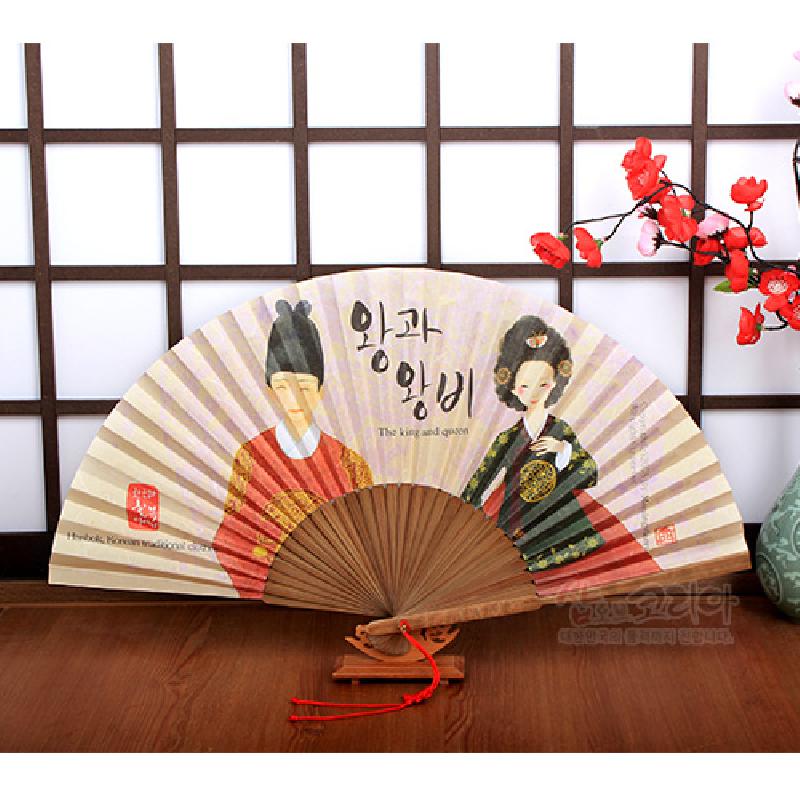
Shopofkorea guides
A Guide to Choosing Commemorative Gifts for Foreign Executives Visiting Korea
Official product names are shown in Korean. Product pages are in Korean; prices are in South Korean won (KRW).
When selecting a commemorative gift for a foreign executive or VIP visiting Korea, the moment of presentation matters more than the recipient's personal taste. Because these gifts are often given on behalf of a company or institution within a tight schedule, something too personal can feel burdensome, while something too light can appear insufficiently formal. Thinking through the recipient's rank, the formality of the occasion, their travel itinerary, and how briefly you can explain the Korean significance of the gift will make the choice much easier.
- Immediately after a formal meeting: prioritize decorum and packaging quality
- Before or after airport or hotel transfers: prioritize manageable size and resistance to damage
- When the gift also serves as a company or institutional introduction: prioritize Korean materials and ease of explanation
- When gifts must also be distributed to accompanying staff or working-level attendees: prioritize portability and having enough quantity prepared
Once handshakes and greetings are done, formality is what people notice first
At occasions such as official meetings, MOU signings, or executive receptions where photographs are taken and remarks are exchanged, a gift must look composed from the very first impression. In these settings, a craft-style gift with stable packaging and good storage qualities suits better than something oversized or flashy. This is because even if the recipient does not open the gift immediately, the box and its presentation alone must convey the sense of appreciation. That said, items that are too heavily decorative may leave the recipient wondering where to put them after returning home, so it is worth checking whether the piece would look natural on a desk or in an executive office.
For instance, a type such as an automatic box (자동함, jadongham — a lidded case with an automatic-open mechanism) featuring inlaid sanggam (상감, sanggam — a traditional Korean inlay technique) patterns works well for creating the atmosphere of an official-visit commemorative gift. It can be described as a holder for small personal items, and the traditional pattern leaves a Korean impression at the same time. Items of this kind tend to be received not as something tied to a specific taste, but as "an object worth keeping as a memento of the visit."
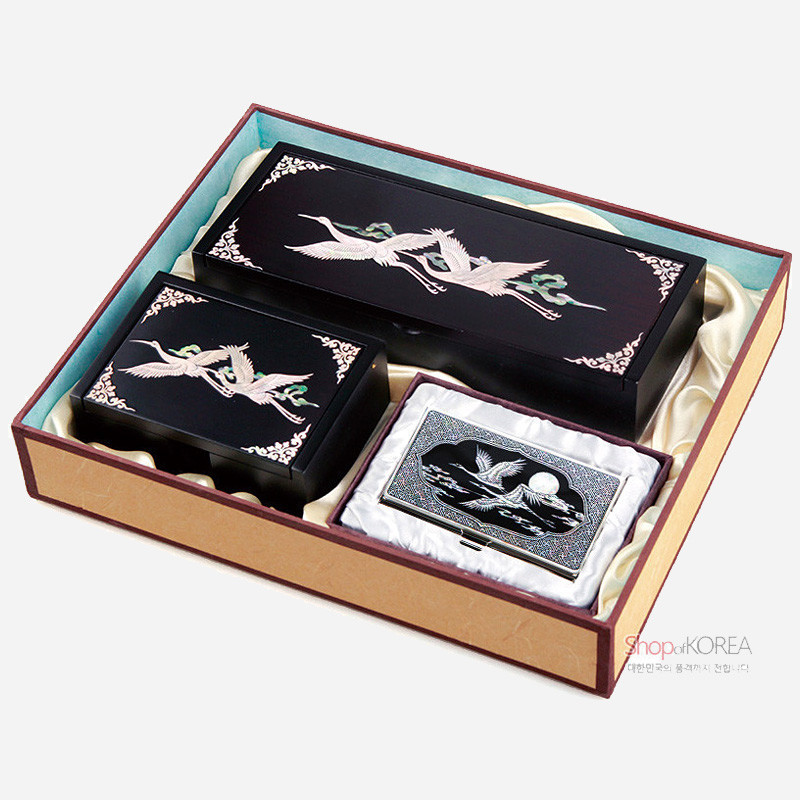
When choosing a craft-style storage accessory like this, it is also worth considering whether the recipient will be moving on immediately after the handover. If the piece is excessively bulky or made of a material prone to breakage, it may be formally impressive yet place a burden on the staff responsible for transporting it. For executive-level recipients, the completeness of the presentation and the stability of the packaging matter greatly; if a schedule requires an attendant to carry the gift on the recipient's behalf, it is also advisable to confirm whether a handled shopping bag or cushioned packaging is available.
In a business relationship, a self-evident purpose reduces any sense of burden
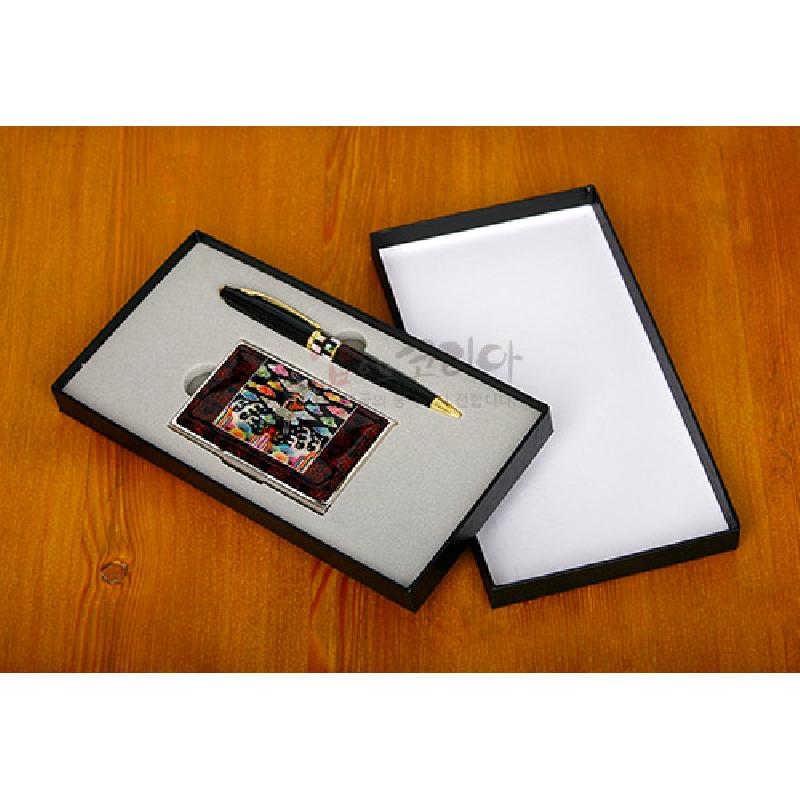
One of the most reliable approaches for gifts to foreign executives is an accessory that can be used naturally in a work setting. When the purpose is clear — as with business card holders, writing instruments, or memo-related items — the recipient understands the gift's use without any additional explanation. For a buyer or partner-company executive being met for the first time in particular, business accessories tend to feel more comfortable than overly personal lifestyle goods. However, if a company logo or text is applied too prominently, the item can look more like a promotional giveaway than a commemorative gift, so it is worth looking for a balance between traditional Korean patterns and practicality.
For example, a type such as a two-piece set comprising a business card case and a ballpoint pen featuring a hyungbae (흉배, hyungbae — the embroidered rank badge worn on the chest of Joseon-dynasty official robes) pattern sits nicely between a ceremonial gift and a functional one. Because it connects naturally to the act of exchanging business cards, the moment of presentation feels unforced, and the traditional pattern can be explained briefly as an image derived from the decorative badges on Korean official court dress. Since the set reads first and foremost as a work accessory without requiring a lengthy explanation of its meaning, it also suits the fast-paced setting of a Korea visit.
For set-type gifts like these, a useful criterion is "Is it Korean in character, and can it actually be used?" Items in familiar forms — a card holder, a ballpoint pen, a bookmark — that incorporate traditional materials are quickly understood regardless of the recipient's cultural background. Conversely, items that require a separate explanation of how to use them, or that serve a purely decorative purpose, may not convey their meaning fully in a brief reception setting. If the relationship is a close collaborative one, a somewhat more distinctive pattern can be chosen; but for a first visit or an official representative gift, calm colors and a composed presentation are the safer choice.
On itineraries with continuous travel, small and sturdy gifts are the ones remembered longest
If a gift must be presented around airport, hotel, or vehicle transfers, portability is extremely important. Foreign executives typically visit multiple locations during a Korea trip, and their luggage for the return journey is often already fixed. In that situation, a large and heavy gift, however impressive it may look, becomes a burden that accompanying staff must manage. Even when choosing a small gift, if the packaging is neat and the meaning is easy to explain, it can still leave a fully adequate impression as a formal gift.
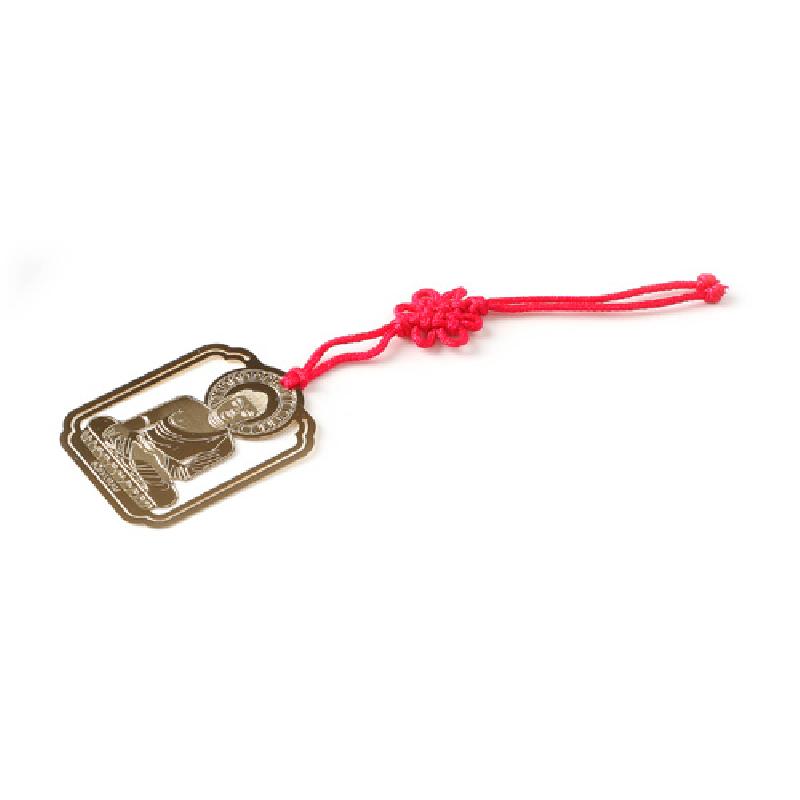
In these circumstances, it is worth looking first at thin and sturdy types such as bookmarks, business card holders, or small desk ornaments. A gold-finished bookmark featuring a gold crown (금관, geumgwan) or cultural-heritage motif, for example, is compact and lends itself to a brief explanation of its Korean historical symbolism. That said, because religious imagery or specific cultural-heritage subjects may be received differently depending on the recipient's background, it is advisable — for official institutional gifts in particular — to choose a design whose symbolism is not too narrowly interpreted.
Portable gifts are also well suited for group visits or accompanying executives. The primary gift can be presented formally to the lead representative, while a smaller accessory in the same vein can be prepared for those accompanying them, which keeps the overall protocol flow natural. In this case, rather than matching every person's gift to the same level, it is practically more sound to adjust the size and composition according to rank and role.
The memory of a Korea visit lives on in symbols that are easy to explain
When a gift is also meant to serve as a company or institutional introduction, an item with a clearly Korean material or motif is the right choice. However, if the "traditional" feel is strong but the purpose or meaning is unclear, the recipient may miss the context of the gift entirely. Symbols that can be understood with a brief explanation — a map, a traditional pattern, a cultural heritage reference, Hangeul, or imagery from the royal court — are advantageous. The gift should be something that can be introduced naturally with a sentence along the lines of "We prepared this so you will have something to remember your visit to Korea."
For instance, a type such as a memo holder (메모홀더, memo holder — a desk accessory for holding notes or slips of paper) in the shape of a map of the Republic of Korea is a commemorative accessory that sits easily in an office and prompts the recipient to recall their visit. It functions as a decorative piece while also serving the practical purpose of holding memos, so it does not read as purely ceremonial. For an executive whose visit was brief or who passed through multiple cities and institutions, it becomes a simple way to leave behind the memory of Korea as a place.

Because symbolic accessories like this are easy to explain, restraint in design is important. Colors that are too bold or decoration that is too heavy may clash with an executive office environment, and if the meaning is weighted too heavily toward a specific region or image, the item can feel too narrow to serve as a gift representing a company or institution. Conversely, choosing calm colors and a clear, defined form allows the recipient to place the piece without hesitation on one side of their own office or meeting room.
The products at the end of the article are candidates to compare within the same situation
The examples in the body of this article are intended as criteria for distinguishing between situations when choosing a commemorative gift for a foreign executive visiting Korea. For a formal meeting, look first at storage quality and packaging completeness; for an itinerary with a great deal of movement, look first at portability and the risk of damage; for an occasion that also serves as a company or institutional introduction, look first at Korean symbols that are easy to explain. The related products at the end are not simply a repeated list of the items mentioned here — they are additional candidates to compare alongside those mentioned, within the same commemorative-visit gift context. If you decide on the moment of presentation and the recipient's travel itinerary before thinking about the product name, you will be closer to a choice that maintains the proper level of formality while keeping the burden to a minimum.