
Shopofkorea guides
Gift for a Foreign Principal: Name-Engraved Najeon Pencil Holder and Yutnori Set
Official product names are shown in Korean. Product pages are in Korean; prices are in South Korean won (KRW).
Having a foreign guest visit the school is not something that happens every year. So that autumn, when word came that the principal of our partner school abroad would be visiting, the staff room buzzed with excitement and a touch of chaos. Scheduling, finding an interpreter, preparing the children's performance — and somehow, the gift ended up becoming my responsibility.

There were two worries. One was dignity. Since we were presenting it on behalf of the school to a principal, it could not look too trivial. The other was luggage. The recipient would be flying home, so something large and heavy would only be a burden. I spent several days searching with phrases like "gift for a foreign principal" and "school commemorative gift," but most results were corporate client gifts that felt somehow out of place for a school to give.
On a Sunday evening I stopped by the staff room briefly to catch up on some work and searched again. I typed '연필곶이' into the search bar and got strange results — it was a typo. Only after correcting it to '연필꽂이' did the items I was looking for appear. The reason a pencil holder came to mind was simple: if it was something that would sit on the principal's desk every day, the memory of visiting a Korean school would not end up buried in a drawer.
The item I chose was the 나전연필꽂이-목단 (najeon pencil holder — peony; najeon lacquerware with a peony motif). It is najeon chilgi — lacquerware made by applying natural옻 (lacquer) multiple times over a wooden base and adhering thinly ground pieces of abalone or pearl oyster shell. At 8 cm wide, 8 cm deep, and 11 cm tall, weighing 210 g, it feels solid in the hand yet is a size that poses no burden in a travel bag. The peony (mokdan) is a traditional motif symbolizing wealth and prosperity, which also made it fitting for conveying congratulations and gratitude.

In fact, right up to the end I was weighing it against the 나전연필꽂이-당초쌍학 (najeon pencil holder — vine-and-twin-cranes). It features a motif of two cranes among vines, said to symbolize longevity and nobility, so that one also seemed well suited as a gift for a principal. It was also slightly smaller at 7.2 cm and lighter.
In the end, what decided it in favor of the peony was the flower itself. Even someone seeing Korean craft for the first time can recognize a flower in full bloom at a glance. I thought it better to choose something that could be felt as beautiful without needing any explanation.
When placing the order, I typed two lines in English in the engraving text field. The top line read "To Principal" followed by the principal's name, and the bottom line read "From" followed by our school's name. I did not place the order that night. A single misspelled letter in a foreign person's name would be discourteous. The next morning I came in, checked the name letter by letter against the business card I had on hand, entered the text one more time, and then confirmed the order.
It felt awkward to have only the principal's gift sitting there on its own, as the teachers accompanying her might feel left out. So I added a 전통 윷놀이세트 (traditional yutnori set; a traditional Korean board game set) for the rest of the party. It includes wooden yut sticks, a paper game board, playing pieces, and instructions, and at 15 × 9 cm and 100 g it is no burden to hand out one to each person. Best of all, it could be played together right there at the moment of receiving it.
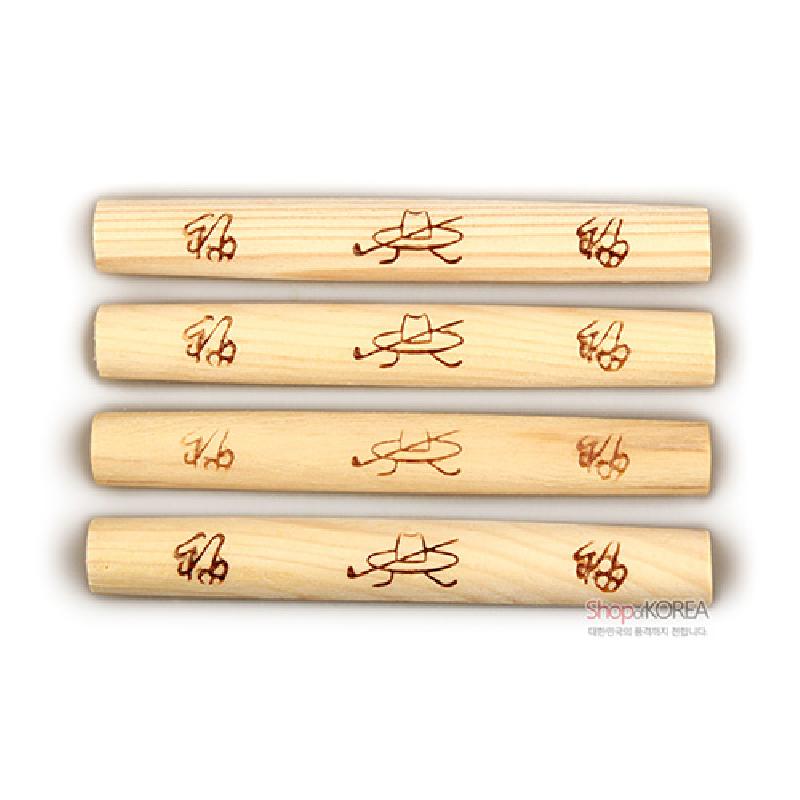
When the box arrived at school, I opened it first at the staff room desk. Turning it toward the window, the mother-of-pearl shell caught the light and shimmered in shades of pink and green, and beneath it the two lines of English text were clearly engraved. The spelling was correct too. Only then did I breathe a sigh of relief.
On the day of the visit, I placed the pencil holder on the desk in front of the principal. She gazed at it in silence for a while, then slowly ran her fingertip once across the surface of the shell. Then she noticed her name, looked up, and said a brief "Thank you." It was not a long greeting, but that gesture stayed with me longer.
The yutnori sets were handed out one each to the teachers who had come with her. In the afternoon, when they stopped by the children's classrooms, the children demonstrated how to throw the yut sticks first. The visitors tried throwing them clumsily along with the children shouting "Do! Gae!" and everyone burst out laughing together. Even when words don't quite get through, four yut sticks are enough to quickly make you one team. Even after the guests had left, the four yut sticks the children had taken out sat untouched in a corner of the classroom for quite some time.
If I ever need to give a gift to a foreign guest in the school's name, I think I would do it the same way as this time. One item to represent the school — something that will stay on a desk for a long time. One item for the accompanying party — something light that everyone can enjoy together. And the English text: let it sit overnight, then check it again.
This account is based on an actual purchase experience; individuals and the institution have been anonymized and some scenes have been reconstructed.