
Shopofkorea guides
MOU Ceremony Commemorative Gifts: An Emille Bell with a Custom Logo Nameplate
Official product names are shown in Korean. Product pages are in Korean; prices are in South Korean won (KRW).
When I receive calls from institutional coordinators preparing for an MOU signing ceremony, the opening line is almost always the same: "We can print whatever we want on the nameplate below the bell, right?" Not long ago, one such call came in. The caller was in charge of external affairs at a public institution. They were about to sign a business agreement with a company and were looking for something to keep that day alive for a long time.

Having received this kind of order many times, I understand what coordinators are worried about. An MOU signing ceremony is over quickly — a few signatures, a few photographs. But for the institution, that day needs to last. So they look for something that can be placed at the center of the venue for a shared ritual, and then displayed in the lobby or a meeting room afterward. Many people find their way to our shop after searching terms like "MOU signing commemorative gift," "institutional agreement ceremony souvenir," or "logo-printed commemorative item." Some compare options like appreciation plaques or crystal trophies, but they say those look the same at every ceremony, and they end up wanting something distinctly Korean.
What was chosen this time was the 에밀레종-청월 국가무형문화재 장인 (Emille Bell – Cheongwol, National Intangible Cultural Heritage Artisan). It is a decorative bell crafted by a National Intangible Cultural Heritage artisan, inspired by the Silla-era Seongdeok the Great Bell — commonly known as the Emille Bell. The body features a flying celestial figure (bicheonsang) pattern, and bronze and metal are combined with wood and mother-of-pearl (jagae). At approximately 27 centimeters wide and 33 centimeters tall, weighing 2.6 kilograms, it commands a definite presence when placed on a table.
The reason a bell is chosen for a signing ceremony is simple: it can be struck. When the two representatives finish signing and ring the bell together, that moment becomes the defining image of the day. It also comes through far more clearly in photographs than a round of applause. And the bell remains in place even after the ceremony is over.
The Nameplate — Small, but All the More Carefully Done
The real heart of this kind of order is, in fact, the nameplate attached to the front of the bell. This time, too, the layout placed the logos of both institutions side by side, with the date of the agreement printed in English below. The nameplate is attached to the front face of the bell. We do not recommend the top surface, as there is a risk of it falling off. Because the space is even smaller than a business card, coordinators always ask: "Won't the text be too small?"
That is why we ask for the original logo files and send a proof first. Once the proof is received, there are almost always 1 or 2 rounds of revision requests. Could the "&" symbol between the two logos be made slightly smaller and lighter, since it stands out more than the logos themselves? Could the spacing between the characters in the date be opened up a little? And then, once it is opened up, could it be brought back together slightly, because now the two institutions look too far apart? It turns out that how close the two names appear on that small plate matters more than one might expect. An agreement is, after all, about standing side by side. Once the coordinator says, "Please go ahead with the final proof," we proceed to printing.
Because a bell is something that can break, we take extra care with the packaging. This time we added a bojagi (traditional wrapping cloth) to the hanji (Korean traditional paper) box, so that it would look presentable carried directly into the venue.
After That Day
On the day of the ceremony, I was told that the two representatives rang the bell together in front of it as it sat at the center of the table. When the event ended, the people from the partner company gathered around the nameplate, found their own logo, and took photographs. Even on a small plate, it seems everyone stops in their tracks when they see their own name on something. The bell still sits at that institution today, and the nameplate with the date on it remembers that day in its place.
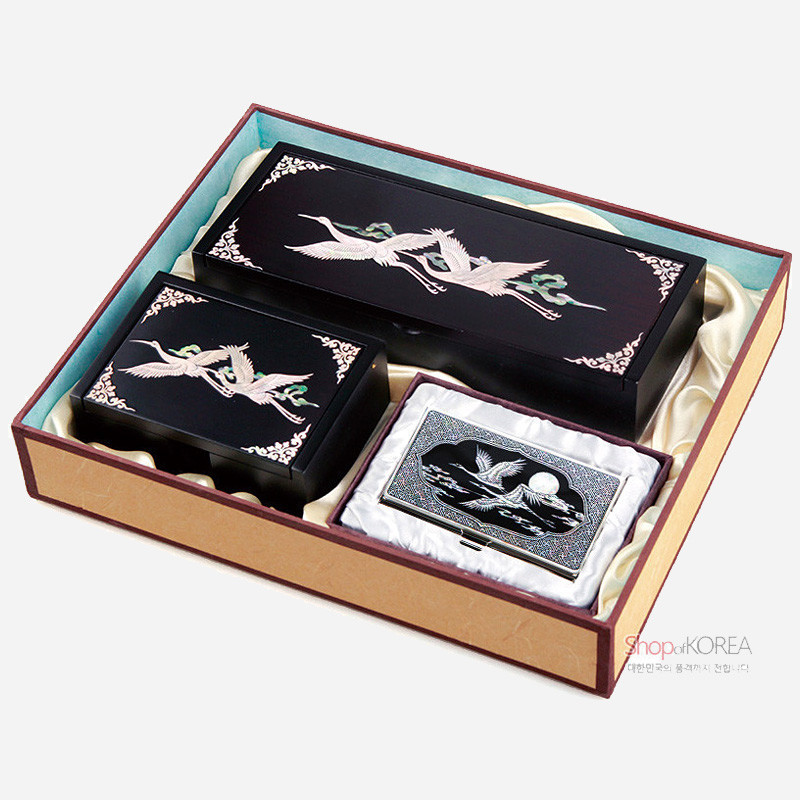
Some people also look for a gift to hand personally to the representative from the other side. If the bell is a commemorative object shared between the two institutions, this is a gift given to a person. What is often looked at alongside it in those cases is the [선물세트]상감 자동함 3종-운학 ([Gift Set] Sanggam Jadong-ham 3-jong – Unhak; inlaid lacquerwork card case set with crane and cloud motif). It contains a business card case (myeonghamham), a pen case (pilham), and a name card holder (myeongham keiseu), all inlaid with mother-of-pearl (jagae) on a lacquer (ottchil) base, presented in a hanji case. The cloud and crane (unhak) patterns carry wishes for abundance and longevity, making them well suited to a celebratory occasion.
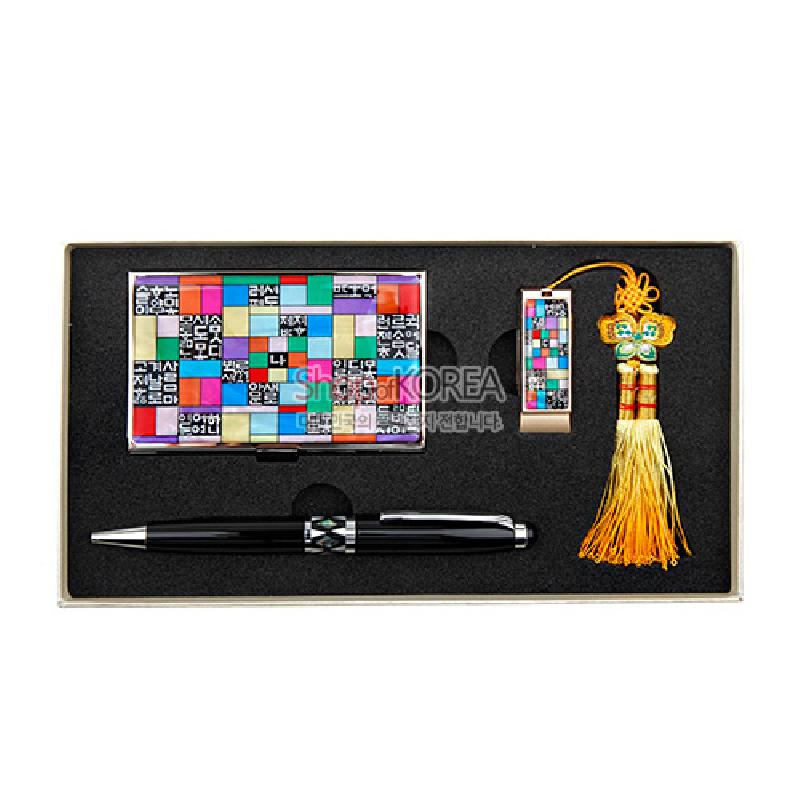
If you also want to look after the staff members who worked on the project together, something a little lighter is better. The USB매듭 명함집3종-훈민정음[조각보]8G,16G,32G (USB Maedeup Myeonghamjip – Hunminjeongeum [Jogakbo]; a business card holder featuring Hunminjeongeum motifs and jogakbo patchwork patterns on mother-of-pearl, paired with a USB drive and traditional maedeup knotwork ornament) is a practical set for passing along agreement materials as well.
If you are thinking about a commemorative gift for a signing ceremony, there is just one thing to decide first: what you will do together on that day. Once you decide to ring the bell, the rest works itself out naturally as you go through the nameplate proofs.
This account is based on an actual purchase; individuals and institutions have been anonymized and some scenes have been reconstructed.