
Shopofkorea guides
Thank-You Gifts for a Foreign Colleague: Seoul Scenery Postcard and a Najeon Business Card Case
Official product names are shown in Korean. Product pages are in Korean; prices are in South Korean won (KRW).
In autumn, a foreign colleague I had worked with for several months was returning to his home country. He was a man in his mid-forties who, whenever I sent him an email in my halting English, would always call back to confirm everything. I owed him a great deal every time work hit a wall. I wanted to properly say thank you before he left, but when it came down to it, I had no idea what to give him.
I had two worries. If it looked too expensive, I was afraid he would feel burdened; but if I just handed him a single generic souvenir, all the gratitude I had built up might seem trivial. And since everything had to go into his luggage on the plane, anything large and heavy was out of the question.
At first I searched for 'jagae jumeoni' (mother-of-pearl pouches). I knew that mother-of-pearl was distinctly Korean, but I had no idea what to choose, so I typed the same words over and over for days. I also looked up 'maedeup jumeoni' (knotted pouches), and clicked on eyeglass cases and mandarin-duck-patterned accessories. Then my hand stopped at 'business card wallets.' He was the kind of person who pulled out his business card first thing at every meeting. I figured that if it was something he held in his hands every day, it would give him that many more occasions to think of Korea.
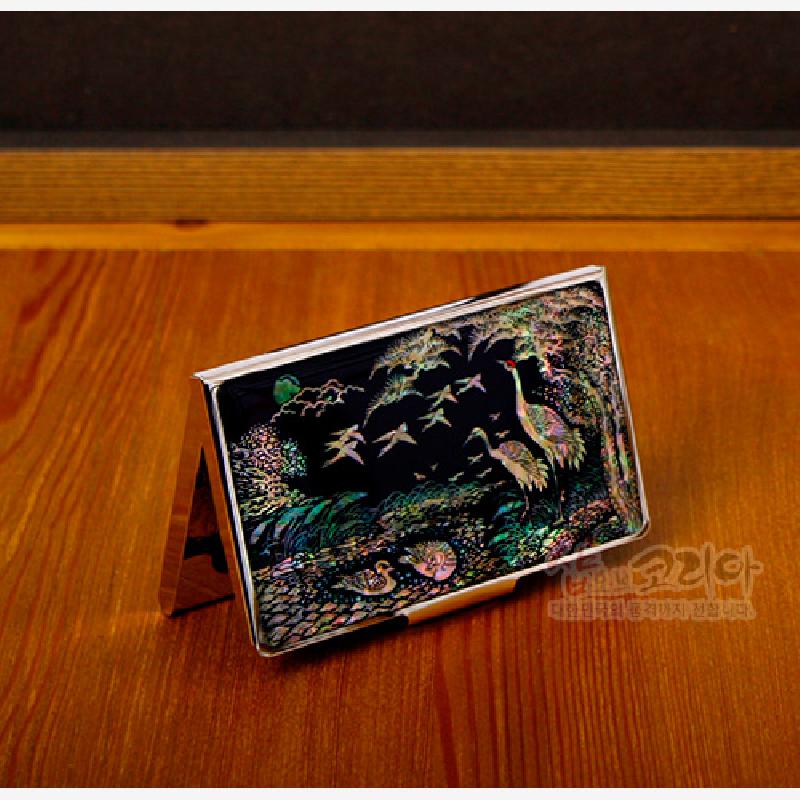
The item I settled on was the 송학 명함집 (Songhak Business Card Case; songhak means "pine tree and crane"). It is made using the najeon chilgi (mother-of-pearl lacquerware) technique, in which natural mother-of-pearl is ground thin and applied to fit the pattern, and when I read that the pine-and-crane motif carries a wish for a relationship that endures for a long time, my mind was made up. It felt like it could stand in for the words: we may be parting now, but let's keep in touch. The case measures approximately 9.4 cm wide by 6 cm tall and weighs 60 g, so it slips neatly into a suit's inner breast pocket. However, because it is mother-of-pearl it is fragile under impact, so I made a point of telling him to tuck it between layers of clothing when packing his bag.
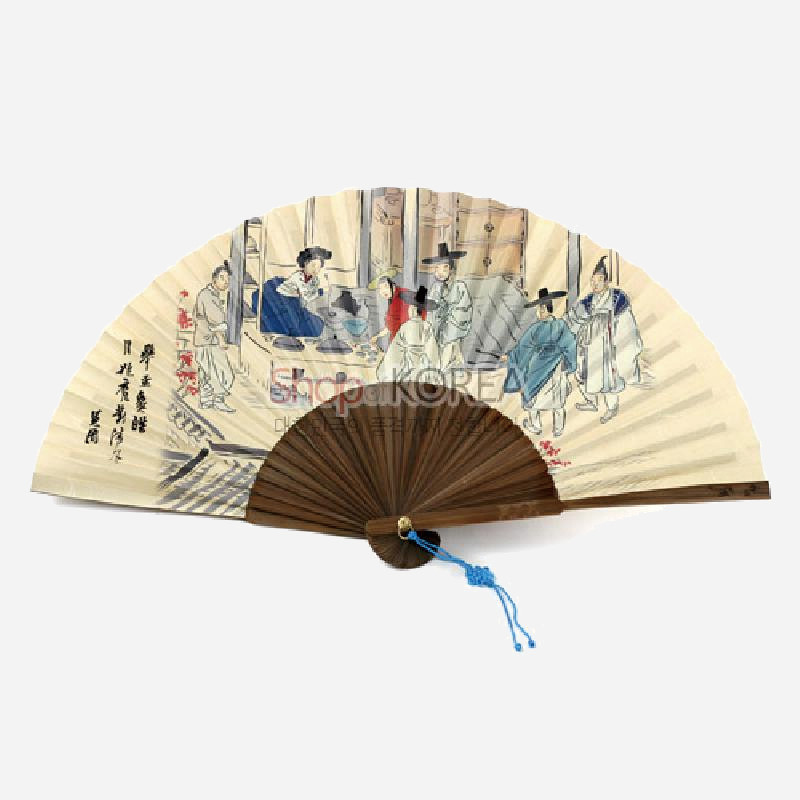
Giving only the business card case felt somehow incomplete. I wanted something that could show Korea itself, beyond work talk. So I chose the 오죽선-신윤복 주사거배 (Ojukson–Sin Yun-bok Jusageobae; a folding fan). The fan's ribs are made from ojuk (black bamboo), and it is fitted with hanji (traditional Korean paper) and traditional knotwork; painted on it is a genre scene by Sin Yun-bok, a painter of the late Joseon period. When you open the fan, the figures of people from that era unfold right before you, so the recipient naturally asks what scene it depicts, and conversation flows on from there.
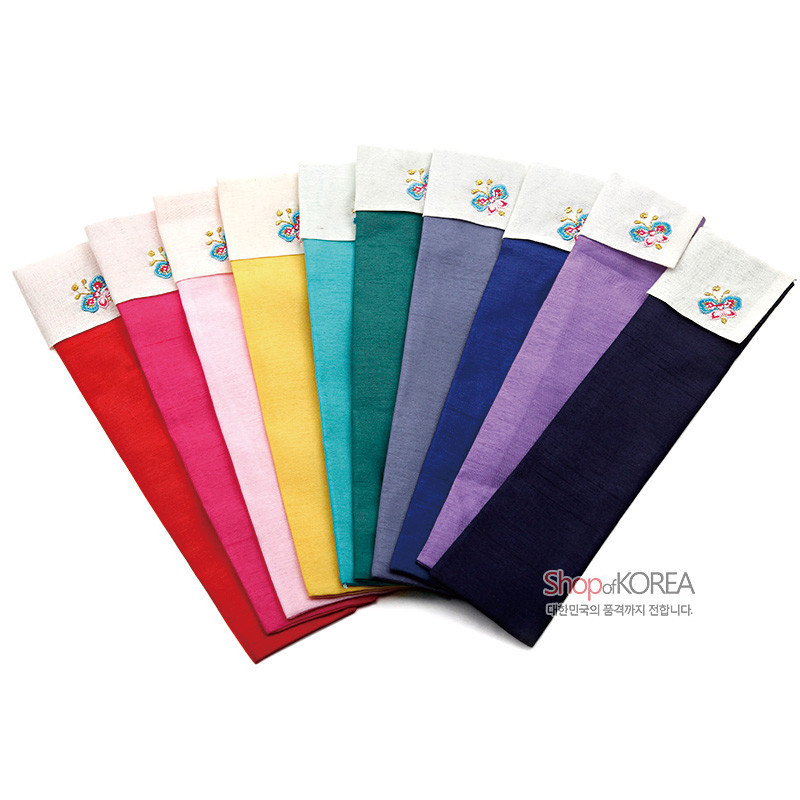
I was worried the fan might get damaged inside his luggage if packed without protection, so I also included the 민속부채주머니 (Minsok Buchae Jumeoni; traditional folk fan pouch). It is a silk pouch with chrysanthemum knotwork and embroidery, approximately 23 cm wide, and a folded fan fits inside it perfectly. Once the pouch was slipped over the fan, the whole thing looked like a much more complete and considered gift.
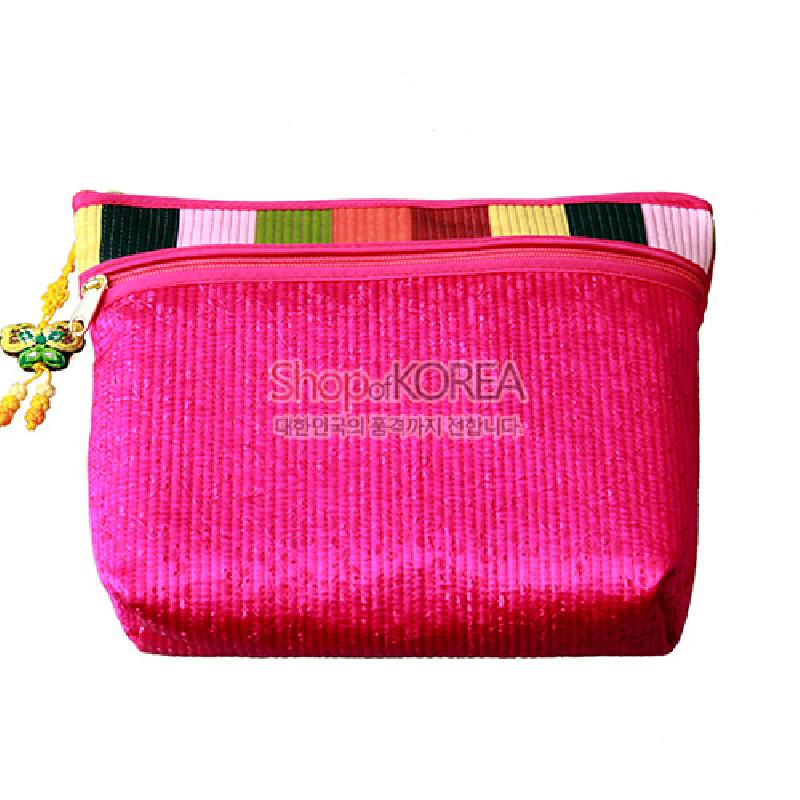
When we ate together, he would occasionally mention his family waiting for him at home. I felt it would be a shame to think only of him, so I considered something for his family as well. What I kept coming back to at that point was nubi (quilted) wallets. The 누비수(秀) 색동파우치지갑[황색] (Nubisu Saekdong Pouch Wallet [Yellow]; nubisu meaning "fine quilting," saekdong meaning "multicolored stripes") and the 누비수(秀) 색동파우치지갑[진분홍] (Nubisu Saekdong Pouch Wallet [Deep Pink]) are made from nubi — multiple layers of fabric stitched closely together — with saekdong color combinations and knotwork decoration. They measure approximately 21 cm wide by 17 cm tall and have metal zippers, making them well suited for carrying cosmetics or small personal items. I agonized over the colors for a long time and in the end chose both. That way, whoever was at home could pick the color they preferred.

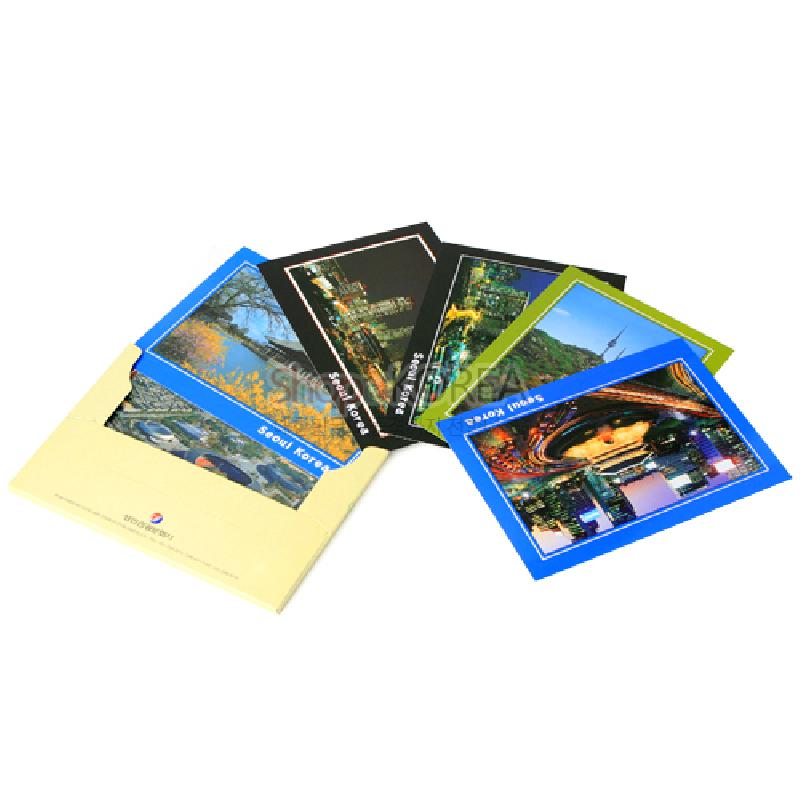
Finally, I added one 풍경엽서-서울 (Punggyeong Yeopseo–Seoul; Seoul Scenery Postcard). It is a postcard featuring royal palaces, Namdaemun Gate, and the Seoul night skyline. I had heard him mention visiting Seoul a few times while he was in Korea, and I wanted him to take that memory with him. On the back I wrote "고맙습니다" (thank you) in Korean and his name, letter by careful letter.
I handed everything over on the afternoon of his last working day. It had been quite chilly in the morning, but the afternoon sun was warm. I held out the shopping bag in a small meeting room, and he took each item out one by one and laid them across the table.
He picked up the postcard first, then traced the Korean writing on the back with his finger and asked me to read it aloud. He opened the fan all the way and studied the painting for a long while. When he opened the business card case, he immediately transferred a few cards from his wallet into it. Watching that, I felt I had chosen well.
He opened and closed the zipper on the deep-pink wallet several times, looking at the color again and again. Then he said "thank you" — just those two words, briefly. He was a man of few words, so that one phrase was enough.
Looking back, I think spreading the gift across several items was the right call, rather than one expensive thing. A business card case he would use every day, a fan carrying a Korean painting, wallets to give to his family, a postcard to bring Seoul back to mind. Each piece was light on its own, but laid out together they conveyed my gratitude properly. If you are wondering what to give a foreign colleague who is leaving, I found that the best starting point is thinking about what they habitually carry in their hands.
This account is based on an actual purchase; individuals and organizations have been anonymized and certain scenes have been reconstructed.