
Shopofkorea guides
Gifts for Foreign Delegations: Mother-of-Pearl Business Card Cases and Hand Mirrors with a Logo
Official product names are shown in Korean. Product pages are in Korean; prices are in South Korean won (KRW).
When we hear from the person in charge of receiving foreign guests at an institution, the opening line is almost always the same. "We have a large group, but we don't know exactly who will be coming." A delegation arrives with a mix of ages, nationalities, and genders — choosing a single item for everyone risks feeling off for some people, while selecting something different for each person takes time no one has. And the institution's name absolutely has to be included.

An order that came in recently from a government office was exactly like that. They were preparing return gifts ahead of an overseas delegation's visit, and the person in charge chose 3 items: a mother-of-pearl business card case, a mother-of-pearl hand mirror, and a mosi (ramie fabric) pouch. At first I wondered why they hadn't settled on just one, but having received this kind of order many times now, the reason becomes clear.
Why They Don't Settle on Just One Item
Delegations typically include people from their 30s through their 60s, men and women alike. There are working-level staff and there are delegation heads. For someone who exchanges business cards throughout the meeting, a card case is immediately useful; for someone who doesn't, a hand mirror or pouch is a more welcome gift. When all 3 items are kept in a similar aesthetic register, they can be laid out on the conference table for each person to choose, and no single item looks better than another. From the coordinator's perspective, this is the most comfortable approach.
For the business card case, the 명함집2종-채색문양 (two-style colored-pattern card case) is the most frequently requested. It is a metal business card case decorated with najeon (mother-of-pearl inlay) — thin natural mother-of-pearl applied to the surface — featuring the sagunja (four gracious plants) and jeonseo-pung (seal-script-style) patterns. At approximately 9.2 × 5.8 cm, it slips neatly into a suit's inner breast pocket. Every time the recipient takes out a business card back in their home country, it is evident that the item came from Korea, making it a gift that stays with the institution for a long time.

The hand mirror is the 자개손거울-담화나비2종 (two-style mother-of-pearl hand mirror with flower-and-butterfly motif). It measures roughly 7.5 × 7.1 cm, with delicate flowers and butterflies rendered in mother-of-pearl. If you mention when presenting it that the pattern represents spring, harmony, and good news, recipients take another look. Because it is an item that can break, we take particular care with the packaging.
Keep the Logo Small — Decide on the Placement First
In institutional orders, the topic that comes up most is the logo. Clients often want to include the full official name of the institution, but the printable surface on a business card case or hand mirror is smaller than expected. When a name is too long to fit, the usual solution is to use just the symbolic mark and the institution's abbreviated name, and that is what we recommend as well. A small logo tucked into a corner is easier to live with over time than a large one stamped prominently on the item.
On the card case, it goes on one lower corner of the inner face, in a width of roughly one finger-joint; on the hand mirror, it goes small on the mirror surface. If you tell us the position and size from the start, it cuts down on the number of rounds of proofs. That said, the printable area and its boundaries differ from product to product, so we always go through this together before the order is placed.
Mix the Pouch Colors
Orders for the mosi pouch often come in with a mix of colors. The pouch measures 21 × 14 cm, with a mosi (ramie) base, jogakbo (patchwork) paneling, and a decorative maedeup (knotted cord) ornament. When you explain the jogakbo — the tradition of joining leftover fabric scraps into a single whole — foreign guests tend to find it quite interesting. The size is also convenient for carrying the hand mirror inside, so some people take both together. Please note that the pouch is manufactured in China.
The 모시 파우치-조각보[분홍] (mosi pouch — jogakbo, pink) is a bright color that catches the eye first when laid out on a table.

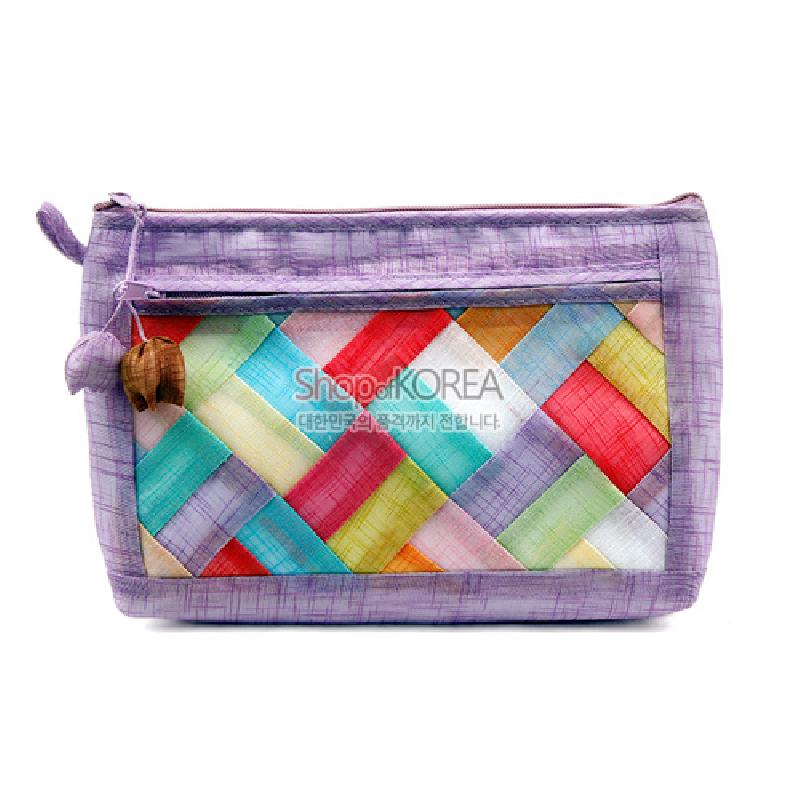
The 모시 파우치-조각보[자색] (mosi pouch — jogakbo, purple) has a flower-bud-shaped maedeup ornament and a calm, subdued color that suits older guests well.
The 모시 파우치-조각보[청색] (mosi pouch — jogakbo, blue) retains the cool, crisp quality characteristic of mosi fabric, making it a color that male guests can choose without hesitation.

Orders with a Fixed Date
Event orders have dates that cannot move. It is common for us to ship in two separate deliveries, starting with whichever items have finished printing first. When the boxes arrive, coordinators typically spend the time up to the day before the event taking everything out and sorting it by item.
And the scene we hear about afterward is usually something like this: as the delegation files out of the conference room at the end of the meeting, each person leaves with one item in hand. Someone opens the hand mirror, takes a look, and tucks it into the pouch; someone else slips the card case straight into a pocket. We often hear that because the logo is small, people receive the items as everyday objects rather than as event souvenirs.
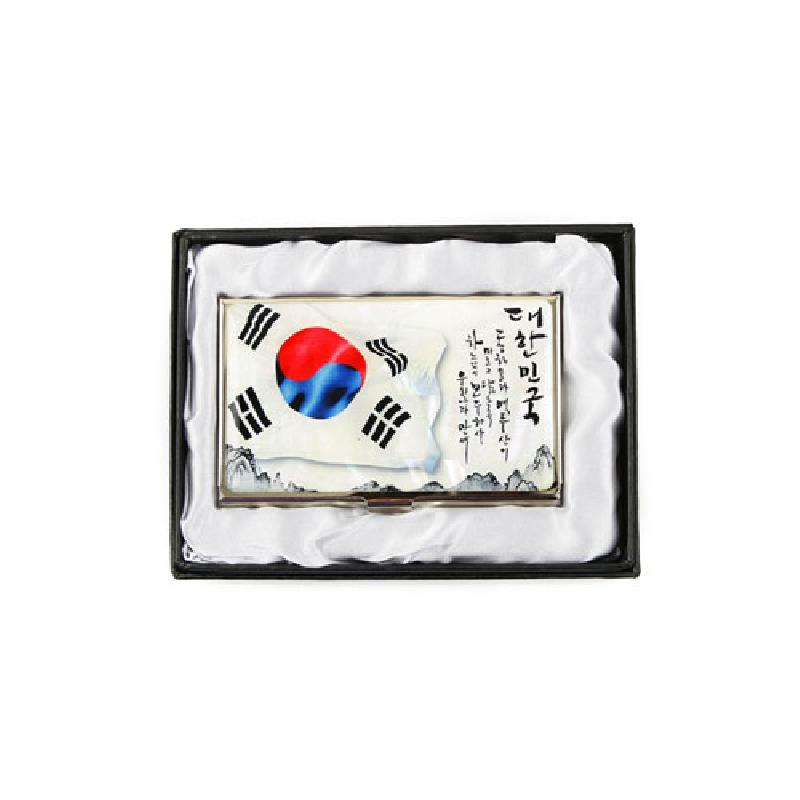
If you want to convey the symbol of Korea more clearly than an institutional mark, there is also the 명함집-태극기 (Taegukgi card case). It is made from domestically produced pure mother-of-pearl and stainless steel, and incorporates the Taegukgi (Korean national flag), the Aegukga (national anthem), and Hangeul elements, so its meaning comes across immediately at official events.
This account is based on actual purchasing situations, with individuals and institutions anonymized and some scenes reconstructed.