
Shopofkorea guides
Why I Packed a Najeon (Mother-of-Pearl) Business Card Case in My Carry-On for a Foreign Buyer Meeting
Official product names are shown in Korean. Product pages are in Korean; prices are in South Korean won (KRW).
After an overseas business trip was scheduled, the first thing that came to mind wasn't the meeting materials — it was the gift. I couldn't show up empty-handed to people I was meeting for the first time, but I also didn't want to lug something too heavy.

At first I took the easy route. I picked out a few fans with a Korean feel and some small keychains, and even completed the payment. But less than a day after paying, something nagged at me. The fans were pretty, but they seemed somehow too casual to hand to someone you're meeting for the first time in a conference room. They also felt too seasonal. The recipients were all working adults — I started wondering where they'd even put something like that or how they'd use it.
So I opened the search bar again. I started with "gifts for foreigners" and "business trip gifts," and I lost count of how many times I ended up typing just "business card case." Exchanging business cards is the very first thing you do at a business meeting. I figured that if the gift was something the recipient could use right at that moment, it would feel less awkward for them too. I briefly looked at bookmark sets as well, but for meeting counterparts, a business card case felt more appropriate.
Switching from Fans to a Business Card Case
In the end I called the shop and left an inquiry message. I wanted to cancel the fans I'd already paid for and switch to the najeon (mother-of-pearl inlay) business card case I'd saved to my wish list. I also asked about the things I was worried about: whether the najeon was genuine natural mother-of-pearl, and whether someone could check the condition of the items before shipping, since I'd be handing them out as soon as I arrived. Once I received confirmation that natural mother-of-pearl is used, I felt reassured. I cancelled the original order and placed a new one.
I chose a different pattern for each business card case. Rather than giving everyone the same thing, I thought it would feel more thoughtful to give each recipient something slightly different.
The first one I chose was the 문양훈민 명함집 (Munyang Hunmin business card case). Its design weaves together Hangeul consonants and vowels with geometric patterns, so I felt it would show at a glance that I'd come from Korea, without me having to say a word. At approximately 9.2 cm wide and 5.9 cm tall, and weighing 54 g, it barely registers in a travel bag.
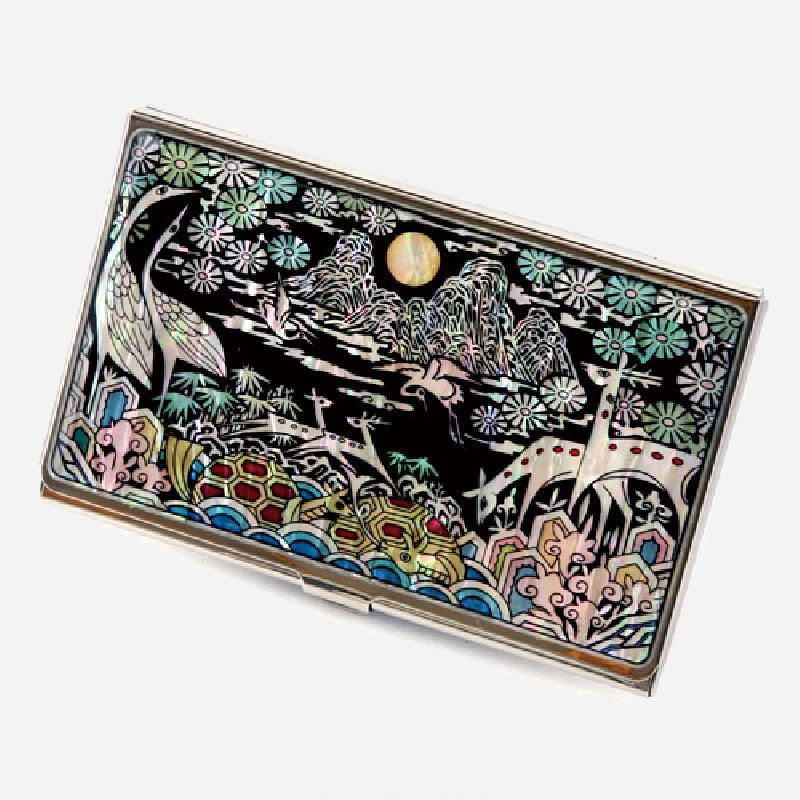
The second was the 십장생꽃무늬 명함집 (Sipjangsaeng Flower Pattern business card case). The sipjangsaeng (ten symbols of longevity) and floral motifs are traditional imagery representing longevity, good fortune, and prosperity, so it felt like a fitting way to say I hoped we'd have a long and good relationship. It has a stainless steel base with mother-of-pearl applied on top, and it comes in a hard case, so I felt less anxious about it getting damaged in transit.
For the third I chose a business card case with a leaf pattern. If you prefer a nature-inspired motif, the 명함집-초충도 (business card case — Chochungdo, a traditional genre depicting plants, insects, and butterflies) is in the same vein. It is made using the najeon (mother-of-pearl inlay) technique, in which thin pieces of natural mother-of-pearl are applied to a stainless steel base, so it would suit someone who appreciates the iridescent quality of mother-of-pearl.

For the others who would be in the meeting — interpreters and working-level staff — I separately packed traditional doll keychains and phone straps as a set. The plan was to give the business card cases only to the key counterparts, and to hand out the smaller accessories more casually to a larger group.
In the Conference Room
When the package arrived, I opened the box and looked at each business card case one by one. Tilting them toward the window, the light played differently across the mother-of-pearl surfaces — the Hunmin pattern came through crisply, while the Sipjangsaeng pattern glowed softly between the flowers. I checked that there were no scratches, then put them back. The keychains and phone straps I packed separately into envelopes and slipped into the front pocket of my travel bag.
At the conference room on the trip, I placed a business card case in front of each counterpart's seat. When I briefly mentioned that each one had a different pattern, one person immediately picked theirs up and ran a fingertip across the surface. They asked whether it was made from a seashell, so I explained that in Korea this is called jagae (자개), and that it was widely used on traditional furniture as well. Another person looked at the Sipjangsaeng design and asked what it meant. When I said it represented longevity and good fortune, they smiled and said "That's a lovely sentiment," then immediately took out a few of their own business cards and slipped them inside to try it out.
The keychains and phone straps I brought out in their envelopes and let everyone at the table pick one. There was a brief exchange about who would take which color of doll outfit, and that small moment did a lot to ease the stiff atmosphere at the start. The meeting carried on from there.
Looking back, switching from fans to business card cases was the right call. When choosing a gift for a foreign buyer, the Korean character of the item matters, but what mattered even more was whether it could be taken out and used right there in that moment. A business card case is something used in the very first instant of a meeting, so I like to think that every time those counterparts pull out a business card from now on, that conference room might cross their minds at least once.
This account is based on an actual purchase experience; individuals and organizations have been anonymized and some scenes have been reconstructed.