
Shopofkorea guides
Why We Chose Mother-of-Pearl Business Card Cases as Gifts for an International Delegation Signing Ceremony
Official product names are shown in Korean. Product pages are in Korean; prices are in South Korean won (KRW).
When a date is set for signing an exchange agreement with an overseas organization, the message that reaches the person in charge tends to start in much the same way. First, it is always a commemorative plaque. "We'd like to have a commemorative plaque made for the agreement signing — we'll send you the English text to engrave, so please take a look at the draft and give us a call." The attached document contains the names of the giving and receiving organizations, the name of the agreement, and the year and month, all written in English.
Almost without fail, while going over the draft on the phone, the conversation moves on to the next topic. "We also need to give something to each member of the visiting delegation. And for the heads of the delegation, we'd like something a bit nicer, separately."
Having received this kind of request many times, we've come to understand what these coordinators are worried about. A plaque goes on the table once and that's it, but delegation gifts are placed in as many hands as there are people. Something too light feels out of keeping with the gravity of a signing ceremony, and something too large becomes baggage on the flight home. You can see the trail of deliberation right there in the site search history: gifts for foreign visiting delegations, souvenirs for international exchange organizations, jewelry box gifts for foreign dignitaries, mother-of-pearl business card cases for group gifts. The pattern is often the same — they look at plaques first, compare a few jewelry boxes, and eventually settle on business card cases.
A Two-Tier Gift Structure: A Few Delegation Leaders and All Visiting Members
The arrangement that tends to take shape is this: the plaque goes in the center of the ceremony table; hanji (Korean traditional paper) or najeon (mother-of-pearl lacquerware) jewelry boxes go to a select few key figures from the other organization; and a business card case goes to each and every member of the visiting delegation.
The reason business card cases are so often the final choice is straightforward. A signing ceremony is the occasion where the most business cards are exchanged. Many people are meeting for the first time, and many more will need to stay in touch going forward. When someone opens the business card case they just received right there at the event and slides their own card inside, the gift aligns perfectly with what is happening that day.
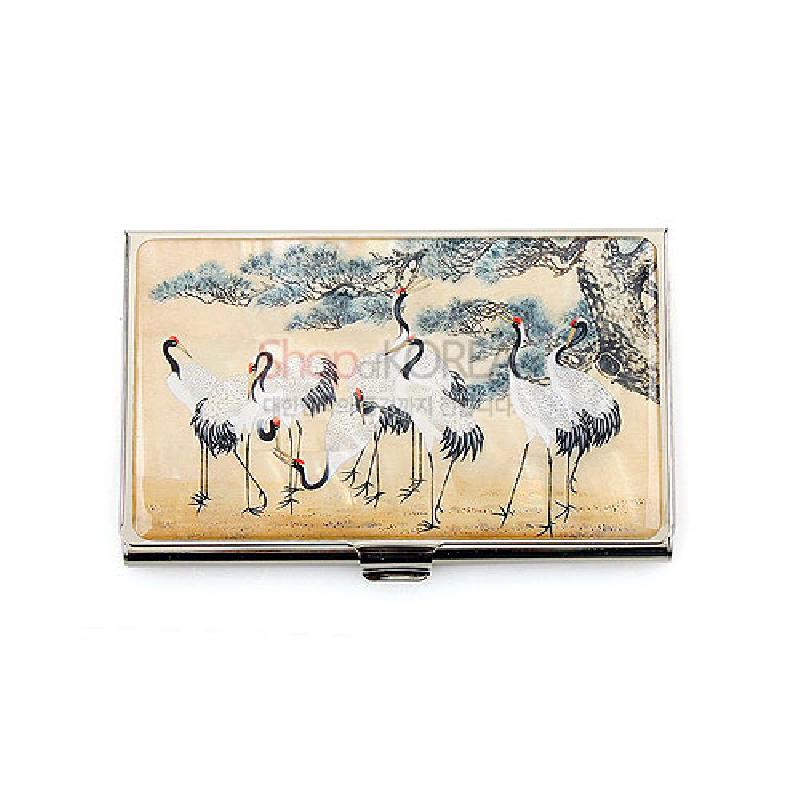
One of the most frequently ordered items is the 명함집-군학도 (business card case — Gunhakdo, a crane-and-pine lacquerware design). It features a najeon (mother-of-pearl inlay) decoration on an ottchil (lacquer) base, with a gunhakdo pattern depicting multiple cranes and pine trees. It measures 9.4 × 6 cm with a thickness of 0.5 cm and weighs 60 g, so it fits in a suit's inner breast pocket and adds no burden to luggage.
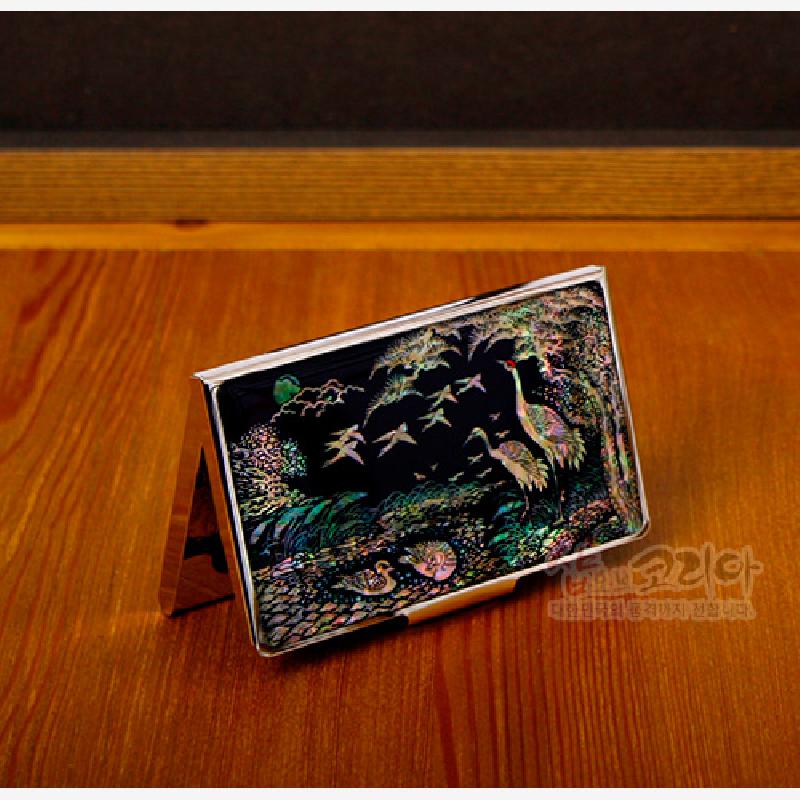
Often chosen alongside it is the 송학 명함집 (Songhak business card case, a crane-and-pine design). It uses the najeon sanggam (mother-of-pearl inlay) technique, in which natural mother-of-pearl is ground thin and applied to fit the pattern, and it features a songhak (crane and pine) motif. This pattern carries the meaning of a long-lasting relationship and longevity, making it a fitting gift for an occasion that marks the beginning of an exchange. It shares the same dimensions as the 명함집-군학도: 9.4 × 6 cm.
Many people order a mix of the two, and this turns out to be surprisingly effective. When everyone receives the exact same item, people tend to simply put it away, but when the person next to you has a different pattern, people take them out and compare. Questions like "How many cranes are on yours?" or "What kind of tree is that?" naturally arise, and when they do, it creates an opening for the Korean coordinator to explain.
The Date Almost Always Gets Moved Up
There is one thing that happens consistently with orders for this kind of event. Someone will initially say "by the end of next week at the latest," and then two days later it becomes "we need to receive it by Thursday morning because we have to prepare the day before the event." Things like rehearsals, seating arrangements, and attaching name tags to gifts come up. For that reason, once the plaque draft is confirmed, we tend to move the schedule up by a day or two, and when things are urgent, we can send items by same-day courier on the morning of the event. The 송학 명함집 is classified as a fragile item, so it is safest to transport it to the venue in its original packaging.
Scenes That Unfold at the Venue
There is a scene we often hear about from coordinators after the event. The agreement is signed, a photo is taken with the plaque in the center, the jewelry boxes are presented to the delegation leaders, and then the business card cases are handed out to the visiting members. At that point, someone always runs a fingertip across the crane design on the surface. Because the mother-of-pearl shifts color depending on the angle, people turn the case back and forth in the palm of their hand. When the question comes — "What does this bird mean?" — the answer is that the crane and pine together represent a relationship that endures for a long time, and at a signing ceremony, there is hardly a more fitting explanation than that.
When You Want the Delegation Leaders' Gifts to Stand Apart
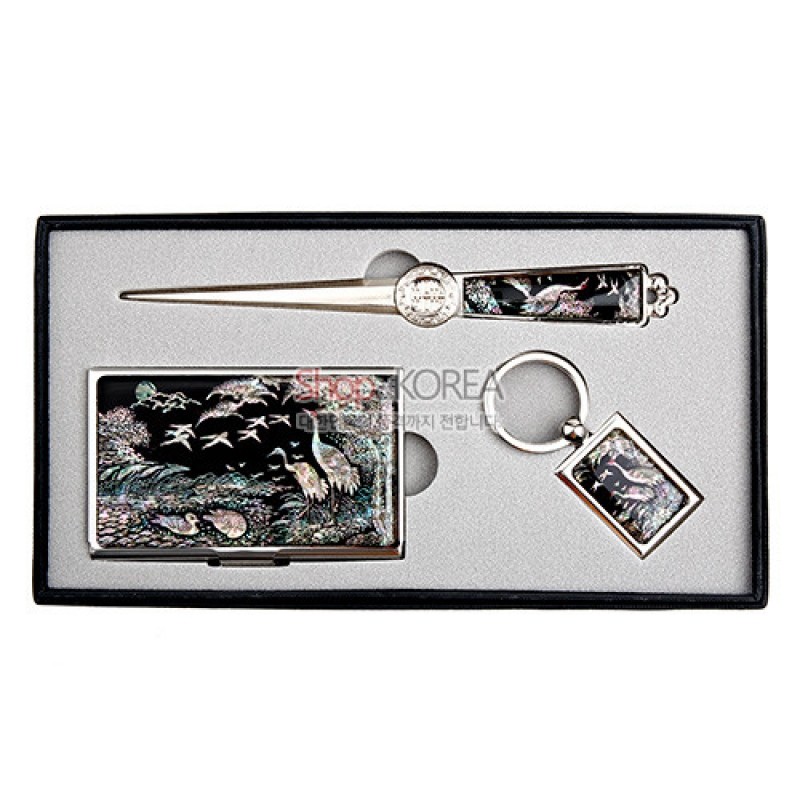
Some people find a jewelry box too much, yet feel it would be a shame to give the delegation leaders the exact same business card case as the rest of the visiting members — people in roles such as delegation head or senior working-level representative. In those cases, we often recommend the 명함집세트-송학3종(지칼) (business card case set — Songhak 3-piece set with jikal, a type of presentation box). It is a 3-piece set with the songhak pattern printed on natural mother-of-pearl, with a box measuring 22.8 × 12 × 2.8 cm and weighing 250 g. Because it belongs to the same songhak family as the business card cases, it maintains a visual continuity with the gifts given to the visiting delegation while still marking the recipient's distinct standing.
The reason an inquiry that begins with a single plaque so often expands into gifts for every member of the visiting delegation seems to be this: for an agreement to be remembered, everyone present that day needs to leave with something in hand. If what they carry home is a business card case they reach for every day, then the next time they meet, they can begin with the same story.
This account is based on actual purchasing situations, with individuals and organizations anonymized and certain scenes partially reconstructed.