
Shopofkorea guides
What Is the Difference Between Jagae and Najeon Chilgi?
Official product names are shown in Korean. Product pages are in Korean; prices are in South Korean won (KRW).
Jagae refers to the decorative material obtained from seashells. Najeon is the technique of cutting and attaching, or inlaying, that jagae. Najeon chilgi refers to the craft completed using the najeon technique together with lacquer (ottchil).
If you come across the name najeon chilgi while searching for a jagae jewelry box, there is no need to feel unfamiliar. The same object can be called by its material or by its production technique. Keeping the three terms distinct makes product descriptions much easier to read.
Jagae Is the Seashell Material Used to Create Patterns
Jagae is made by grinding the shells of abalone, top shells, and similar mollusks into thin pieces. In craft objects, it is used as the material for expressing patterns such as flowers and butterflies. Because its sheen and color change depending on the angle at which light strikes it, even a slight movement of the object alters the impression the pattern gives.
In this context, the word jagae does not refer to the form of a jewelry box or business card holder. It is a name that tells you what material was used for decoration.
There are also jewelry boxes in which vines and flowers are expressed in jagae against a black ground. Against the dark background, the many hues of the jagae are revealed. Even the same floral pattern gives a different impression from a picture drawn by following only the outlines.
Najeon Is a Technique, and Najeon Chilgi Is a Lacquerware Craft
The work of grinding jagae thin, cutting it into patterns, and attaching it belongs to the najeon technique. Inlaying jagae into a base—sangam (inlay)—is also one of the najeon techniques. The name of the material carries over directly as the name of the technique.
In najeon chilgi, jagae decoration and lacquer (ottchil) are used together. Product descriptions also describe the process of attaching jagae and finishing with lacquer. Some production descriptions note that lacquer is applied to a wooden base multiple times. The luminosity of the jagae and the lacquered surface are thus contained within a single object.
It is therefore a misreading to treat jagae and najeon chilgi as two different materials. Jagae answers the question of what was used; najeon answers the question of how the decoration was applied. Najeon chilgi describes the craft completed with lacquer and jagae decoration. This is also why all three terms can appear together in a product name.
A Plum Blossom Jewelry Box Contains Both Material and Method
The '나전칠기 색매화-직보석함' (Najeon Chilgi Color Plum Blossom Straight Jewelry Box) uses wood, lacquer, and jagae. Hanji (Korean paper) and velvet are also included among its component materials. The production description covers the process of grinding jagae thin, cutting it into patterns, and attaching them. It is a najeon chilgi jewelry box finished with lacquer.

Calling this jewelry box a jagae jewelry box makes it a name that foregrounds the decorative material. Calling it a najeon chilgi jewelry box makes it a name that conveys the production technique and the craft as well.
Knowing the meaning of the pattern reveals a story beyond the description of the material. The plum blossom symbolizes integrity and the beginning of spring. The birds and butterflies depicted alongside it carry meanings of good fortune and beauty. A box for holding jewelry thus has the wish for spring and good things added to it.
Here, jagae is the material that renders those meanings as visible patterns. The subject of the plum blossom and the luminosity of the jagae each play different roles.
In a Peony Business Card Holder, the Two Names Are Used Together as Well
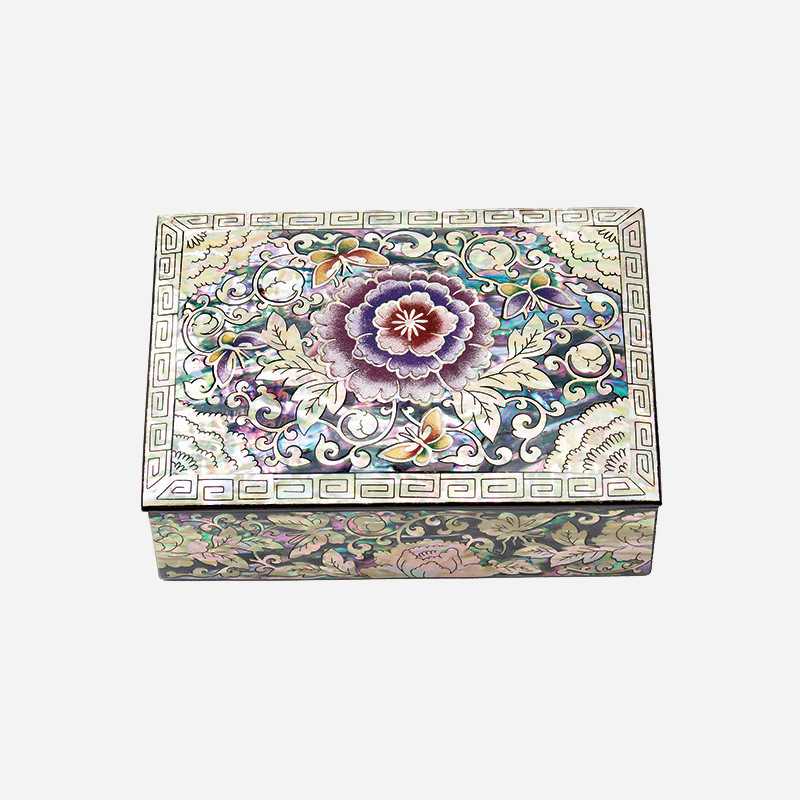
The '자개명함함-나전으로 핀 모란' (Jagae Business Card Holder – Peony in Bloom Through Najeon) carries both material and technique in its name from the outset. It is a business card holder made using jagae, lacquer, and wood. The peony and butterfly patterns are expressed using the jagae sangam (inlay) and najeon chilgi techniques.
The peony is a flower also called mokdan. In traditional auspicious patterns, it symbolizes wealth and prosperity. The butterfly carries meanings of good fortune and harmony. A business card holder featuring flowers and butterflies together is thus a craft object that places auspicious meaning inside an everyday item.
Its function of holding business cards differs from that of a jewelry box. Even so, the description of creating patterns with jagae and using lacquer alongside it carries through unchanged.
The 'jagae' and 'najeon' in the product name are not an unnecessary repetition of the same word. The first term refers to the decorative material, and the second refers to the technique used to work with that material. The peony is the pattern expressed through that technique.
Even When an Object's Use Differs, the Meaning of the Terms Carries Through
The names jagae and najeon chilgi are also applied to hand mirrors. One buyer who gave a najeon chilgi hand mirror as a gift wrote, "I felt so proud because they were so happy to receive it." It is the experience of one person who gave a hand mirror, but it shows the same craft being used outside of storage boxes.
On Shop of Korea's najeon chilgi page, objects grouped under the same craft name can be seen. Items for holding business cards continue under najeon chilgi – business card holders.
The difference between jagae and najeon chilgi is the difference between a material and a craft. When speaking of the decorative material used in a jewelry box or business card holder, the word is jagae. The technique for working jagae is najeon, and the craft completed together with lacquer is najeon chilgi. It is perfectly natural for these names to appear together in a single product description, because each one tells you separately what the object is made of and how it was made.