
Shopofkorea guides
Korean Office Supplies That Stay on the Desk for a Long Time
Official product names are shown in Korean. Product pages are in Korean; prices are in South Korean won (KRW).
Korean office supplies used frequently at a desk touch the recipient's everyday life. A person who writes down schedules grows comfortable with a diary in hand, and a person who meets clients finds occasions to pull out a business-card case. Traditional decorations, too, remain part of daily life when placed beside objects used every day.
Shop of Korea's office supplies range from bookmarks to najeonchilgi (mother-of-pearl lacquerware) folding screens. Small stationery items and craft pieces that decorate a space share the single common thread of being used in an office, and so they sit together in one place. When choosing a gift, it is therefore quickest to start by thinking about what the recipient actually does at their desk.
A Desk for Writing Schedules and Collecting Records
For someone who jots down meeting dates and leaves work memos, the closest things are objects to write in. When something is opened many times a day, the decoration it carries catches the eye each time.
Reviews of the 'Shop of Korea 만년다이어리 뿌리깊은나무 세트' (perpetual diary Roots-Deep-Tree set) reflect exactly that kind of use. A buyer who received it as a complimentary gift cited schedule management and scrapbooking as its strengths and added that it suits working adults. It is a review in which the act of recording and collecting led directly to satisfaction.
There is also a set that pairs a writing instrument with a business-card case. One buyer of the '명함케이스와 볼펜 2종세트–송학' (business-card case and ballpoint pen 2-piece set – Songhak) was satisfied with how lightweight it was. They also noted that the packaging looked luxurious and expressed the expectation that it would make a distinctly Korean gift. It is a review that conveys the impression made when presenting it as a gift rather than its writing performance.
Leaving a Place to Return to While Reading Documents
When sorting through documents, a small habit of marking where one left off naturally follows. When moving back and forth among multiple pages to check content, one needs to leave a spot to return to. The bookmarks found in the office supplies category are objects closely tied to exactly this reading habit.
Gathering papers on a desk and marking where one was reading are two different things. This difference also becomes a fork in the road when choosing a gift. Someone who reads materials for long stretches is more at home with reading tools, while someone who frequently meets people is closer to objects that help them keep business cards at hand.
Rather than looking only at whether the decoration is appealing, try picturing the moment when the hand reaches for it. The more concretely one can envision the scene in which the object is taken out, the clearer it becomes which gift is the right fit.
Traditional Patterns Appear at the Moment a Business Card Is Produced
A business-card case is an accessory that travels from the desk, after the cards are gathered, all the way to the meeting itself. The 꽃나비 명함집 (Flower-and-Butterfly business-card case) is a product that uses metal and mother-of-pearl. Flowers and butterflies rendered in najeon (mother-of-pearl inlay) decorate the outer surface, and those patterns also carry a wish for good fortune.
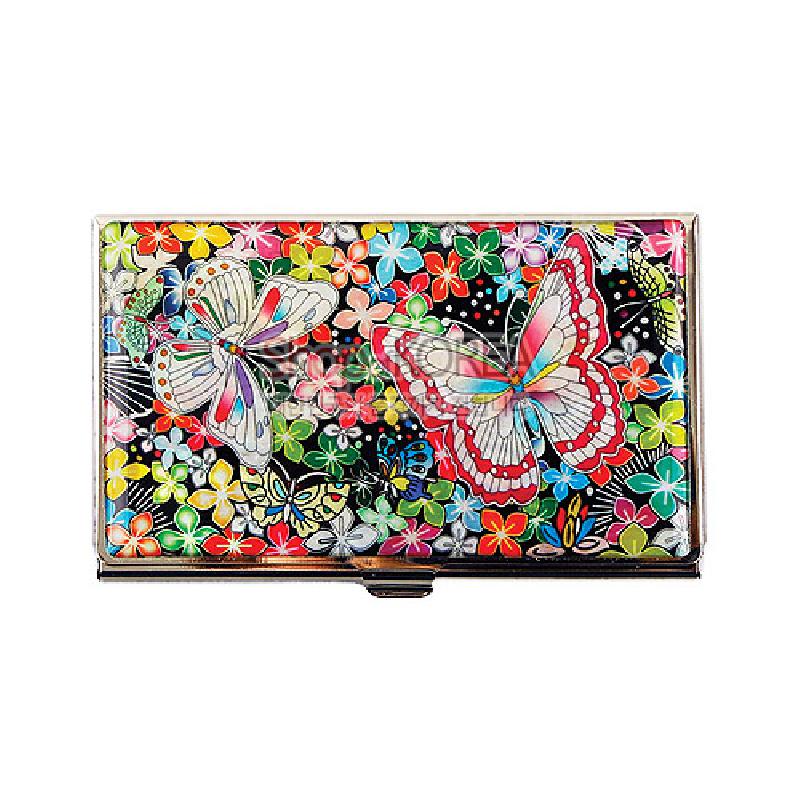
At the moment a business card is handed over, the decoration on the case also enters the other person's field of view. This is a different kind of use from a decorative object that simply stands on its own. The patterns of Korean craft naturally accompany a gesture repeated throughout the workday.

The 나비당초 명함집[흑색] (Butterfly-and-Arabesque business-card case [black]) adds najeon patterns against a black background. It uses the najeon technique of attaching or filling thinly ground shell pieces according to the pattern. The design combines the auspicious symbolism of the butterfly with the prosperity and vitality of the arabesque (dangcho), carrying a wish for good connections and the expansion of one's business. That is why it also pairs well with greetings exchanged with business partners.
The 문양훈민 명함집 (Munyang Hunmin business-card case) is decorated with najeon combining Korean alphabet characters (jamo) and geometric patterns. As a product that holds Korean written culture, it suits someone who prefers to keep letters close rather than flowers or butterflies. The purpose of holding business cards is the same, yet the picture it presents on a desk is quite different.
A Desk That Also Keeps a Mirror and a Key Ring
The 마름모당초 명함집 (Diamond-Arabesque business-card case) renders lotus flowers and arabesque patterns in najeon. The interior uses stainless steel and also functions as a mirror. Because the function of gathering business cards is combined with the ability to check one's reflection, someone who ordinarily carries a small mirror separately may well find their eye drawn to this feature.
The lotus carries a wish for purity, and the arabesque carries a wish for prosperity. These traditional patterns have long been used in hanbok, ceramics, embroidery, and metalwork. They take shapes drawn from nature and imbue them with hopes for good fortune and longevity. On a business-card case, that decoration moves into something small enough to hold in the hand.
For those who wish to give a business-card case and a key ring together, there is the 마름모당초 2종세트 (Diamond-Arabesque 2-piece set). It is a set in which arabesque and lotus motifs are expressed in najeon. One can naturally picture the scene of gathering business cards at the desk and then picking up keys on the way out. For someone who uses both objects regularly, there is a reason to reach for each of them.

Having more items in a set does not mean they will all be used as often. Some people need only a single business-card case, while others also use a key ring. It is more natural to include only as much as fits the recipient's habits.
Korean office supplies that remain on a desk for a long time are ultimately objects that work their way into what one already does. If recording is frequent, a diary and writing instruments come to mind first; if reading materials, a bookmark; if exchanging business cards, a business-card case. To those uses, flowers and butterflies, arabesques and Korean script are added. The decoration leaves a distinctly Korean impression each time the object is taken out and used.