
Shopofkorea guides
Why Is the Hahoe Mask's Smile Crooked?
Official product names are shown in Korean. Product pages are in Korean; prices are in South Korean won (KRW).
The crooked smile of the Hahoe mask is not mere decoration. It is a face that calls to mind the comic spirit of mask dance. Behind that smile lies the gaze of ordinary people looking at a society defined by social rank.
To truly understand the Hahoe mask, looking at its appearance alone is not enough. You also need to know the role it played in the byeolsingut ritual and the mask dance. Only then do mask replicas, framed pieces, and keychains look different to you.
Where Was the Hahoe Mask Used?
The Hahoe mask is a mask used in the byeolsingut (별신굿) ritual of Hahoe Village in Gyeongsang Province. The byeolsingut was a shamanistic ritual performed to pray for the village's prosperity, a good harvest, and the well-being of individuals. Within it was a mask dance of an independent, theatrical character.
The Hahoe mask was first made around the 12th century, during the mid-Goryeo period. Records and legends mention twelve types of masks in all. Today, nine types survive, including the gaksi (각시, young bride), yangban (양반, aristocrat), and bune (부네, a refined woman).
Each mask represents a different social status and class. The Hahoe mask is therefore not simply a collection of masks with different face shapes. They are the faces that make up a drama in which various characters come into conflict.
How Did a Smile Become Satire?
The byeolsingut mask dance addressed the absurdities of the world through humor. Even the ruling class, such as the yangban, became targets of mockery and satire. Ordinary people used the performance to express the hardships and grievances of their lives.
Satire was a way of turning heavy criticism into laughter. For the ruling class, it could also serve as an occasion to hear the voice of common people. This is why it is difficult to see the Hahoe mask's smile as simply a cheerful expression.
From a brightly smiling face, wit and humor are conveyed naturally. The playful mockery of the mask dance is layered over that expression. The face of the Hahoe mask becomes a clue that calls that theatrical culture to mind.
What Does the Movable Jaw Reveal?
Some Hahoe masks were made with a jaw that could move. In actual performances, this feature added to the comical appearance. It was, in effect, a device that brought a fixed face to life within the drama.
The imaetal (이매탈), which has no jaw, is associated with the legend of Heo Doryeong. Heo Doryeong received a divine command from a mountain spirit to make twelve masks. He was not permitted to show the process to anyone.
However, a young woman secretly watched him at work. Heo Doryeong is said to have died without finishing the final mask. That is why the imaetal has been passed down without a jaw.
What Remains in Mask Replicas and Framed Pieces?
The mask dance ends with the performance, but the characters and expressions of the masks live on in craft objects. The 하회탈 大-양반/부네탈 세트 (Hahoe Mask Large — Yangban/Bunetalset, a set pairing the yangban mask and the bune mask) is composed of the yangban mask and the bune mask. Viewing both characters together allows one to reflect on the difference in roles among the Hahoe masks.
Decorative Hahoe masks serve a different purpose from the masks used in actual performances. After wood is cut and shaped, an artisan carves the face by hand. The decorative craft object is completed through sanding and painting.
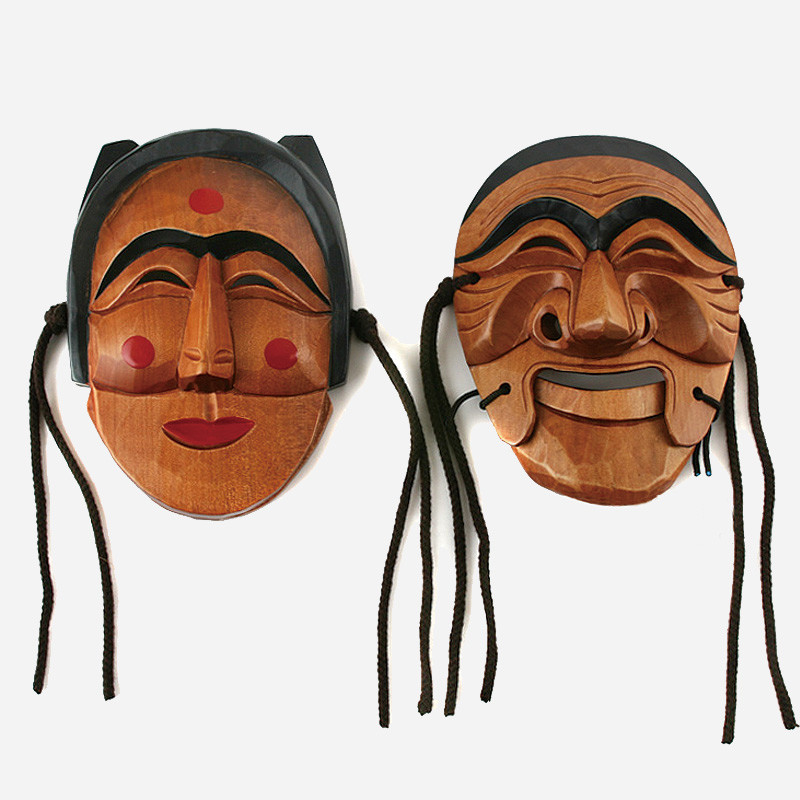

Framed pieces are a product category that brings the faces of the mask dance into interior decoration. The 하회탈 문창살 액자 세트 (Hahoe Mask Munchangsal Frame Set) pairs a Hahoe mask with a munchangsal (문창살, traditional Korean lattice window) frame. There are also forms that hold two types of masks, such as the 하회탈 2형 사각 액자.
Does Satire Survive Even in a Small Keychain?
Keychains bring the face of the Hahoe mask into everyday objects. The 탈열쇠고리-양반부네세트 (Tal Keychain — Yangban Bune Set, a keychain set pairing the yangban and bune masks) pairs the yangban and the bune as one set. A vast performance culture has been reduced to a souvenir that fits in the palm of your hand.
One buyer wrote, "It's a small gift, but it doesn't look cheap and it's cute." They also noted that the neat, traditional appearance left a strong impression. It is the review of one person, but it brings a real gift-giving scene to mind.

There is also the 자개열쇠고리(사각)-하회탈 (Jagae Keychain [Square] — Hahoe Mask), which incorporates jagae (자개, mother-of-pearl inlay). It is an example of the same Hahoe mask motif meeting a different craft expression. Even when reduced in size, paying attention to which character is depicted makes the meaning clear.
The smile of the Hahoe mask does not end as merely an amusing expression. The origins of the byeolsingut ritual and the humor of the mask dance lie behind it. The satire directed at the yangban and the voice of ordinary people can also be read within it.
Mask replicas, framed pieces, and keychains preserve this face at different scales. Understanding the culture of the Hahoe mask means that souvenirs no longer look like simple mask shapes. The story within the crooked smile finally comes into focus.
If You Want to Compare a Broader Range of Products
The pages below link only to product categories that connect directly to the selection criteria in this article.
- Hahoe Mask — After understanding the meaning of the Hahoe mask, you can explore connected product categories — including mask replicas, framed pieces, and keychains — within a single theme.
- Dolls / Masks / Frames — You can browse mask replica and framed-piece product categories separately and extend your understanding of how the expressions of performance props are carried over into decorative craft.