
Shopofkorea guides
Ebony Keychains as Gifts for Foreigners: How to Choose the Right Traditional Pattern for Your Relationship and Occasion
Official product names are shown in Korean. Product pages are in Korean; prices are in South Korean won (KRW).
When giving a traditional-pattern keychain to a foreign recipient, it is better to first consider your relationship with that person and the setting in which you will present the gift, rather than simply choosing based on how Korean the design looks. The same pattern can be received as mere decoration if handed over without any explanation, while a brief note on its meaning can turn it into a memento of a visit to Korea or a meaningful encounter. I will divide situations into three criteria: the level of formality in the relationship, how readily you can explain the pattern, and the practical burden of carrying the item.
- For overseas colleagues or business contacts: prioritize a neat impression and an easy-to-explain meaning
- For close friends or acquaintances: connect the recipient's personal taste with your feeling of gratitude
- As a souvenir of a visit to Korea: prioritize a pattern that instantly evokes Korea
- If giving during travel or to multiple people: check the size and how burdensome it is to carry
In a professional relationship, you should be able to convey the pattern's meaning briefly and comfortably
For gifts intended for overseas work colleagues or business contacts, types that make it easy to express gratitude for the meeting and convey good wishes are more suitable than those carrying overly personal meaning. Look at motifs such as dragon (용), fortune (복), and longevity (수) to which you can add a brief explanation, but also consider the possibility that they may be interpreted differently in the recipient's cultural context. Rather than placing heavy emphasis on the meaning of the pattern, it is less burdensome to introduce it first as "a small souvenir featuring a Korean motif" and then add one sentence explaining why you chose it. For formal occasions, it is also worth checking the packaging condition and finish.
For example, 흑단열쇠고리-승용 (Heukdan Yeolsoe-gori Seungyong; ebony keychain with a dragon motif) is a type whose name incorporates ebony and a dragon motif, and it can be considered as a comparison option when you want to convey a neat Korean impression in a professional relationship. However, rather than defining the dragon pattern as having a specific meaning such as authority or success, it is safer to explain directly to the recipient what meaning you had in mind when you chose it. If you do not know the other person's taste well, also check whether the decoration is excessively large or complex. The formality of a gift is created not by a single pattern alone, but by the entire scene including the words you say and the packaging.
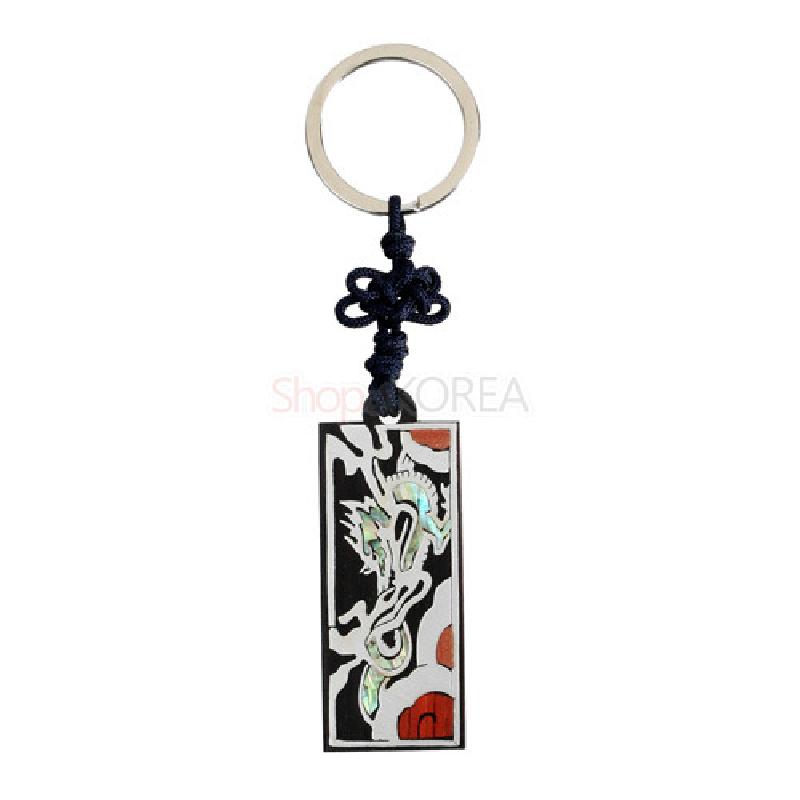
It is better to understand this not as the one definitive answer, but as a reference point for looking at ebony material and an explainable traditional motif together. If you want to convey a wish for good fortune, you can compare a small bok-mun (복문; fortune character) type as an additional candidate, and if the relationship calls for wishing someone health and longevity, you can compare a su-mun (수문; longevity character) type. However, in a relationship where directly mentioning health or age feels delicate, it is worth thinking first about whether you can explain the intention behind the su-mun before choosing it. When the recipient can comfortably receive the meaning, the pattern will naturally stay in their memory.
For a close acquaintance, what remains is not the pattern but "why you chose it for this person"

For a foreign friend or a long-time acquaintance, you can reflect the recipient's personal taste a little more. Even when choosing motifs that evoke a traditional atmosphere — such as lotus (연꽃), tal (탈; traditional mask), or yeopjeon (엽전; traditional coin) — it is best not to assume that a pattern carries only one fixed meaning. In particular, types such as Bune-tal (부네탈; a female mask character) or Yangban-tal (양반탈; a nobleman mask character) may have a striking expression and form, so first check whether the recipient enjoys figurative decorations. For yeopjeon types as well, introducing them with a focus on their traditional form and impression as a souvenir, rather than their meaning as currency, can reduce any sense of awkwardness.
A type like 흑단열쇠고리-삼연꽃 (Heukdan Yeolsoe-gori Samyeonkkot; ebony keychain with a triple lotus motif), whose name incorporates a triple lotus motif, is worth considering as a personal gift candidate for conveying gratitude. Rather than saying "I chose this because you specifically need this meaning," it is more natural to say you chose it because you wanted to share a Korean decoration along with the memory of your meeting. If the recipient prefers simple designs, check the complexity and size of the pattern; if they enjoy traditional decorations, compare types where the motif is clearly visible. The closer the relationship, the more comfortably a short message explaining why you chose it will be received, compared to a lengthy explanation of the symbolism.
Since a lotus motif is not read with the same meaning by every person, there is no need to explain its symbolism in definitive terms. Share the reason you chose it based on the product name and form, conveying a traditional atmosphere, and leave room for the recipient to interpret it freely. If you prepare a small note to accompany the gift, start with gratitude for the visit or the meeting rather than an explanation of the pattern. That way, the keychain becomes a practical souvenir that keeps the relationship in memory, rather than a cultural artifact that requires explanation.
The memory of a visit to Korea begins with a pattern that is easy to recognize
For an acquaintance you are parting with after a short trip, or for someone to whom it is difficult to give a lengthy explanation of a pattern's meaning, a taegeuk (태극) type that makes it easy to think of Korea is convenient. In actual purchase cases as well, responses have been noted from people who thought of it as a gift that blends the feel of the Taegukgi (태극기; Korean national flag) and traditional aesthetics to introduce Korea and leave a memory of the visit. There are also assessments that a small keychain type appeared easy to carry or hand over during travel, making it a point of comparison for itineraries with a lot of movement. However, please check the product information for the actual attachment position and size, and if the recipient is unlikely to use it, also consider whether it is easy to store.
흑단 작은열쇠고리-태극 (Heukdan Jageun Yeolsoe-gori Taegeuk; small ebony keychain with a taegeuk motif) is a good example to look at when the purpose of giving it as a souvenir of a visit to Korea is clear. Because the taegeuk motif can be confirmed from the product name without a lengthy explanation of its symbolism, it is also easy to connect to situations where you are preparing the same gift for attendees of multiple nationalities. Even so, you should consider whether the recipient enjoys using accessories that display national symbols. If you do not know their taste, handing it over with the words "Please remember your time in Korea" is sufficiently unobtrusive.

The taegeuk type is not the only option either. The candidates differ depending on whether you prioritize a clear impression of Korean commemoration, or a name that carries a good wish such as bok-mun or su-mun. When distributing to multiple people, unifying the purpose of giving first, rather than choosing a different pattern for each person, makes the selection easier. Purchase cases expressing satisfaction with the packaging and finish can be used as a reference, but at the time of preparation it is best to check the current information for the product you have selected.
Even if it is small and light, thinking through how the recipient will actually use it reduces the burden further
A keychain is a souvenir that is relatively easy to give without imposing, but not everyone attaches decorations to their keys. If you are giving it during travel, check whether the size is small enough not to be a burden in luggage; if it is a professional setting, check whether the packaging is neat; and if you are preparing it for multiple people, check whether you can explain the pattern briefly. In actual reviews as well, the small size and convenience of carrying it during travel were mentioned as reasons for choosing it. On the other hand, for a recipient who does not use decorative accessories, you might think about whether it is a form that will remain in memory even if stored on a desk or in a drawer.
The related products at the end are not simply a list repeating the examples explained in the main text, but candidates to compare together in the same gift-giving situation. Looking at the Seungyong, Samyeonkkot, and Taegeuk types alongside small bok-mun and su-mun types, choose whichever is closest to the level of formality in your relationship and the feeling you want to convey. Rather than placing great emphasis on the meaning of the pattern, convey your reason for choosing it in words the recipient can easily understand, and check the burden of carrying and using it. In the end, what endures is not a specific product name, but the selection criteria of "for whom, with what feeling, and in what setting will I give this."
If you want to compare a broader range of products
The page below links only to product categories that connect directly to the selection criteria in this article.
- Keychains — Not limited to ebony products; a wide variety of traditional-pattern keychains can be compared in one category, broadening the range of choices for material, size, and pattern.