
Shopofkorea guides
Why Did the Folding Screen Become the Backdrop for Feasts and Ancestral Rites?
Official product names are shown in Korean. Product pages are in Korean; prices are in South Korean won (KRW).
A byeongpung (folding screen) is a panel that is spread out lengthwise to block the wind. It was also used as interior decoration. Because it folds, its width can be adjusted. Wherever it is placed, a natural visual boundary is created.
The uses of the byeongpung begin with this boundary. It is not a wall that completely separates people from a space. It is closer to a piece of furniture that sets up a backdrop wherever it is needed. As paintings and symbols were added to it, its cultural significance deepened as well.
A Draft-Blocking Panel That Came to Define a Space
Korea's ondol (underfloor heating) system kept floors warm. However, drafts entering from above were difficult to block. The byeongpung was widely used as a practical tool for blocking wind. Where the panel was spread out, an effect of distinguishing an inner side from an outer side also emerged.
The history of the byeongpung is long. There is a record from 686 CE of it being exported to Japan along with gold, silver, and silk. This suggests it was in use even before the Three Kingdoms period. It subsequently became a fixture of everyday life through the Goryeo and Joseon periods.
A byeongpung placed inside a room also served a decorative role. Scholars of old used it as an object that expressed the dignity of their household and themselves. In this way, a draft-blocking panel expanded into a piece of interior decoration carrying symbolic meaning.
Why Was a Byeongpung Placed at Ceremonies and in Reception Rooms?
The byeongpung appeared at first-birthday celebrations (dol), birthday parties, weddings, and sixtieth-birthday (hwangap) feasts. It adorned the backdrop behind the guest of honor and conveyed a festive atmosphere. At solemn occasions such as ancestral rites (jesa), it served as a backdrop that made the meaning of the ceremony more distinct.
The symbols depicted in the paintings also defined the character of the occasion. The ilwoldo (sun-and-moon painting) represented royal authority. The sipjangsaeng (ten symbols of longevity) expressed a wish for health and long life. The crane was used to convey nobility and longevity.
The hwajodo (flower-and-bird painting) carried wishes for harmony and happiness. The 8폭실크병풍大-화조도 (8-panel silk folding screen, large — flower-and-bird painting) is a decorative byeongpung through which these symbols can be explored. One buyer chose a hwajodo as a gift for someone who loves birds. The vibrant colors and Korean aesthetic were also cited as reasons for the choice.
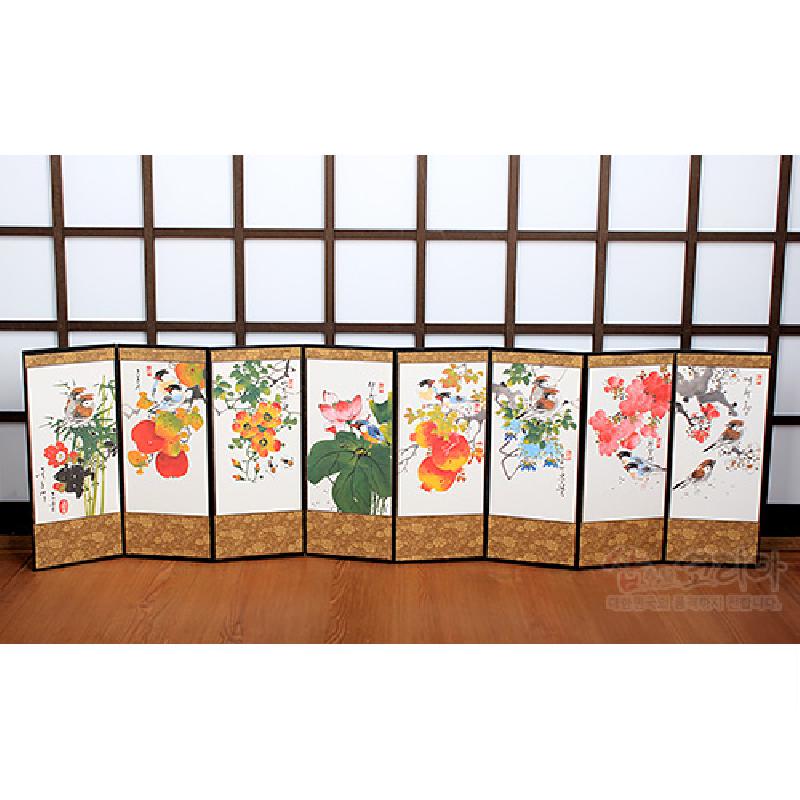
In this way, a byeongpung is somewhat different from a painting that simply fills an empty wall. It transforms the very spot where it is placed into a backdrop for ceremony and reception. With the meaning of the painting added on top, it expresses the wishes held for that occasion.
What Kind of Atmosphere Does a Sansudo Byeongpung Create?

The paintings placed on a byeongpung are not limited to one type. The subject matter varies — sansudo (landscape painting), hwajodo, and pungsokdo (genre painting depicting everyday life), among others. The impression a space conveys changes depending on what is depicted.
The 8폭실크병풍大-산수도 (8-panel silk folding screen, large — landscape painting) is a representative product featuring a sansudo. Readers looking for a sansudo byeongpung should first check the actual dimensions. One buyer noted that it was smaller than expected. However, they assessed it as suitable as a decorative byeongpung for placing in a space.
Traditional byeongpung were originally about 160–180 cm tall. Most byeongpung products at Shop of Korea are made in a reduced form of around 30 cm. If one expects the same scale as a traditional byeongpung, the difference is significant. This product range is suited to those looking for a decorative item rather than a room divider.
What Has the Miniature Byeongpung Preserved?
The modern miniature byeongpung focuses on decoration rather than draft-blocking. It is made in a size that can be placed on a desk, bookshelf, or display cabinet. The folding form remains, so its width can still be adjusted when positioning it.
The 사군자 나전칠기 4폭병풍 (sajunja najeonchilgi 4-panel folding screen — sajunja, mother-of-pearl lacquerware) is a decorative piece that brings together the byeongpung and najeonchilgi (mother-of-pearl lacquerware). The mother-of-pearl (jagae) produces different colors depending on the angle at which it catches the light. It is closer to a display piece for a study or office than a full-sized byeongpung. The depiction of the sajunja (four gracious plants) and the mother-of-pearl together convey a Korean decorative sensibility.

Small silk byeongpung also offer the enjoyment of choosing a painting. Small byeongpung featuring landscape paintings and products featuring pungsokdo are available. There are also reviews from buyers who chose a mini byeongpung as a gift for a foreigner. The buyer cited its quality as a Korean-style interior accessory as the reason for the choice.
The byeongpung began as a panel for blocking drafts. Wherever it was placed, a boundary was created. The painting added meaning to that space. That is why it could serve as the backdrop for feasts, ancestral rites, and receptions. Today, miniature decorative versions carry on its form and symbolism.
For a Broader Comparison of the Product Range
The pages below link only to product ranges that connect directly to the selection criteria discussed in this article.
- Byeongpung (Folding Screens) — A keyword shop that gathers byeongpung products directly, making it easy to continue browsing the range of paintings and sizes described in this article.
- Najeonchilgi — Byeongpung (Mother-of-Pearl Lacquerware Folding Screens) — Allows a more detailed look at the flow from miniature byeongpung into najeonchilgi decorative pieces.