Shopofkorea guides
Sending Gifts Directly Overseas: Small Criteria to Check Before Wrapping
Official product names are shown in Korean. Product pages are in Korean; prices are in South Korean won (KRW).
When you need to send a gift directly overseas, what matters first is not the item itself but "in what condition will the recipient first see it." If you are dispatching without being able to unwrap and inspect it yourself in Korea, you need to look separately at the gift's meaning alongside the packaging unit, the possibility of missing components, and the risk of crushing or damage in transit.
Dividing the situation as shown below makes the choice a little easier.
- Sending to a personal acquaintance: a clear purpose and an unimposing size
- Sending to a business contact or professional relationship: a formal case and a neat appearance
- Distributing to multiple recipients: individual packaging and quantity verification
- Materials that break or scratch easily: inspection before packaging and cushioning condition
When the recipient immediately understands the purpose, the first impression is comfortable
When sending a small craft gift to an overseas recipient, it is just as important that the occasion for use is clear as it is that the item has a Korean feel. If the recipient can tell right away "what this object is for" when they open the packaging, the gift comes across as natural rather than unfamiliar. Types that are small and easy to understand in purpose — such as pouches, bookmarks, and hand mirrors — are well suited to personal acquaintances, homestay hosts, or light expressions of gratitude. That said, the smaller the gift, the more advisable it is to check both the individual packaging condition and the neatness of the exterior, so that the wrapping does not look too sparse.
For example, a type such as the 모시 파우치-조각보[감색] (ramie fabric pouch with jogakbo patchwork pattern, in navy) is not bulky and carries a low risk of damage, making it relatively easy to handle in overseas-dispatch situations. The texture of the fabric and the jogakbo (조각보, traditional Korean patchwork) pattern create the impression of the gift, while the recipient will have little difficulty understanding that it is meant for carrying personal belongings. When choosing this type, rather than making strong assumptions about the recipient's color and pattern preferences, it is better to use as your criterion whether the recipient can use it comfortably in daily life.

This type is conveyed less as "a Korean decorative object" and more as "a practical accessory with a Korean feel." It therefore causes particularly little difficulty when sent to a close acquaintance or an individual recipient. However, even fabric items can develop crease marks from being pressed during packaging, so it is worth checking that the item does not look too flat after wrapping. If you include a gift message, it is more natural to convey simply that it is a small, easy-to-use gift rather than offering a lengthy explanation of the object's significance.
In professional relationships, the condition of the case stands in for the gift's formality

For recipients who are closer to a professional relationship — such as business contacts, buyers, professors, or institutional representatives — accessories that are easy to use on a desk or in a bag are more reliable than items that feel too personal. In this case, you should look not only at the design of the main item but also at the case, the set composition, and the exterior appearance after packaging. When sending directly overseas, the condition in which the recipient first sees the item becomes the impression of the gift, so if the wrapping paper is crumpled or the corners of the case look crushed, the sense of care conveyed by the gift can be diminished. The purchasing concern of "since it's a gift going overseas, it's hard to check the internal condition directly once it's received in its packaged state" frequently arises at exactly this point.
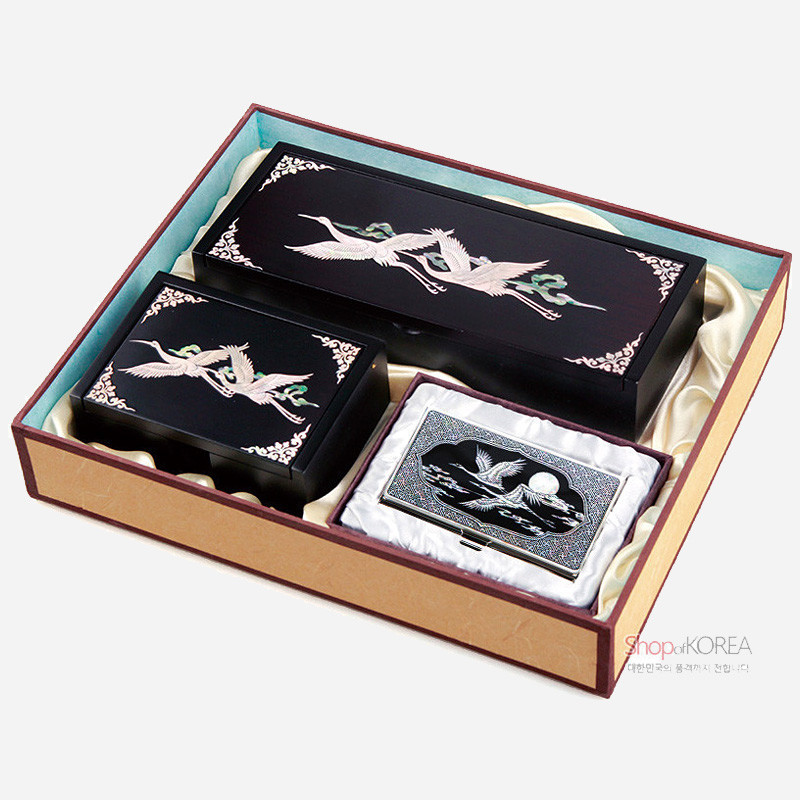
For example, a type such as the 명함집-조각보3종(거울) (business card holder with three jogakbo designs, with mirror) is well suited to conveying Korean patterns in a professional relationship without giving an excessively personal impression. A composition with a clear purpose — such as a business card holder or a mirror — is one that foreign recipients can relatively easily understand in terms of how it is used. However, because gifts with multiple components are difficult to inspect internally after packaging, you need to think separately about whether any components are missing and whether there are surface scratches before dispatch.
In gifts for professional use, "a sense of tidiness that is not burdensome to receive" is often more important than visual splendor. Especially if the overseas recipients span multiple cultural backgrounds, accessories that are easy to store and use are safer than overly personal decorative items. When choosing a set-type product, do not look only at the richness of the composition; also check whether each component fits firmly in its place and whether it might shift during transit. Even when requesting packaging, separating the inspection of the main item from the check of the exterior after packaging reduces mistakes.
For gifts to be distributed among many people, uniform condition matters more than beauty
For gifts sent to a group of recipients, it is more important that multiple people receive items in a similar condition than that a deep impression is made on any one person. When items are distributed in the same setting or allocated within an institution, individual packaging, quantity, and whether colors are mixed determine the overall quality of the gift. Small craft items are easy to dispatch one by one because of their size, but as quantities increase, you need to check for omissions and inconsistencies in packaging. If the items need to be redistributed overseas, an important criterion is whether the person receiving them on that end will need to do additional packaging work themselves.
For example, a type such as the 복을 담은 모시 주머니 (중) -적색 (ramie pouch carrying good fortune, medium size, in red) is light and easy to deliver individually, making it worth considering for group-dispatch situations. The item itself is not a large gift, but if the packaging is neat, it can give a sufficiently tidy impression even as a small keepsake. With this type, it is best to first confirm whether to prepare slightly more than the number of recipients, whether to unify the color or pattern, and whether each item is in a condition that can be delivered separately.

In group gifts, the priority is not a lengthy explanation of the meaning of one product but whether it can be delivered to everyone by the same standard. Especially when sending directly to an overseas institution or event coordinator, there is one additional step of "who delivers to whom" in the middle. It is therefore convenient if the packaging units remain intact, the quantity is easy to count, and the items are in a form that the recipient can distribute right away. Small types such as hand mirror sets or bookmarks also meet this criterion, but surface scratches and set composition should be checked separately before dispatch.
For materials that break or scratch, look at the transit route before the gift's meaning

Decorative craft items or accessories with a glossy surface may make a strong impression at the moment of receipt, but in overseas dispatch the risks during transit must be considered more carefully. Ceramics, mother-of-pearl inlay, mirrors, and case-type products can be sensitive to impact or crushing even when they appear small. If you are sending directly overseas without being able to receive and inspect the item yourself, you need to think first about inspecting the exterior of the main item and the need for cushioning packaging. Since it is difficult to check the interior once an item is packaged, it is advisable either to choose a type with a low risk of breakage from the outset or to make the points of care clear when requesting packaging.
A decorative small craft item such as the 청자 미니 주매병-3P세트 (celadon mini jumabyeong — small-necked bottle — 3-piece set) is a candidate that can convey a distinctly Korean impression. However, because this type requires consideration of the risk of breakage independently of the gift's formality, cushioning condition is important when the transit distance is long or the item passes through multiple shipping stages. You should also consider whether the recipient is someone who would appreciate a decorative item and whether they have space to store it.
For gifts with a risk of breakage, it is more realistic to apply the standard of "even something small can sustain an impact" rather than "it's small so it will be fine." In particular, because overseas shipping may involve the box being moved multiple times more than domestic transit, craft items for which exterior appearance matters require checking before and after packaging. Conversely, types with a low risk of breakage — such as paper items, fabric materials, and thin accessories — may be more convenient for group dispatch or long-distance transit. The related products at the end should be viewed as candidates to compare alongside one another in the same overseas-dispatch situation.
For small craft gifts sent directly overseas, dividing your consideration first among the number of recipients, the formality of the relationship, the condition after packaging, and the possibility of damage in transit — rather than starting from the product name — leads to a more stable choice. For individuals, look for accessories with an easy-to-understand purpose; for professional relationships, look for compositions with a neat case; for group dispatch, check individual packaging and quantity; and for materials that break easily, use cushioning and exterior inspection as your criteria.