Shopofkorea guides
Najeonchilgi for Beginners — Where to Start When Choosing Your First Piece
Official product names are shown in Korean. Product pages are in Korean; prices are in South Korean won (KRW).
Najeonchilgi (Korean mother-of-pearl lacquerware) can look beautiful in a vague way, yet it is easy to feel lost about where to begin when choosing a piece for the first time. Breaking the decision down — gift or personal collection, functional object or display piece, and whether the recipient will feel burdened by care and storage — makes the choice considerably simpler.
- If you want something used often on a desk: small accessories with a clear purpose, such as a pilham (stationery box) or a business-card case
- If you are giving it to family or someone close: a jewelry box that combines both storage practicality and decorative appeal
- If you are unsure of the recipient's taste: a small, practical mother-of-pearl accessory that is easy to pass along
- If you want to start with a display piece: first check where it will be placed and how elaborate the pattern is
Keeping it somewhere you see every day reduces the sense of burden
The most reliable starting point when choosing your first piece of najeonchilgi is asking, "Where can I actually put this?" Traditional craft objects chosen purely for their beauty can end up in an awkward spot with nowhere obvious to go, so it is better to begin with items whose setting is clear — a desk, a study, or a dressing table. A pilham (stationery box) or a business-card case is relatively unimposing in size and fits naturally into everyday spaces, making it an approachable entry point. Even when you are not sure whether the recipient likes traditional patterns, an item with an obvious use creates less pressure to give than a purely decorative piece.
A type such as the 나전칠기 한지필함-적학 (Najeonchilgi Hanji Pilham — Jeok-hak; mother-of-pearl lacquer hanji stationery box with red-crane pattern), for example, is easy to picture sitting on a desk and organizing stationery. A product with a traditional impression like the crane pattern does not feel out of place as a thank-you gift or a gift for a senior colleague, and its advantage is that it does not take up much space the way a large decorative object would. That said, if the recipient prefers a minimalist desk, it is worth checking both the color of the pattern and the dimensions together. For a first purchase, using "can I immediately picture where this would go?" as your criterion reduces the chance of disappointment.
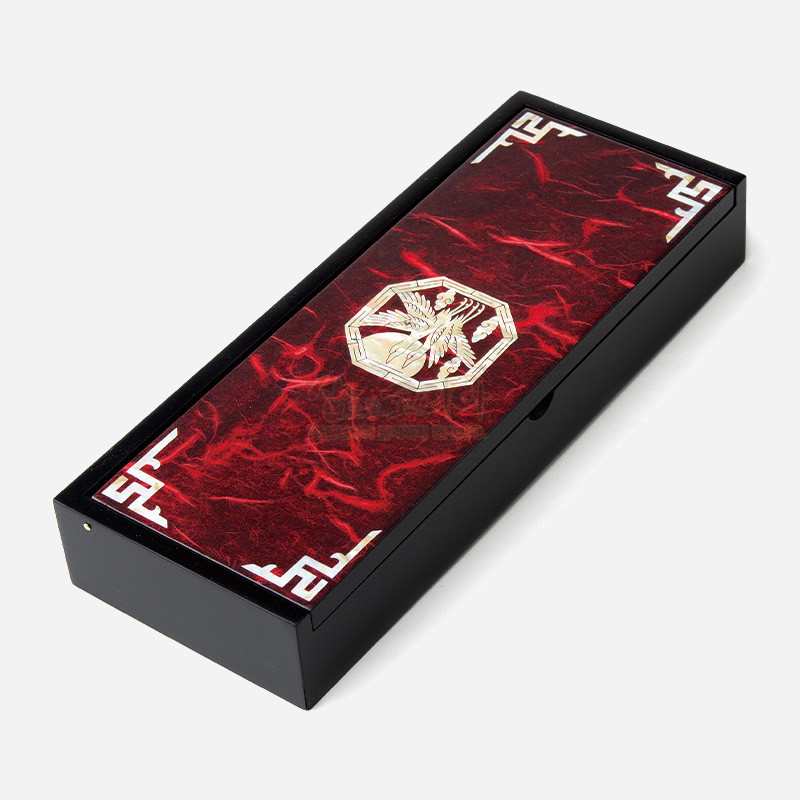
This kind of pilham is not so much a single definitive answer as it is an example of the approach of starting with najeonchilgi through a practical everyday accessory. A bold pattern lends a sense of formality to a gift, but how it feels will vary depending on the user's taste and the atmosphere of their desk. For that reason, it is a good idea to begin by comparing small everyday accessories rather than large decorative objects, and to use that process to get a feel for the shimmer of the mother-of-pearl and the texture of the lacquerwork.
When giving to someone close, think about what they will store inside
When choosing najeonchilgi for family or a long-standing acquaintance, rather than selecting on practicality alone, thinking about what the recipient will actually keep inside makes the decision easier. A jewelry box is used to store personal items such as rings, necklaces, and small mementos, so the meaning of the gift is relatively clear. However, a very elaborate pattern or strong colors can be a matter of personal taste, so it is worth looking at the atmosphere of the recipient's room and their general preference for accessories at the same time. For relationships where you want to show proper respect — a mother, a mother-in-law, a mentor — the finish and the internal storage structure may feel more important than the size.
A small jewelry box type such as the 나전주합정보석함-쌍학 (Naejeon Juhap Jeong Boseokham — Ssanghak; mother-of-pearl round-lidded jewelry box with paired-crane pattern) is a good example to compare between personal use and gift use. It has a traditional pattern that conveys a sense of formality, and if it is not excessively large it is easy to place on a dressing table or display shelf. For a first-time buyer, it is worth checking the internal storage structure, the way it opens and closes, and whether the colors of the pattern suit the recipient's living space. Reviews of traditional craft gifts also include responses noting that packaging and first impressions affected overall satisfaction, so it is worth thinking about the moment of presentation as well.
A jewelry box is both "a beautiful object" and "an object entrusted with personal belongings." For that reason, rather than emphasizing decorative appeal alone, you should think about whether the recipient actually has things to store in it. If the recipient does not use accessories very often, a pilham, a business-card case, or a small frame-style accessory may feel more natural than a jewelry box. Conversely, for someone who enjoys keeping small items organized, a jewelry box is an entry-level choice they can live with for a long time.
When you do not know the recipient's taste, a gift whose use is immediately obvious is easier
When the gift is for someone whose taste you cannot pin down precisely, a product whose use is immediately apparent is more comfortable than one chosen for the meaning of its pattern. A myeonghamham or myeonghamsip (business-card case or business-card holder) is a type that is easy to explain to a working professional, a business contact, or an acquaintance abroad. It retains the feel of a traditional material while having a clear purpose, so the recipient can immediately understand what it is for. That said, because portable accessories are touched frequently, it is worth also checking the finish of the edges and the feel of opening and closing.

A type such as the 나전 명함집 4종세트-기와단청 (Naejeon Myeonghamsip 4-piece set — Giwa Dancheong; mother-of-pearl business-card holder set with roof-tile dancheong pattern) suits formal gift-giving occasions well. A product with a distinctly Korean impression, like the dancheong (traditional multicolored paintwork) pattern, can also become a talking point for an overseas business trip gift or in a business relationship. When you need to prepare gifts of the same character for several people, business-card case types are relatively consistent in size and straightforward to present. However, if the recipient rarely uses business cards, it is better to compare other mother-of-pearl accessories in the same range — such as a hand mirror or a pilham — that they would use more often.
Practical mother-of-pearl accessories reduce the pressure of a first gift, but being small does not mean any product will do. Items that are carried around or touched frequently can be affected in feel by the quality of their finish. Among reviews of portable accessories there are opinions noting that a product was beautiful but the edges felt somewhat sharp, so for products that involve a lot of hand contact it is worth checking the detail photographs and finish information. Especially for a first purchase, thinking about the user's movements and sense of touch before the elaborateness of the pattern is the better approach.
For display pieces, look at the placement spot and the strength of the pattern together
If you want to bring a piece of najeonchilgi into your home for personal enjoyment, the approach of deciding on "where to display it" before "what to use it for" works well. For a small frame, a tray-style objet, or a jewelry box with strong decorative character, the impression it leaves in the space matters more than how often it is used. Placing it where light enters — on a living-room cabinet, a study shelf, or an entryway console — brings out the shimmer of the mother-of-pearl, but in too confined a space the pattern can look cluttered. Rather than going straight to a large objet, it is less daunting to start with a small decorative piece to confirm your taste in patterns before expanding.

A tray-style objet or mini-frame type sits somewhere between practical use and display. A type such as the 나전칠기 오브제-쟁반 정원속 쌍학 (Najeonchilgi Objet — Jaengban Jeongwon-sok Ssanghak; mother-of-pearl lacquer objet, tray with paired cranes in a garden), for example, can be imagined as something to bring out when receiving guests, and at other times can simply be left out as decoration. However, even if a product is called a tray, one with delicate surface decoration is better treated closer to a display piece than an everyday-use item. If you plan to place things on it frequently, you should also consider scratches, moisture, and storage location.
Display pieces involve personal taste to a greater degree than gifts do. The larger the pattern and the stronger the colors, the greater the power to change the atmosphere of a space, so you should think about whether you already have traditional accessories in your home and whether the piece will be placed alongside modern furniture. For a first purchase, it is a good idea to start with a small decorative item or storage box and see how a mother-of-pearl pattern looks in your everyday living space. Once your taste becomes clearer, you can expand toward a tray-style objet or a jewelry box with a larger pattern.
The related products at the end are not a list where each item has been explained as the one correct answer, but rather candidates to compare alongside one another in the same beginner situation. When choosing najeonchilgi for the first time, it helps to first sort out the gift relationship, where the piece will be placed, whether it will actually be used, and how much care it requires — rather than starting from the product name. Once those criteria are in place, it becomes naturally clear which direction to look in first among a pilham, a business-card case, a jewelry box, and decorative accessories.