Shopofkorea guides
Korean Traditional Pattern Office Gifts: Choosing Items That Work Naturally on a Desk
Official product names are shown in Korean. Product pages are in Korean; prices are in South Korean won (KRW).
When choosing Korean-style office accessories for foreign clients or overseas colleagues, it is better to ask first whether the item can be used naturally on a desk rather than how Korean it looks. Even if the traditional pattern is striking, if the size or decorativeness feels like too much, the recipient is unlikely to actually use it; conversely, if the item is too plain, it may leave a weak impression as a commemorative gift.
Dividing situations by the three criteria below makes the choice easier.
- For a formal client: prioritize compositions connected to business settings such as exchanging business cards, meetings, and writing
- For an overseas colleague or visiting researcher: prioritize a size and practicality that will not feel burdensome even when left on a desk for a long time
- For an acquaintance interested in Korean culture: prioritize types whose pattern or material you can explain briefly
- If distributing to multiple people: also check portability, packaging condition, and neatness at the moment of handover
At a first meeting, a composition whose usefulness is immediately visible puts people at ease
At occasions where the relationship is still delicate—such as a client meeting, an academic conference visit, or a return gift after an overseas business trip—it is important that the gift does not feel too personal. Types with a clear purpose in a work setting, such as a business card case and a ballpoint pen, make it easy for the recipient to understand the gift's use right away. Traditional patterns also sit well with a formal impression when placed against a calm background—such as metal, celadon blue, or a baekja (white porcelain) feel—rather than appearing excessively decorative. However, if the recipient is in a profession that rarely uses business cards, or belongs to a casual organizational culture, stationery or desk-organizing accessories may feel more natural than a composition centered on a business card case.
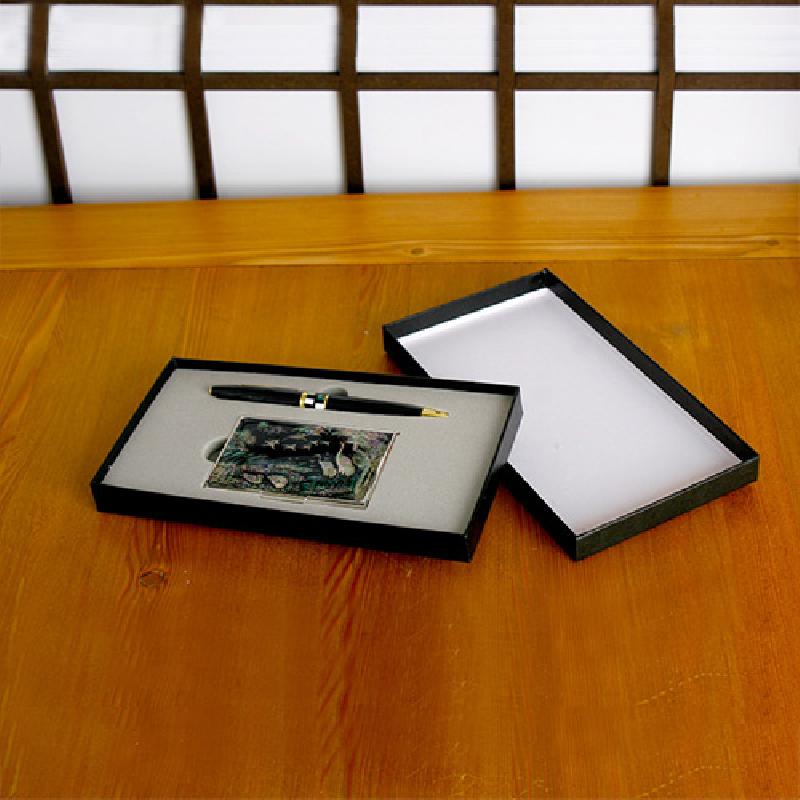
For example, a type such as a business card case and ballpoint pen set featuring a cheonghua-baekja (blue-and-white porcelain) cloud-and-crane pattern is well suited to establishing a sense of formality at the moment of first handover. The meaning connects immediately in a setting where business cards are exchanged, and the pen can continue to be used in the office or meeting room afterward. This kind of set-type gift is appropriate for leaving the impression of "practical office accessories with a Korean pattern" rather than strongly highlighting a single product.

When choosing this type, it is better to be able to add something brief—such as "a design drawn from Korean porcelain patterns"—rather than attempting a long explanation of the pattern's symbolism. The longer the explanation, the more it can burden the recipient, so it is more stable to let the neatness of the packaging and composition be seen first, with the pattern following naturally afterward.
For a desk seen every day, a tidy feeling lasts longer than decoration

For someone who will actually use the item on a desk for a long time—such as an overseas colleague or a visiting researcher—accessories with an organizing function, such as a pen holder (pen-kkoji), a pilham (필함, a traditional brush-and-pen case), or a pencil holder, are a good fit. These types make it easy to imagine right away where to place the gift after receiving it, and they slightly change the atmosphere of a work space without compromising usability. Particularly when the recipient's personal desk is not large, a size that can stably hold a few writing instruments is more manageable than something with an excessive height or a wide decorative surface area. Because traditional patterns with too many colors or strong gloss can clash with surrounding office supplies, you should also check whether the item blends in like a background element on a desk.
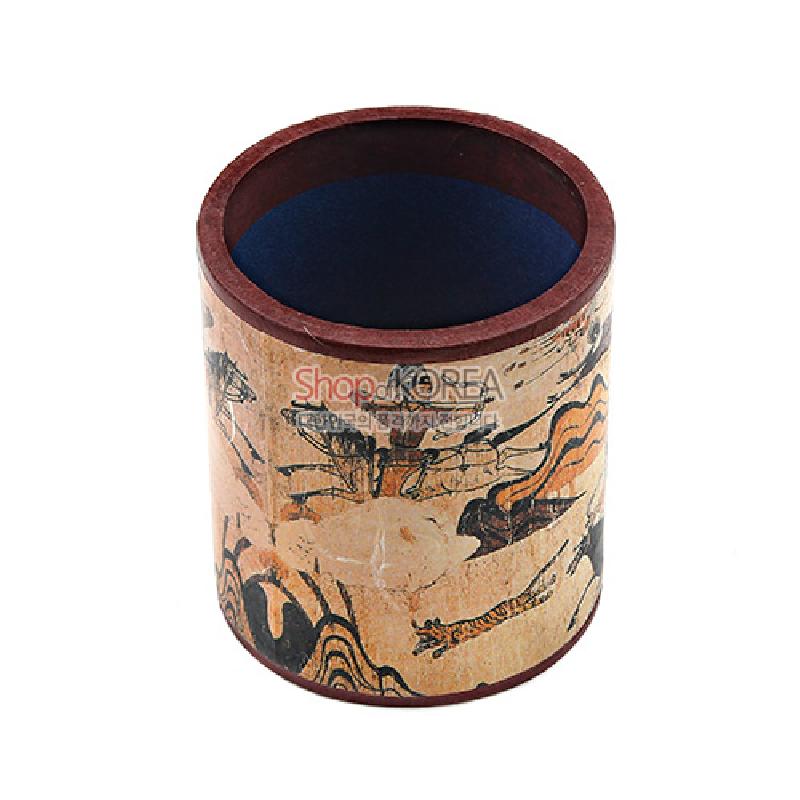
A type such as a pen holder featuring a yeonso-dapcheon (연소답청, a traditional Korean pattern) design is an example that conveys a Korean atmosphere while having a clear purpose. Even if the recipient does not know the name of the pattern, the impression of "a practical accessory from Korea" remains when it is placed on a desk. Because a pen holder is something that is reached for every day, it is used more frequently than a decorative object, and it naturally creates occasions for the recipient to think of the person who gave it.
However, pen holders and pencil holders are greatly affected by the recipient's desk environment. For someone at a company with hot-desking, a space such as a laboratory where it is difficult to keep personal items for long, or a researcher who moves around frequently, a compact set of writing instruments or a business card case may be more convenient. Conversely, for someone with a fixed research office or a private office, this kind of desk-organizing accessory becomes a choice that combines commemorative value and practicality.
For someone interested in Korean culture, a gift that leaves room to explain the material is ideal
If the recipient has shown interest in Korean craft, patterns, or historical imagery, an accessory that allows you to briefly introduce the material or pattern suits them better than simply "a Korean-style design." Elements carrying a Korean image—such as hanji (한지, traditional Korean paper), a mother-of-pearl (jagae, 자개) feel, sanggam (상감, inlay) patterns, or cloud-and-crane (unhak, 운학) and pine-and-crane (songhak, 송학) motifs—lend themselves well to explaining the background of the gift. Here too, the shorter the explanation, the better. The essence of the gift is not a cultural lesson but the fact that a Korean story is layered onto an object that can be used on a desk.
A type such as a pilham with a sanggam pattern can give both the function of organizing writing instruments and the impression of a souvenir. For a visiting researcher or a colleague who stayed in Korea for a period of time, it can become an accessory that is pleasant to keep on a desk even after returning home. For example, a type such as a pilham with an unhak (cloud-and-crane) pattern, where the traditional imagery is clear, conveys a Korean atmosphere without needing to over-explain the pattern.
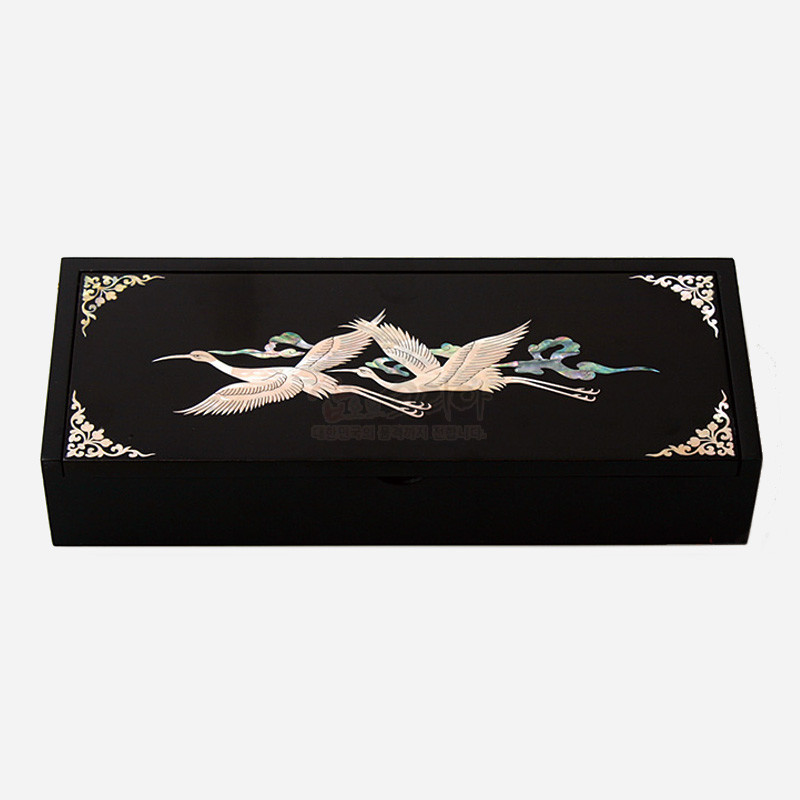
With this type, satisfaction can vary depending on whether the recipient enjoys decorative objects or tends to keep items on their desk to a minimum. For someone who values practicality more, a ballpoint pen set or a small business card case is more convenient than a pilham, and for someone who values commemorative quality more, a desk accessory with a somewhat more prominent pattern is also fine. What matters is not the product's traditional character but whether it will feel out of place when it enters the recipient's space.
The more you want a lasting impression, the more you need to calibrate the scale of presence
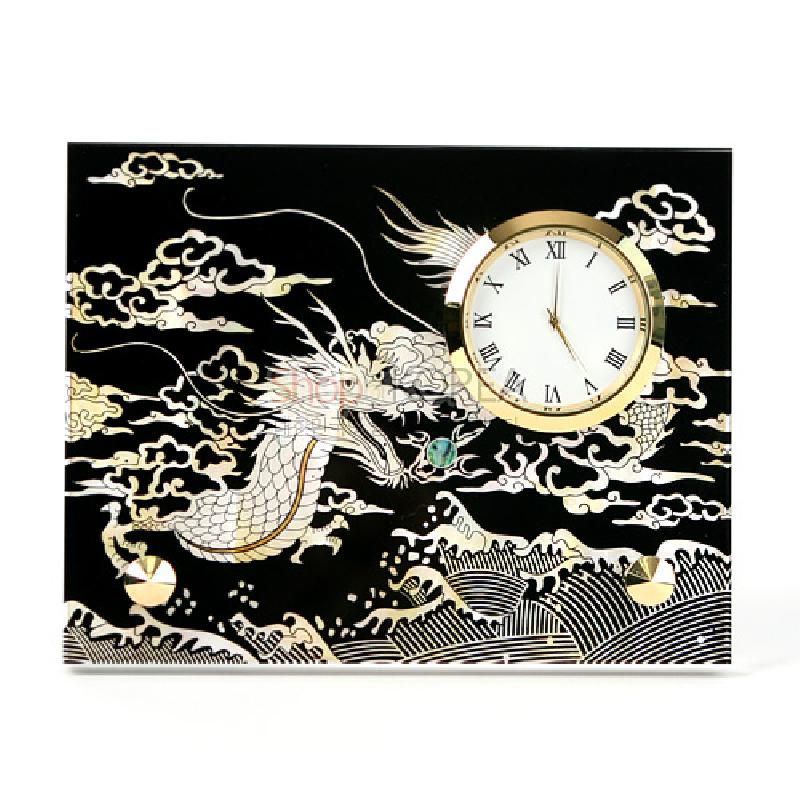
Desk clocks and decorative desk accessories have the advantage of leaving a long-lasting presence as a gift. However, the stronger the presence, the more the item depends on the recipient's taste and space. It may be a good fit in cases where there is a clear place to put the item—such as the office of a formal client's representative, a personal research office, or a reception area—but in a general office seat or a work environment with frequent movement, it may feel like too much. For this reason, with decorative accessories it is better to first determine whether "a long-lasting commemoration" is needed or whether "everyday practicality" is more important.
In reviews, there were assessments that an item felt appropriate to hand over casually while also conveying a sense of Korean pattern and practicality, and in other cases there were reactions that the neat packaging made it well received at a gift-exchange occasion. As this shows, how the recipient actually receives the gift is influenced more by the setting of handover and the clarity of purpose than by the size of the product. If you need to prepare gifts for multiple people, it is worth comparing portable writing instruments or set-type accessories; if you want to leave a slightly stronger expression of gratitude for one person, compare desk accessories that will be placed on a desk.
The related products at the end are not a list that simply repeats the products mentioned in the body text but are candidates to compare alongside them in the same situation. The appropriate type differs depending on whether the gift is for a formal meeting, a gift to be used for a long time on a personal desk, or a souvenir whose Korean pattern can be explained briefly. If you look first at the formality of the relationship, the desk environment, and the restraint of the pattern rather than at the product name, you will find it easier to choose Korean traditional pattern office accessories naturally.