Shopofkorea guides
Choosing Traditional Korean Display Pieces That Fit Naturally into a Home Abroad
Official product names are shown in Korean. Product pages are in Korean; prices are in South Korean won (KRW).
When adding a Korean atmosphere to a home abroad, it is better to start by asking "In which space of that home will this look natural?" rather than "How traditional will it look?" The type of piece that suits the situation varies depending on how well the recipient knows Korean culture, whether the home's interior is on the tidy side, and whether there is wall space available for hanging.
- For a spacious living room or entryway: wall decorations or decorative plaques that are easy to recognize from a distance
- For a desk, shelf, or study: three-dimensional decorations that are small and easy to explain
- For a casual housewarming gift: small functional pieces featuring traditional patterns
- For a home with a modern interior: pieces with restrained color and visible material texture
When you want a distinctly Korean first impression the moment the door opens
In places where the eye lands first—such as an entryway or hallway—pieces whose meaning is immediately readable when hung on a wall or stood upright tend to work better than overly large decorations. Homes abroad often have bare walls, so even a small framed traditional pattern or wall-hanging decoration can change the atmosphere. However, placing several strongly colored pieces together at once can make them look disconnected from the rest of the home's interior, so it is safer to start with just one piece as an accent. It is worth looking first at types that have a clear Korean element—traditional patterns, hanbok imagery, or a fragrance-pouch form—without being excessive in size.
For example, a type such as 전통무늬 향 액자-연꽃,귀면문[황색] (a traditional-pattern incense frame featuring lotus and dokkaebi-mask motifs, in yellow) can be hung without difficulty near a wall or entryway, and serves as a reference point when you want to add a small Korean first impression to a home. When the pattern itself carries visual strength—as with the lotus or the dokkaebi-mask (gwimyeonmun) motif—the impression of "Korean decoration" is conveyed relatively easily even if the recipient does not know the detailed meaning of Korean patterns. Because pieces like this do not take up much space, they are also suitable for situations where the display location is hard to know in advance, such as a homestay, a casual visit, or a housewarming for a foreign acquaintance. However, if the home already has many wall decorations, it is better to choose a pattern-based piece with a calm tone rather than one with vivid colors.
Rather than treating any single product as the only correct answer, this type is best understood as a criterion for choosing "a decoration that can be hung on a wall, shows a Korean pattern at a glance, and is not excessive in size." In reviews from people who deliberated over how to share something Korean, there were accounts of receiving reactions that the colors were beautiful; in overseas spaces, this kind of first impression reduces the burden of having to explain the gift. If the recipient is encountering traditional pieces for the first time, a piece whose color and form are read before its symbolism is more approachable than one with overly complex symbols. Conversely, for someone with a deep interest in Korean culture, choosing a product whose pattern's meaning can be briefly explained makes the moment of giving feel more natural.
When you want to add an accent to one side of the living room without disrupting the home's atmosphere
Because the living room is the space that remains visible the longest in a home, the stronger a piece's traditional character, the more important it is to consider its balance with the surrounding furniture. Pieces with a distinctly Korean image—such as saekdong (multicolored stripes), hanbok, minhwa (folk painting), or traditional scenery—draw the eye even when there is just one. So when choosing something for the living room, "Does it float apart from the existing furniture?" matters more than "Is it elaborate?" In a home with white walls, wooden furniture, and calm fabrics, a colorful wall-hanging piece can serve as an accent, but in a home that already has many decorations, a smaller size or simpler form is better.

A type such as 전통벽걸이 향주머니-색동저고리 (a traditional wall-hanging fragrance pouch in a saekdong jeogori form) is a useful reference when you want to convey a Korean atmosphere intuitively, because the colors and form of hanbok are immediately visible. Particularly when giving to a foreign family or acquaintance, there is the advantage that the piece is visually understood without needing a long explanation of what cultural image it represents. However, because saekdong-style pieces can look cheerful and bright in some spaces and somewhat eye-catching in others, the recipient's taste should also be considered. It suits someone who likes traditional decorations or displays travel souvenirs at home, while for someone who prefers a minimal interior it is better to compare more restrained, pattern-based pieces.
Wall-hanging pieces like this also sit well not only in the living room but at the entrance to a study, in a hallway, or in a guest room. What matters is "Is the Korean element clear?" and "Can you easily picture where to hang it?" To keep the recipient from wondering where to put the gift after receiving it, a type that can be added lightly to one side of a wall is more convenient than something too large. Just as reviews describing satisfaction with decorating a home with Korean items note, whether something has a traditional feel while also harmonizing well with a contemporary space is a particularly important criterion in overseas living spaces.
On desks and shelves, small decorations with something to talk about are more comfortable
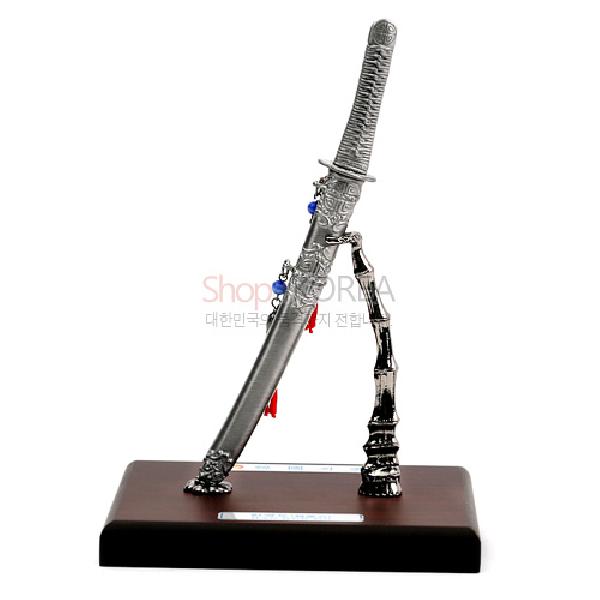
In spaces viewed up close—such as a study, bookshelf, or console table—three-dimensional decorations or small decorative plaques work well. If wall-hanging pieces set the mood for the whole space, pieces on a shelf become small conversation starters that visitors can look at closely and ask about. Pieces with material presence—brass, wood carving, pewter—have a sense of presence even when small, and forms that capture traditional everyday tools or Korean scenery are also easy to explain. However, for a gift intended for a desk, it is better to avoid decorations that are too heavy or bulky, and to look for types that are not burdensome to move or clean.

For example, a type such as 소품 장식-황동지게 (a small decorative piece — brass jige, a traditional Korean A-frame carrier) is a display piece that shows the image of traditional Korean daily life in three dimensions. The jige as a subject may be unfamiliar to foreigners, but that is precisely what makes it easy to accompany with a brief explanation. Because decorations like this serve more as objects for appreciation and conversation than for practical use, they suit the recipient better when that person enjoys objects with a handcrafted feel or a cultural story behind them. Conversely, for someone who strongly prefers practical gifts, it is better to compare pieces such as memo-magnet clips that have everyday utility.
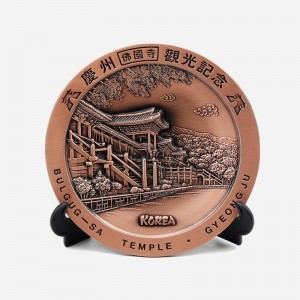
Shelf decorations need a distinct form within a small size. Pewter decorative plaques featuring Korean scenery, location-specific plaques such as one depicting Gyeongju Bulguksa, and freestanding traditional decorations can all be compared against the same criterion: "a piece that can be stood upright and viewed." If there is a relational context—such as a couple or a new-home visit—decorations depicting a scene, such as Gyeonghoeru or a bride-and-groom image, also become candidates. However, when the recipient's religion, home decoration preferences, and available display space are unknown, products centered on Korean scenery or patterns are more universally suitable than those with strong specific symbolism.
When you want to give something light, look at the balance between decorative and practical
When passing something along casually to an acquaintance abroad, or when you need to distribute among several people, there is no need to look only at strongly decorative products just because the purpose is display. Small pieces usable around a refrigerator, a memo area, or a desk can also add a Korean atmosphere naturally to a home. Practical small pieces featuring traditional patterns—such as 민속 메모자석집게 (folk memo-magnet clips)—carry less burden around "where to put this," and have the advantage that the recipient can start using them in daily life right away. In actual reviews, there were reactions noting that they were easy to choose as a light gift and could be given without pressure to someone who appreciates practicality.
In this case, portability, the location of use, and preparing the right quantity become more important criteria than elaborate decorativeness. Especially when items need to be carried overseas or shipped, pieces with a low risk of breakage and a small volume are more convenient. However, choosing only very small souvenirs can weaken the impression of the gift, so if the relationship with the recipient is on the formal side, it is worth comparing a small practical piece alongside a decorative plaque or wall-hanging piece. The related products at the end are not simply a repetition of the products mentioned in the body; they should be seen as candidates to compare side by side in the same Korean home-decorating situation, in terms of size, material, and atmosphere.
For traditional pieces suited to a home abroad, the location where they will be placed comes before the product name. The choices become considerably clearer when divided by criterion: for the entryway, a wall decoration that makes an easy first impression; for the living room, an accent piece that does not disrupt the space; for the study and shelves, a decoration with a story to be seen up close; and for a light housewarming gift, a small piece with practical utility.