Shopofkorea guides
How to Choose Small Korean Gifts with Hanbok Motifs
Official product names are shown in Korean. Product pages are in Korean; prices are in South Korean won (KRW).
Small Korean gifts featuring hanbok motifs have the advantage of conveying Korean colors and lines without the burden of gifting actual clothing. However, the right form varies depending on whether the recipient is a foreign friend, a professional colleague, or a brief visitor. If you first consider the closeness of the relationship, the formality of the occasion, and a size that is easy to use or store, the choice becomes much simpler.
- For a foreign friend: a small accessory with bright colors that is easy to explain as hanbok
- For an overseas colleague: a practical type that can be used comfortably at a desk or in daily life
- For a visiting guest: a small souvenir with neat packaging and a tidy first impression
- When distributing to multiple people: a type that is compact and easy to prepare in matching quantities
- If travel or a return trip is involved: a form with low risk of breakage and minimal luggage burden
When you want to convey a distinctly Korean impression at a glance
For a close foreign friend or a student you have an exchange with, the impression that is immediately understood matters more than the formality of the gift. Hanbok motif gifts carry the bright colors of saekdong (traditional multicolored striped fabric), the lines of the jeogori (upper garment) and chima (skirt), and the silhouette of traditional dress in a small form, so a Korean atmosphere is conveyed without lengthy explanation. In this case, small accessories that can be attached to a bag, keys, or a pouch are less burdensome than items that are overly decorative. However, products with strong colors may feel toy-like depending on the recipient's taste, so if the relationship is quite formal, it is better to look at a slightly more understated type.
For example, a type such as a saekdong hanbok keyring immediately shows the colors of hanbok, and the context for using it is straightforward, making it easy to hand over casually. As reflected in reviews from people who found small, meaningful Korean gifts to distribute to foreign friends before departing the country, what matters more for these small accessories is whether they suit the situation of giving rather than how much explanation they require. For a friend, briefly adding something like "colors drawn from Korean traditional dress" keeps the gift from feeling overly heavy. When multiple items need to be prepared, individual accessory forms are also easy to distribute to each person.
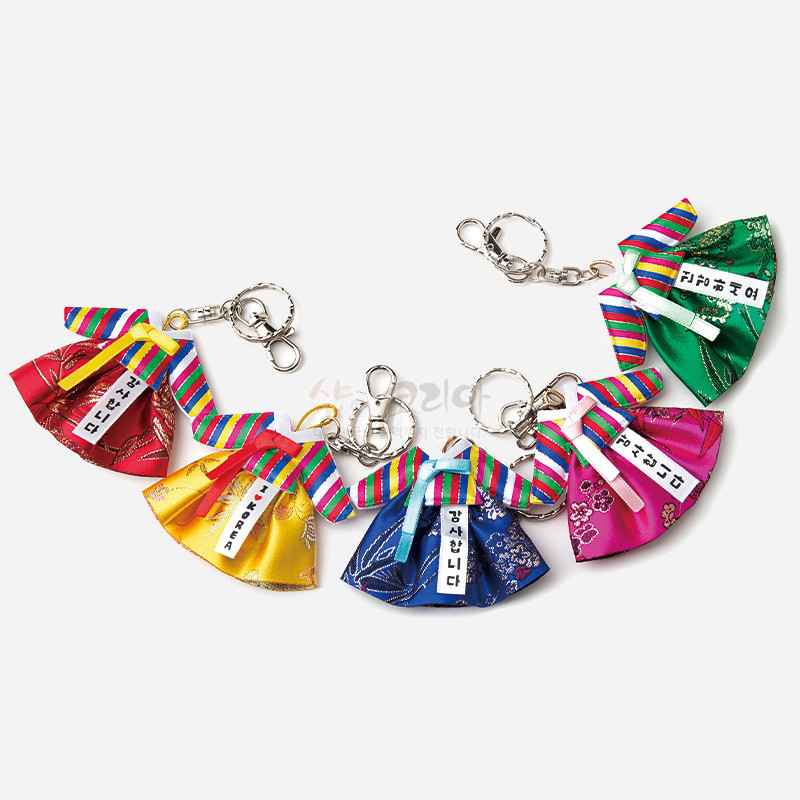
This does not mean a keyring is the only right answer in this category. In the same context, small magnets, stickers, and bookmarks that show the colors and forms of hanbok while being easy to place in everyday life can also be compared alongside it. What matters is whether the recipient immediately understands the meaning of the gift and whether it can be packed without burden even among luggage on the way home. If bright colors suit the relationship, look toward saekdong-style items; if you want a slightly calmer impression, you can narrow it down by looking at accessories with a subtle dangui (a type of traditional upper garment) or traditional pattern.
In a professional relationship, it is reassuring when the usefulness is apparent

Small Korean gifts given to overseas colleagues or business counterparts do not need to feel overly personal. Practical types such as ballpoint pens, memo accessories, and bookmarks that can be used at a desk or taken out during a meeting without awkwardness carry less risk. Even with a hanbok motif, if the colors and imagery are not excessively large but are neatly composed alongside Seoul imagery or traditional patterns, they are more comfortably received in a professional relationship. Especially at a first meeting, it is better to prioritize a tidy first impression over a cute, strongly character-driven item.
For example, a type such as a pen set featuring hanbok and Seoul imagery together shows both Korean elements and practical usability. The advantage is that the recipient can use it right away, and it does not feel excessively souvenir-like even when left on a desk. In such cases, rather than giving a lengthy explanation, saying something like "a small souvenir featuring the colors of Korean traditional dress and Seoul imagery" is sufficient. However, for a very formal institutional visit or an official occasion of appreciation, it is also good to check the neatness of the packaging and the composition.
In a professional gift, it is better for the hanbok motif to function as a small cultural element that reduces the burden of conversation, rather than becoming the centerpiece of the gift. So when choosing a practical type, look first at forms such as stationery, desk accessories, and thin bookmarks that the recipient can use without having to express strong personal taste. Conversely, decorative dolls or accessories in very vivid colors are fine for close relationships, but in formal relationships they may feel burdensome to place in the other person's space. The further the relationship, the better it is to look first at "easy to use or store" rather than "pretty."
For visiting guests, a gift that comes with a brief explanation is ideal even if it is small
A gift given after a brief encounter—such as a homestay, a school exchange, or a company visit—should be something the recipient can recall the meaning of later, even when looking at it alone. In this case, accessories where the form of hanbok is clear, or where the composition of male and female traditional dress is visible, are easy to explain. Bookmarks are compact, have a low risk of breakage, and can be stored tucked between books or notebooks, making them a safe choice for a visit gift. However, if the recipient is in an environment where they rarely use books, it is also good to compare types with a wider range of uses, such as keyrings or magnets.
For example, a bookmark type featuring a traditional hanbok composition is well suited to introducing the lines and forms of hanbok. As seen in reviews noting it was used in cultural lessons, an image that shows hanbok being worn beautifully can serve not only as a gift but also as a small reference for explaining Korean culture. For a visiting guest, briefly saying "a bookmark motif based on Korean traditional dress" keeps it unburdensome, and the context of the gift comes across naturally. The small size also makes it convenient to prepare for multiple people, but when selecting items that are very thin paper-based products, it is good to also look at packaging that prevents creasing.
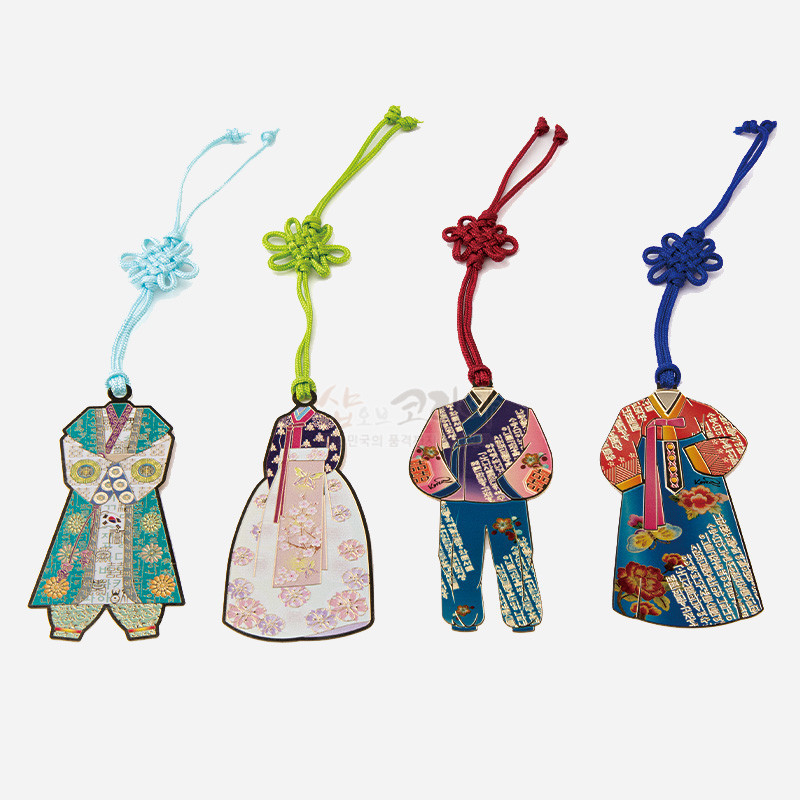
This type of bookmark gift tends to be easy to keep as a souvenir regardless of whether the recipient actually reads books. However, for very young students, stickers or keyrings may feel more fun than paper-based items, and for working adults, stationery or pens may seem more practical. Therefore, when choosing a gift for a visiting guest, do not look only at how clearly the hanbok image appears, but also think about where it can be placed after it is given. Choosing something small that comes with a brief explanation means the intention of the gift remains relatively clear even after a short encounter.
When distributing to multiple people, uniformity is more convenient than prettiness
When distributing to many people—such as at a group visit, an overseas business trip, an exhibition, or a class—preparation becomes more complicated if each gift is too different in character. In this situation, small gifts where the hanbok motif is clearly visible and the size and form are consistent are more convenient. Types that are compact and easy to hand out, such as stickers, bookmarks, and keyring sets, are also less burdensome for recipients. As actual reviews note reactions such as it being a size that was small and easy to give lightly, reducing the burden of size is an important criterion for group gifts.
However, when giving the same gift to multiple people, types with a wide range of uses are safer than decorative items that are too dependent on personal taste. Accessories with strong decorative character, such as hanbok dolls, can be memorable, but when quantities are large or the itinerary involves long travel, storage and transport must be checked first. Conversely, stickers and postcard-type items are lightweight but may feel somewhat simple as standalone gifts, so supplementing the sincerity through a message card or packaging method is a good idea. The related products listed at the end are not a collection of only the products described in the main text, but rather candidates to compare alongside one another in the same situation in terms of color, size, and practicality.
Choosing a hanbok motif gift is less a matter of selecting a showy product and more a matter of adjusting the appropriate level of burden to suit the recipient and the occasion of giving. For a close relationship, look first at bright colors and a form that is immediately recognizable; for a professional relationship, look first at practicality and neatness; and for a visiting guest or a group gift, look first at portability and a composition that is easy to explain. If you establish these three criteria before the product name, even a small gift can naturally convey a Korean impression.