Shopofkorea guides
How to Choose a Korean Gift for an International Conference Presenter
Official product names are shown in Korean. Product pages are in Korean; prices are in South Korean won (KRW).
Choosing a gift for an international conference presenter calls for a little more care than selecting an ordinary souvenir. Recipients are often overseas researchers, and the setting—a reception, closing ceremony, or institutional visit—tends to be formal. In these situations, asking three questions first makes the choice much simpler: 'Does it convey a Korean meaning without feeling burdensome?' 'Is it easy to carry home?' and 'Can it sit naturally on a desk or in a lab?'
- For a keynote speaker or lead presenter: prioritize formality and durability
- For a visiting researcher or collaborator: prioritize practicality for long-term desk use
- When distributing gifts to multiple presenters: prioritize consistency in size, weight, and composition
- When handing over the gift before the recipient departs: also check the risk of breakage and the bulk of the packaging
For a lead presenter, the weight of gratitude should linger quietly
For a keynote speaker or specially invited presenter, the gift itself stands in for the message: 'Thank you for playing such an important role at this event.' That is why a craft-style gift that can be kept tends to work better than an everyday consumable. That said, for a conference gift, a type that displays clear Korean patterns and materials yet can be placed neatly on a bookshelf or in one corner of a lab is more reliable than a decorative item that depends heavily on personal taste. If a presentation photo will be taken or the gift is being given in the name of an institution, the quality of the packaging and the overall visual composure should also be considered.
For example, a jadong-ham (자동함, an automatic-lid decorative box) set with sanggam (상감, inlaid) patterns is a useful reference point for explaining the standard of a keep-worthy craft gift for a lead presenter. A gift in box form can be placed on a desk or in a study even if it is not used immediately, and the pattern conveys a distinctly Korean impression. When choosing this type, it is worth checking that the size is not too large and that the recipient can carry it without worrying about breakage while traveling.
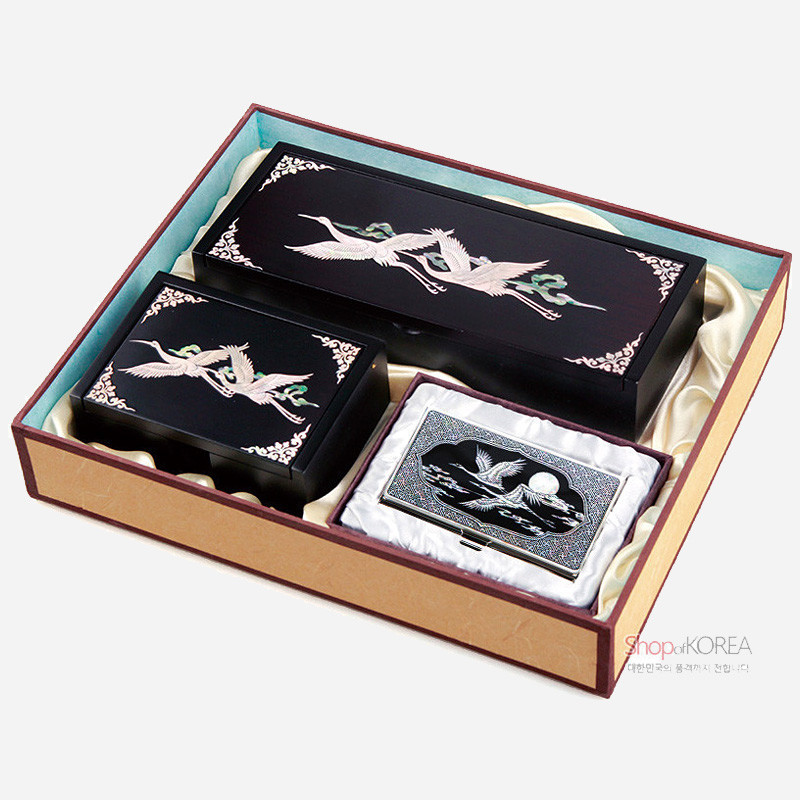
This kind of keep-worthy gift is especially reliable when expressing sincere gratitude to a single person. Conversely, if the same gift must be distributed to several people at once, balancing bulk and budget can become a burden; in that case, it is natural to scale down to smaller stationery items or business-card accessories that share the same Korean patterns. Since the formality of a gift is not determined by size alone, preparing a conference name card or a thank-you message alongside it can add an official touch without going overboard.
When business cards are being exchanged, practicality is what gets remembered

At international conferences, networking, institutional meetings, and discussions about joint research often follow the presentations. In that context, a gift whose use is immediately obvious—such as a business card case or a ballpoint pen—is easy to explain to the recipient. Even if it features Korean patterns, a clear function reduces the sense of burden that a purely decorative item can carry. When giving a gift to an overseas researcher you are meeting for the first time in particular, the quality of being 'a souvenir you can actually use' helps maintain an appropriate degree of relational distance.
A business card case and ballpoint pen set is a good example for this kind of situation. Exchanging business cards happens naturally at a conference venue, and a writing instrument has practical use for taking notes during sessions or while on the move. Types featuring traditional patterns such as songhak (송학, cranes among pines) or unhak (운학, cranes among clouds) give a Korean impression while retaining the form of a business accessory. Actual gift reviews also confirm reactions along the lines of: it felt refined when giving it to an overseas professor, and it was easy to hand over without any awkwardness.
That said, even a practical gift can end up being used less often if its color or decoration is too strongly tied to personal taste. For conference presenter gifts, it is better to prioritize a neat pattern over showiness, a size that feels right in the hand, and stable packaging. Even with the same composition, a business card case on its own is convenient for distributing to multiple people, while a ballpoint pen set can give a slightly more considered impression when presented to a lead figure.
If you want it to stay in the lab for a long time, picture where it will sit on the desk
For a visiting researcher or collaborator, the scene of use after the handover matters just as much as the formality of the moment itself. A gift that fits naturally into a space where someone spends a long time—a lab desk, a personal study, an office shelf—keeps the meaning of the occasion alive over time. In this case, a pilham (필함, a pen or writing-instrument holder), a stationery organizer, or a small desk accessory that has a traditional craft feel but a clear purpose is a reliable choice. If the decorative quality is too strong, it may not suit the recipient's personal space, so it is better to choose something that combines function and symbolism.
A stationery-organizer piece such as the 상감자동필함 (sanggam jadong pilham, an inlaid automatic-lid pen holder) is a fitting example for an academic exchange setting. Because it is used to organize writing instruments and small office supplies, it is easy to explain to a researcher, and a design featuring Korean symbols such as the unhak (운학, cranes among clouds) pattern conveys the meaning of a keepsake naturally. As one review puts it, 'it is well suited to introducing Korean culture and the meaning of a souvenir comes through naturally'—this type works best when the context of giving it is alive alongside the object itself.
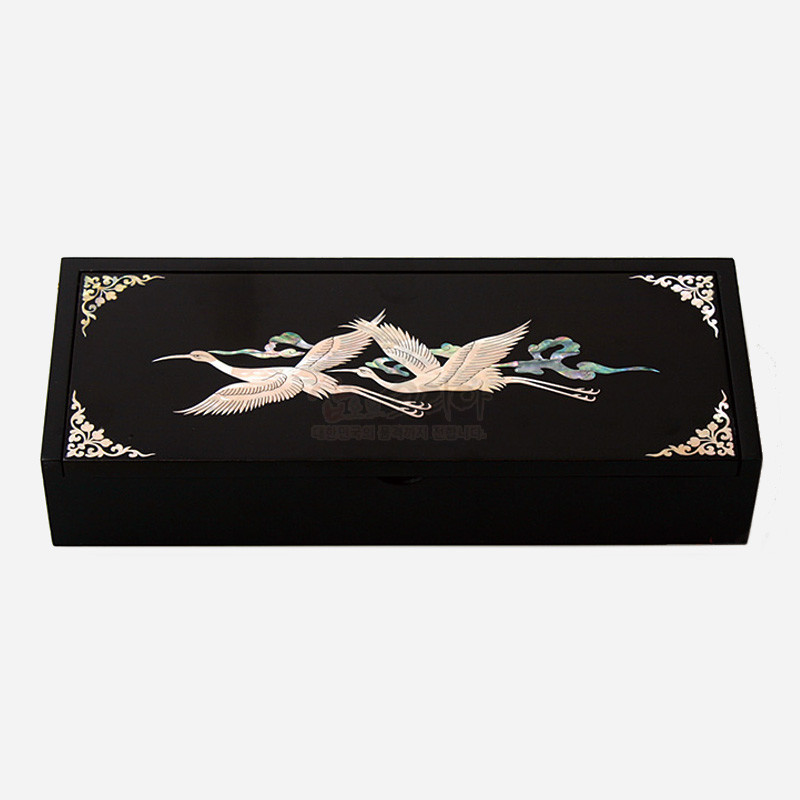
When choosing this type, it is also worth confirming whether the recipient is about to fly home. A pilham or decorative accessory may take up more space than small stationery items, so if air travel is planned, packaging stability and portability should both be checked. On the other hand, if there is a dedicated handover moment during an institutional visit and the gift is being prepared carefully for one or two people, a desk accessory that remains on the desk helps keep the impression of gratitude alive for a long time.
For multiple presenters, what matters is that every gift feels chosen by the same standard
When preparing gifts for several people—session presenters, panelists, discussants—the overall balance matters more than the formality of any single gift. If one recipient appears to receive a noticeably larger gift, a sense of difference can be felt regardless of intent. In this case, small souvenirs with little variation in size and composition that are easy to carry—such as bookmarks, ballpoint pens, business card holders (명함집), or eyeglass-cleaning cloths—are appropriate. The key is that the Korean symbolism is clear while the item does not become a burden to carry.
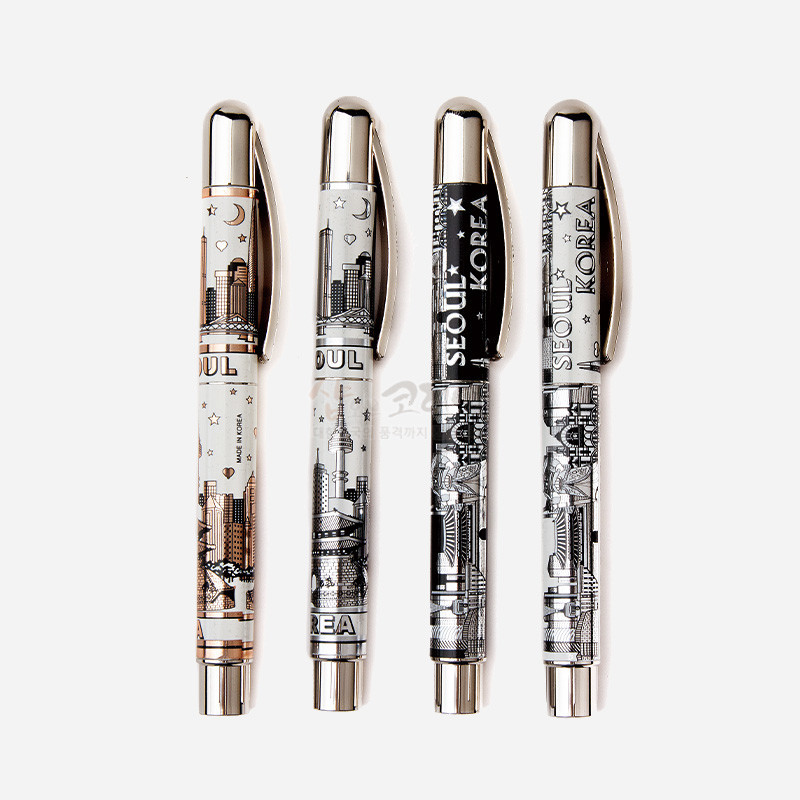
For example, types such as a gold-decorated bookmark (금장 책갈피) or a Korean-culture bookmark-and-pen set pair well with an academic event. Because they connect naturally to a setting where books, papers, and reference materials are handled, the meaning of the gift is easy to explain, and distributing the same item to multiple people by the same standard is not burdensome. Lightweight accessories such as a Seoul-landmarks pen or a traditional-pattern eyeglass-cleaning cloth can be handed over relatively easily even to recipients who have a lot of luggage before departing. However, if only very small items are prepared on their own, they may appear too slight as a formal thank-you gift, so it is better to vary the composition according to each recipient's role.
The related products at the end are not simply a re-listing of the items mentioned in the body; they are candidates to compare in the same international conference or institutional thank-you context. Keeping the following criteria in mind will prevent second-guessing: for a lead presenter, look for keep-worthiness and formality; for a visiting researcher, look for usability on a desk; for multiple recipients, look for portability and consistency. If you clarify the handover scene and the recipient's travel situation before thinking about product names, it becomes much easier to choose a gift that leaves a Korean impression without feeling like a burden.