Shopofkorea guides
How to Choose Understated Korean Souvenir Gifts for a First Meeting with an Overseas Business Partner
Official product names are shown in Korean. Product pages are in Korean; prices are in South Korean won (KRW).
When choosing a gift for a first meeting with an overseas business partner, the first question to ask is not "does this look like a good Korean souvenir?" but rather "will this be comfortable to give?" At a first encounter, a gift that is too large or too decorative can make the recipient self-conscious about storage and reciprocation, while one that is too modest can blur the significance of the occasion as a formal business greeting.
- If giving to a president or executive: a small item with a tidy presentation and clear symbolic meaning
- If distributing to several working-level staff: a small item that is easy to carry and easy to prepare in quantity
- If handing over during a brief visit: a compact item that requires little explanation
- If you want to leave a Korean impression: an item whose pattern you can describe in a few words
When you want to observe formality at a first greeting without creating pressure to reciprocate
For a gift given for the first time to a business counterpart's president or decision-maker, a composed impression matters more than size. A practical desk item that the recipient can understand on the spot and store without inconvenience is a safe choice. Items such as a business card case or a ballpoint pen set connect naturally to the meeting setting, making the context of "the start of a business relationship" feel unforced. That said, overly ornate decorative pieces or craft items that require lengthy explanation are best avoided at a first meeting, as they depend heavily on the other person's personal taste.
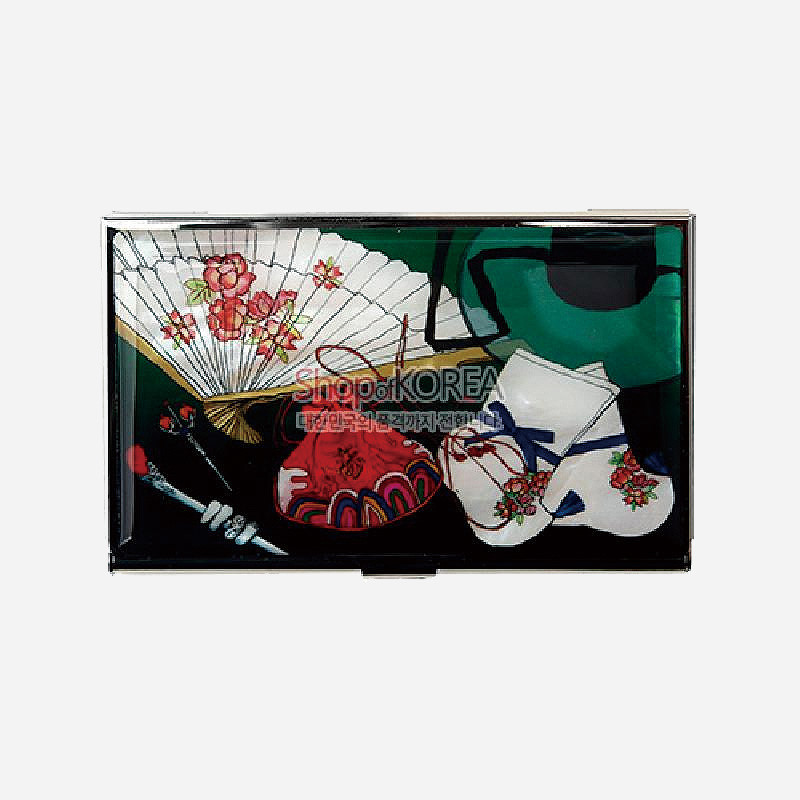
For example, a jogakbo (조각보, traditional Korean patchwork textile art)-style set that combines a business card case, a writing instrument, and a key ring covers several uses at once without making the moment of presentation feel excessive. The jogakbo pattern gives a Korean impression, yet the items themselves are familiar accessories in a business setting, so the recipient can immediately understand their purpose. This type of gift can be introduced briefly as "a practical office item featuring a traditional Korean pattern," which suits a first meeting well without requiring a long explanation.

With a set-style gift like this, it is worth considering the balance between packaging and contents together. Checking whether the items are ones the recipient will actually use, whether they are easy to store on a desk or in a bag, and whether they feel appropriate alongside business card exchanges and company introductions will make the choice more reliable. However, if the recipient's company has strict gift-acceptance policies, a set with a simpler and smaller configuration may be the better option.
When distributing to multiple people, what matters is whether the same impression is conveyed consistently to everyone

In situations where gifts must be distributed to several people—such as at a working-level meeting or a trade show consultation—the uniformity of the overall presentation matters more than the individual impact of each gift. If one person appears to receive a noticeably larger gift, or if some recipients feel they have been given a different item from the others, it can create unnecessary awkwardness at a first meeting. In such cases, it is best to prioritize a small, flat form factor, packaging that fits easily into a bag, and a purpose that is not strongly tied to gender or job function.
A set bundled as practical office accessories—such as a business card case and a 2-piece ballpoint pen set—is relatively reliable for team-wide distribution. A pattern like jogakbo-dancheonghwa (조각보단청꽃, a design combining jogakbo patchwork with dancheonghwa, the traditional multicolored decorative painting used on Korean architecture) is distinctly Korean, yet the items' use is professional, so recipients can immediately tuck them into a desk drawer or travel bag. Reviews from people who prepared these as gifts for business partners' staff during overseas business trips also noted that the packaging, which evokes the feel of traditional Korean hanji (한지, traditional Korean paper made from mulberry bark), was well received as something appropriate to present in a professional setting—confirming the advantage of practical gifts with understated packaging.
When distributing to multiple people, portability and the ease of repeated presentation matter more than the vividness of the pattern. Even a small item can become cumbersome to manage in transit if its packaging is too thick or its structure is fragile. In addition, if the number of attendees at a meeting is not confirmed in advance, writing instruments, business card holders, and bookmarks that are suitable for anyone are easier to manage than gifts that appear intended for a specific rank.
For a brief visit or on-the-go handoff, a gift that needs little explanation is more convenient
When traveling directly from an airport, when meeting time is short, or when visiting multiple locations in succession, both the bulk of a gift and the length of explanation required can become burdens. In these situations, an item that the recipient does not need to spend time examining on the spot is preferable. A form that carries a clear Korean pattern but requires no separate instructions on how to use it makes the moment of presentation comfortable. Fragile materials, liquids, and large decorative items are best avoided for business trip gifts that involve a lot of movement.
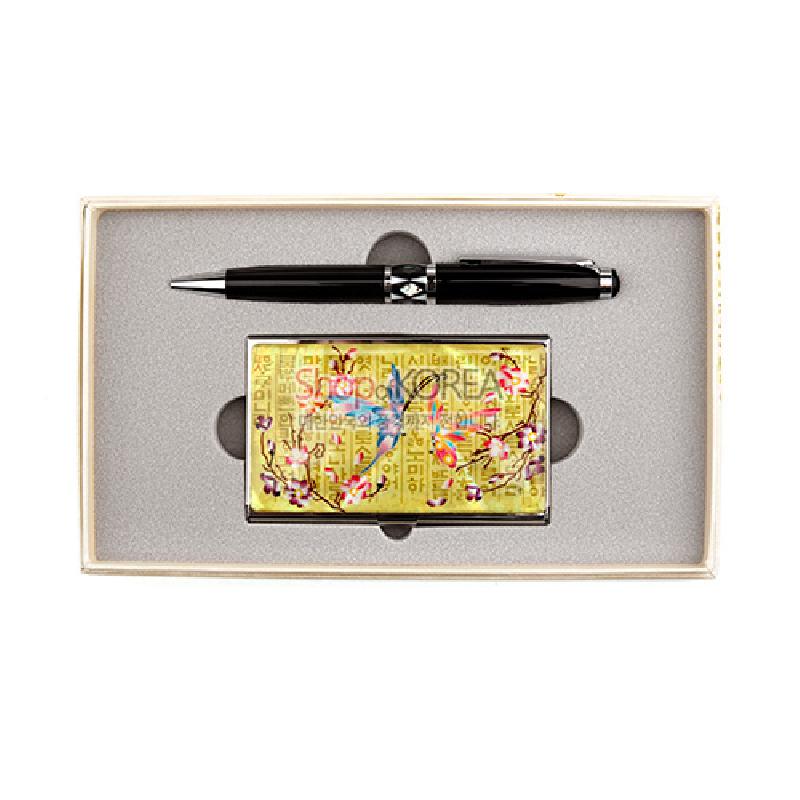
A business card case and ballpoint pen set featuring a Hangeul (한글, the Korean alphabet) motif can be introduced briefly as "a design drawn from Korean script," making it easy to convey meaning at a first greeting. Because the items themselves are for professional use, the recipient has little need to wonder what to do with the gift, while the pattern serves to leave a Korean impression. In particular, even for recipients who are not familiar with Korean culture, the element of Hangeul tends to be remembered intuitively.

This type of gift is also convenient for the person presenting it. There is no need to prepare a lengthy product explanation, and the gift can be handed over naturally just before or after a business card exchange or the start of a meeting. However, products that feature large Hangeul lettering or traditional patterns may come across as decorative depending on the atmosphere of the recipient's company and their role, so for conservative meetings in finance, legal, or public-sector contexts, it is advisable to choose a version with more subdued colors.
It is better for a Korean impression to linger in memory than to appear striking in the moment
In a first-meeting gift, more Korean elements are not necessarily better. When there is one material or motif that the recipient can understand immediately, and that motif connects naturally to the item's purpose, the impression lasts longer. Elements such as jogakbo, dancheonghwa, Hunminjeongeum (훈민정음, the Korean royal proclamation that introduced the Hangeul alphabet), and celadon (청자, Korean celadon pottery) patterns are all suitable because they can be explained briefly, but when too many symbols are crowded into a single product, the overall impression can become cluttered. The ideal gift explanation is one that can be completed in a single sentence.
For instance, a business card case or ballpoint pen set in a celadon cloud-and-crane pattern (청자 구름학문), a Hunminjeongeum design, or a jogakbo style are not all equally correct answers—they are candidates to choose among depending on the tone of the meeting. For a composed, managerial-level meeting, a stable pattern such as celadon or dancheonghwa is fitting; if you want to leave a somewhat more distinct impression of Korean culture, a version with a Hangeul motif is also a good option. If there is a strong likelihood that the relationship will develop into a close working one, a practical item with a clear use case—such as a writing instrument—feels more natural.
The related products at the end are not a definitive list of the only correct answers for the situations described in this article; they are candidates to compare side by side in terms of formality, portability, and Korean impression for the same first-meeting context. If you first clarify the recipient's rank and the number of people, the location of the handoff and the travel itinerary, and a short single sentence with which you can describe the pattern, choosing a product becomes considerably simpler. For a first-meeting gift, a tidy, modest item that the recipient can accept without feeling burdened and recall later is more reliable than something large and special.