Shopofkorea guides
How to Choose Korean Gifts to Send Overseas Family at Christmas
Official product names are shown in Korean. Product pages are in Korean; prices are in South Korean won (KRW).
When sending Korean gifts to overseas family at Christmas and year-end, thinking only of "something Korean" first can actually make the choice harder. You also need to consider how familiar the recipient is with Korean culture, whether the item can be used right away at home, and whether there is any risk of breakage or excessive bulk during shipping. For family gifts in particular, the warmth of a greeting matters more than formality, but a gift that looks too casual can feel lacking, so it is better to pair a small personal message with practicality.
- If it must be shipped a long distance: prioritize cards and stationery that are light and unlikely to break
- If sending to parents or a family home: prioritize everyday household items that are easy to use daily
- If there are nieces, nephews, or young relatives: prioritize small items that introduce Korean culture without pressure
- If it needs to be divided among several people: prioritize sets that are easy to prepare in the right size and quantity
A year-end greeting should arrive in the heart before it arrives in the box
For a Christmas gift sent to family living abroad, the message that "I was thinking of you this year too" must come through before the object itself. That is why, when it is hard to choose a large gift or the shipping schedule is tight, a type that can be enclosed as lightly as a postcard is a reliable option. Postcards that combine hanbok (Korean traditional dress) imagery with Christmas scenes convey a year-end atmosphere right away, without any need to explain the Korean feel. However, sending a postcard on its own can feel more like a card than a gift, so pairing it with a small accessory, a family photo, or a handwritten message makes the whole thing feel more natural.
For example, a postcard type featuring a Santa image dressed in hanbok is well suited to capturing both the Christmas spirit and a Korean scene together. Even if the recipient cannot read Korean well, the mood of the illustration conveys the meaning, and the item fits easily inside an envelope or small box, keeping the shipping burden low.
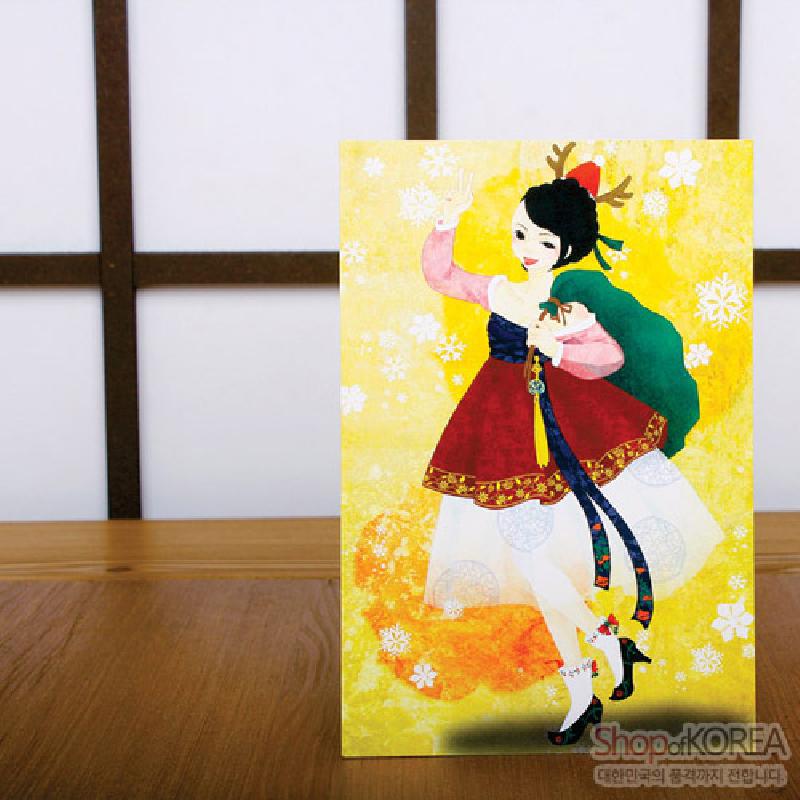
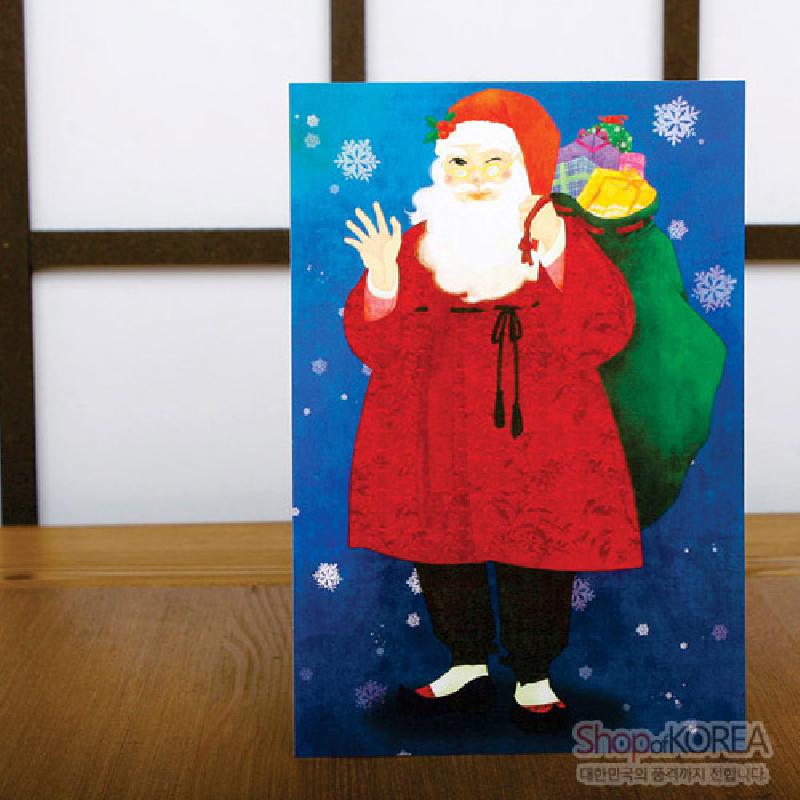
By a similar standard, a type such as the 한복입은 산타할아버지 엽서 (postcard featuring Santa Claus dressed in hanbok) is also unobtrusive for recipients who are a family unit. To the parents' generation it reads like a warm year-end card, and to nieces, nephews, or young family members it is easy to remember as a Korean-style Christmas image. This kind of card-format gift is better suited to a supporting role that raises the overall warmth of the gift, rather than being the centerpiece.
A gift that is seen inside the home every day stays with people long after the explanation is forgotten
When sending a gift directly to the home of parents, siblings, or close relatives, practical everyday items that can actually be used are more comfortable than purely decorative objects. In life abroad, having even a single Korean item in the home is enough to naturally bring someone to mind at the dining table or desk. Items with a clear purpose—such as mugs, writing instruments, and bookmarks—do not depend heavily on personal taste, yet they leave the impression of "a gift sent from Korea." That said, if the material can break, more care must be taken with packaging and shipping, and if the recipient's home has limited storage space, it is better to avoid items that are excessively large.
A mug type featuring a cheongsa chorong (청사초롱, traditional Korean lantern) pattern is an example that carries a clear Korean symbol while being easy to use in daily life. It has a more obvious use than a souvenir kept only in a display cabinet, and it fits well with the everyday habit of drinking tea or coffee. For a gift going to a family home, it helps to apply the standard of "adding a little Korean atmosphere to something used every day."
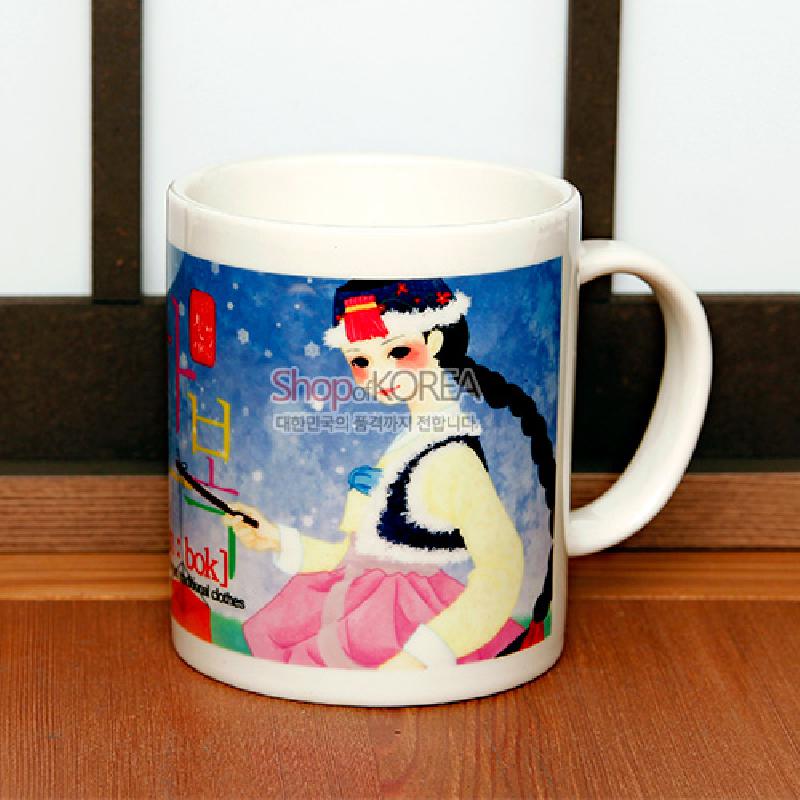
With everyday items like these, no single design is the right answer; what matters is whether it fits the recipient's daily rhythm. A mug featuring hangeul elements is good for conveying the meaning of the Korean script, while a cup with a traditional pattern communicates its atmosphere without any explanation. If there are several family members, rather than matching the same item in multiple quantities, it is also less burdensome to include a card or small stationery piece so that a personal message can be shared with each individual.
For nieces, nephews, and younger relatives, something to touch is more comfortable than something to learn from
For nieces, nephews, or young relatives who have grown up abroad, a type that can be used directly or played with is a better fit than a souvenir that requires a lot of explanation. For a child who is not familiar with Korean culture, color, illustration, and shape catch the eye before meaning does. Hands-on items such as coloring paper, keyrings, and ballpoint pens let children encounter Korea naturally, without making it feel like studying. However, for very young children it is worth checking that there are no small detachable parts or sharp points, and it is safer to avoid items whose decorations are so large they would be embarrassing to use at school.
In this case, the guiding standard is: "Does it retain a Korean feel while being simple to use?" A portable item such as a taegeuk (태극, the yin-yang symbol used in Korean design) pattern keyring can be attached to a bag or keys, making it light and easy to carry, and a coloring type featuring images of travel in Korea can give the whole family something to talk about together. If the child receiving the gift does not know much Korean, an approach centered on illustrations or clear symbols is more approachable than one centered on text.
When dividing gifts among several family members, the balance between size and meaning matters
If the gift is not going to a single household but must be divided among several relatives, the size and quantity of the gifts become important. In that situation, the first question is not how luxurious the item is, but "Is it something each person can receive without feeling burdened?" Practical stationery such as a bookmark-and-ballpoint-pen set is easy for people of different generations to find a use for, and when Korean cultural imagery is included, even a small gift feels like a sincere greeting. In actual reviews, responses along the lines of having prepared it as an unobtrusive Korean-style gift before departing the country do appear, with the ease of giving such a set noted as an advantage.
For example, a bookmark-and-ballpoint-pen set type featuring Korean cultural imagery is well suited to being divided among family members. The bookmark finds a natural use with someone who reads frequently, while the writing instrument is naturally used by students or working adults. However, when sending the same gift to a large number of people, it is better to attach a short card or write each person's name separately so that the messages do not all look identical.
The related products at the end of this article are not simply a list repeating the items described in the text; they are candidates to compare alongside one another for the same situation of choosing year-end gifts for overseas family. Deciding first whether to lead with the heart—like a Christmas card—or to leave something lasting through a practical household item, or to prepare small stationery pieces to divide among several family members, makes the choice considerably simpler. More important than any product name are the standards of the recipient's living environment, the burden of shipping, and the warmth of the greeting that will pass naturally between family members.