Shopofkorea guides
A Guide to Choosing Korean Thank-You Gifts After an International Academic Conference Presentation
Official product names are shown in Korean. Product pages are in Korean; prices are in South Korean won (KRW).
When selecting a thank-you gift after an international conference presentation or joint session, it is just as important that the recipient can accept it without feeling burdened as it is to make a distinctly Korean impression. The appropriate size and level of formality will differ depending on whether the gift is handed over briefly right after a presentation, given as an institutional gesture at the end of a laboratory visit, or chosen with the possibility of future collaborative research in mind.
- If giving to a session chair or host: prioritize neat formality and durability.
- If giving to a collaborator: look for a set that is genuinely useful on a desk.
- If distributing among several people: reduce the burden of portability and quantity preparation.
- If travel or a return journey is involved: consider volume, risk of damage, and security screening together.
For session chairs and hosts, formality should be apparent even with just a brief word of thanks
A gift for a session chair, discussant, or invited professor should convey the intention of gratitude clearly, without requiring a lengthy explanation. Because exchanging business cards is a natural part of academic exchange, items related to business cards or writing instruments that fit the context of a researcher's work are a safe choice. In this case, Korean patterns serve to indicate the origin of the gift, but it is better if they are not so decorative that they overwhelm the recipient's personal taste. If the gift is handed over in a public setting, a size that is easy to carry by hand is more practical than packaging that appears excessively large.
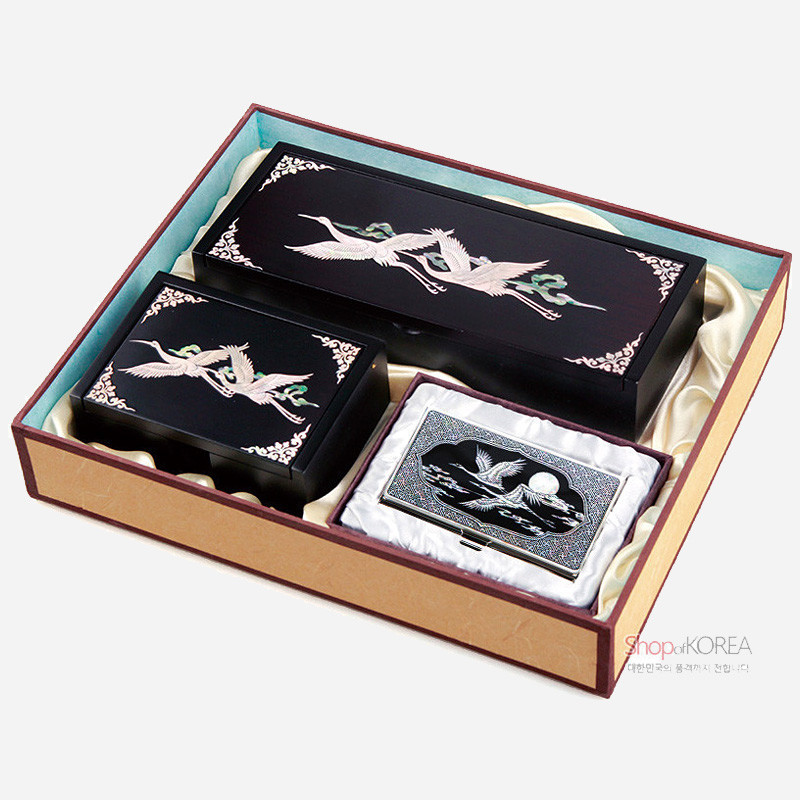
For example, a type such as the 명함케이스와 볼펜 2종세트–송학 (business card case and ballpoint pen two-piece set – Songhak) suits the atmosphere of greetings that continue from the conference venue, email exchanges, and follow-up meetings. Business card and writing tools are not skewed toward any particular field and are easy to explain as useful to both researchers and institutional staff. However, if the recipient already uses many items bearing their own institution's logo, it is better to choose something with a subtle Korean pattern rather than something that looks purely functional.

Rather than thinking of one specific product as the definitive answer for this type of gift, it is better to understand it as a standard for concluding a formal expression of thanks in a tidy manner. The key is whether the gift conveys both the impression of "a gift prepared in Korea" and the practicality of "something that can be kept in a work space without feeling like a burden." Given that actual delivery experiences have included reactions noting that a formal gift that was not overly burdensome for overseas researchers was well received, it is safer to first check the balance between formality and size.
For collaborators, something that can naturally remain on a research desk is ideal

After co-running a joint session or completing a laboratory visit, a gift plays the role of gently continuing the relationship rather than making it overly formal. In this case, rather than looking only at decorative appeal, it is helpful to consider whether the item would look out of place on the recipient's desk, in a meeting room, or in a personal research space. Small accessories with a clear purpose—such as a business card holder, bookmark, or small stationery item—are not heavily dependent on the recipient's field or nationality. However, items in colors that demand very specific personal taste, or large decorative objects, may be burdensome for the recipient to store.
A type such as the 명함집-청자상감운학문 (business card holder – celadon inlaid crane-and-cloud pattern; cheongja sanggam unhangmun) has a Korean pattern while also having a clear context of use. Even after the conference, it can be used to store business cards or kept on a desk, so the meaning of the gift does not remain a one-time memento. In academic exchange in particular, the explanation "a small work accessory featuring traditional Korean design" is sufficient to convey the intention of the gift.
This kind of choice feels more natural when a relationship has already been established to some degree. If it is right after a first meeting, stationery-type gifts that everyone can easily understand may be more comfortable than items that look too much like personal keepsakes. Conversely, after a longer exchange such as a laboratory visit, a joint project meeting, or an institutional invitation, a small accessory to keep and use on a desk is well suited to leaving a lasting impression of gratitude.
When giving to multiple people, a configuration that shares the same sentiment lightly is more practical
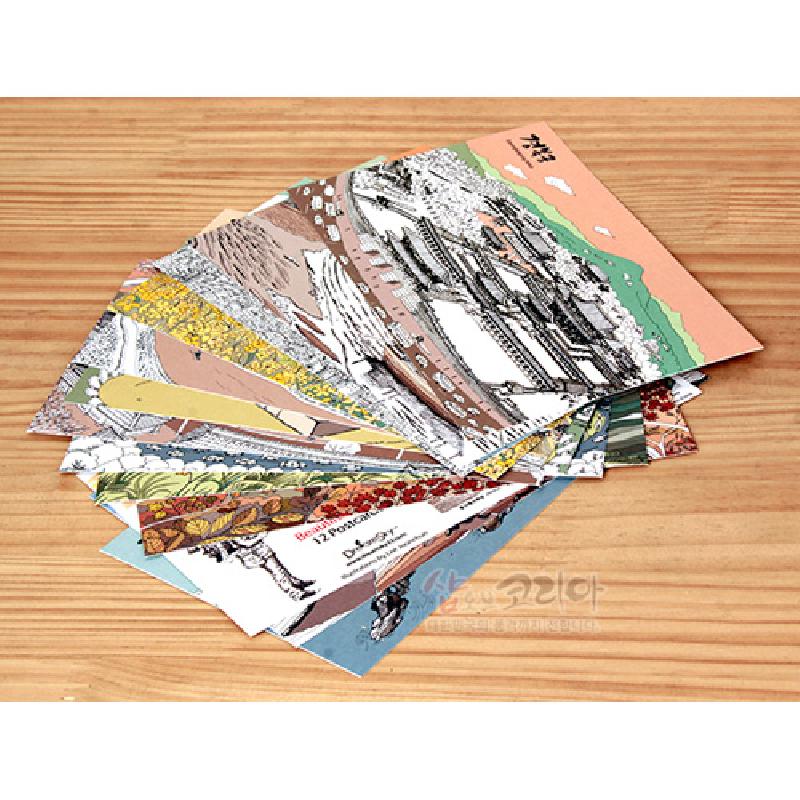
When it is necessary to greet the organizing staff of a joint session, laboratory members, or several graduate student researchers, what matters more than the formality of the gift is how easy it is to distribute. In this case, small accessories that can be prepared according to a consistent standard are more practical than gifts that place disproportionate weight on a single person. Items that are small in volume and low in risk of damage—such as lens cloths, postcards, or small stationery—are easy to hand over directly at the conference venue or in a laboratory. However, if they look too much like souvenirs, the sense of gratitude may be diluted, so adding a short message card or a brief note about the Korean pattern can give a more composed impression.
A type such as the 전통의멋 안경닦이-자수(봉황) (Traditional Elegance lens cloth – embroidery, phoenix; jasu) has a practical point of contact with academic settings where glasses, laptop screens, and presentation materials are frequently handled. Even when distributing to multiple people, the burden of size and weight is small, and the Korean pattern makes it easy to explain the nature of the gift. In group thank-you situations, it is difficult to precisely match each person's individual taste, so choosing something that can be used immediately in daily life is the safer approach.

These practical accessories serve a different role from gifts given to an official representative. For a session chair or host, formality should come first; for multiple participants, the priority should be a sense of evenly distributed, unburdensome gratitude. Even within the same academic event, the roles of recipients differ, so rather than trying to resolve everything with a single type of gift, it is also a good idea to prepare a representative gift and a distribution gift separately.
Gifts that remain after the journey home should be small and have a clear meaning

Overseas researchers often move on immediately after a conference schedule or return home via several cities. For this reason, even a gift with great meaning can become a burden in practice if it is large or fragile. Thin, lightweight items such as bookmarks or postcards are easy to fit in a bag and are also well suited to conveying a brief Korean image. For researchers who frequently handle books and papers in particular, stationery-type gifts fit naturally within the context of the relationship.
A type such as the 금장 책갈피 大-금관 (gold-plated bookmark, large – gold crown; geumjang chaekgalpi) carries the symbolic quality of Korean culture while being relatively easy to store and transport. It can be used alongside conference proceedings, academic texts, and personal notebooks, so the reason for giving it to a researcher is also natural. However, since metal accessories or desk accessories with sharp edges may be burdensome depending on the travel environment, it is better to prioritize a thin and simple configuration for recipients with a complicated return itinerary.
The smaller the gift, the more important the accompanying words are. A short phrase such as "thank you for joining today's session" or "I hope you will remember the exchange we had in Korea" makes the direction of gratitude clear regardless of the size of the item. As reflected in reactions noting that such souvenirs were well suited to introducing Korean culture naturally, these items often convey their meaning without requiring a lengthy explanation.
The related products listed at the end are not a collection of only the items mentioned in the body text, but rather candidates to compare alongside one another in the same international conference thank-you context. Deciding first whether the recipient is a session chair, a collaborator, or multiple laboratory members, and then looking at the balance of formality, practicality, and portability, will make the choice considerably easier.