Shopofkorea guides
Korean Culture Gift Guide for Korean Language Class Teachers
Official product names are shown in Korean. Product pages are in Korean; prices are in South Korean won (KRW).
When choosing a gift for a Korean language class teacher, what matters more than a pretty souvenir is whether the gift connects naturally to the classroom setting. The right choice varies depending on whether the teacher can use it directly in class, whether it can sit on a personal desk without feeling like a burden, and whether it is light enough to be given by a student or parent.
- If you hope it will be used during class: small accessories close to the learning setting, such as bookmarks, writing instruments, or postcards
- If you want it to stay on the desk for a long time: practical desk items that are easy to keep in place, such as a mug, pen holder, or memo holder
- If you want to pass along a light word of thanks: a small, clearly meaningful gift with a hangeul motif
- If an institution or a group of people is preparing the gift together: stationery that is easy to order in quantity and unlikely to clash with personal taste
Gifts That Sit Naturally Among Teaching Materials
For a teacher of Korean, accessories that connect directly to the context of the lesson are a safe choice. Items close to reading and writing situations—such as bookmarks, ballpoint pens, pencils, and postcards—can be used by the teacher without requiring any particular personal preference to show through. When a hangeul or Hunminjeongeum (the royal proclamation introducing the Korean alphabet) motif is included, the gift becomes more than a simple souvenir; it evokes the relationship of teaching and learning Korean. That said, items that are too decorative or too large can end up with an unclear purpose inside the classroom, so it is better to look for a size and composition that would not look out of place alongside teaching materials.
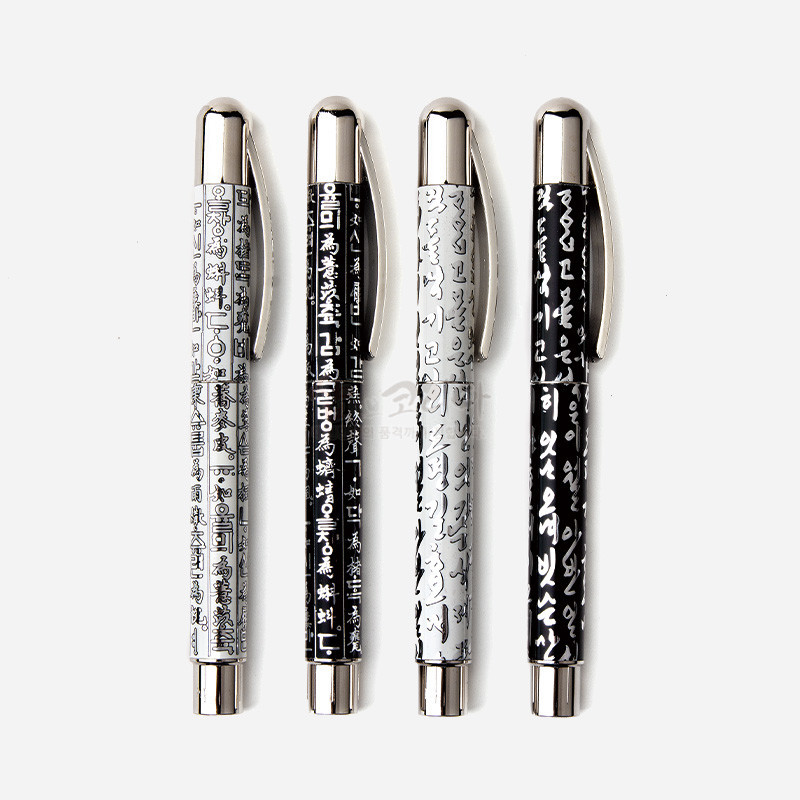
For example, a type like the 한국문화4종 책갈피+볼펜세트 (Korean Culture 4-piece Bookmark + Ballpoint Pen Set), which combines bookmarks and writing instruments, conveys a word of thanks without significantly disrupting the teacher's actual workflow. The bookmark can be slipped between a textbook or resource binder, and the ballpoint pen connects directly to lesson preparation or note-taking. This kind of combination does not come across as too personal a gift, making it easy for students, parents, and fellow teachers alike to choose. The key is not any single specific product but rather the standard of "a small cultural accessory that comes to hand during class."

When choosing this type of gift, it is better to picture the moment of use before thinking about the packaging or composition. If the teacher moves between several textbooks during a lesson, a bookmark is meaningful; if writing is frequent—for marking corrections or taking attendance—a pen set is more practical. Passing along a short thank-you card or postcard at the same time makes the gesture feel less empty even when the item itself is small. Reviews have noted that this kind of gift worked well as a light expression of thanks to a teacher or as a gift for a foreign recipient, so it is worth referencing as a low-pressure option.
An Impression That Does Not Feel Like a Burden Even Left on the Desk

For a gift intended for the teacher's personal desk, everyday practicality that does not cause fatigue over time matters more than something too large or showy. Items with a clear role on the desk—such as a mug, pen holder, or memo holder—are less likely to miss the mark than decorative objects. For a Korean language teacher, motifs connected to the educational context, such as hangeul, Hunminjeongeum, or King Sejong, feel especially natural. That said, strong color choices or excessive decoration that reflect a particular personal taste can be difficult to use for a long time in an office setting, so it is better to choose a calm design.
A mug with a Hunminjeongeum motif is a good example for explaining these criteria. A mug can be used frequently before and after class or in the teachers' room, and a hangeul design makes the relationship of Korean language education clearly visible. A type like the 한국의 아침 머그컵 시리즈 - 훈민정음 (Korean Morning Mug Series – Hunminjeongeum) makes it easy to carry the meaning of the lessons alongside the words "thank you." Since there is also a possibility that the teacher already owns many cups, it is better to look for a composition where a cup sits naturally on the desk rather than an overly large set.
Mugs or desk accessories with imagery have the advantage of letting the recipient immediately understand the meaning. However, breakable items require consideration of the distance they must travel and the method of delivery. Giving directly in person is fine, but if the gift must be sent far away or distributed to multiple people, writing instruments or postcards may be more convenient. The impression a gift makes comes not from its size but from the sense of connection—that it was chosen with the teacher's lessons in mind.
A Choice That Observes Formality Without Making the Teacher Uncomfortable
If you want to convey your thanks in a slightly more polished way, desk accessories with a clear purpose on the desk are worth considering. Pen holders, memo holders, and small desktop items have more presence than stationery yet more practicality than purely decorative objects. For a Korean language teacher, products featuring a hangeul or King Sejong motif make the theme clear without making the formality feel excessive. However, if the teacher's workspace is a shared area or the desk is small, an overly large accessory can become a burden instead.
A type like the 한국의멋 펜꽂이-훈민(세종) (Korean Beauty Pen Holder – Hunmin (Sejong)) has a relatively clear use case on a teacher's desk. It can hold pens, highlighters, and frequently used small tools, and it also carries a symbol connected to hangeul education. This kind of gift may feel more settled when it comes from a class, a parents' group, or a program organizer conveying appreciation, rather than from an individual student alone. What matters is not creating an impression of high cost but achieving a balance that does not look out of place in the teaching space.

When choosing a desk accessory, it is better not to make too firm assumptions about the teacher's personality. Even if a traditional pattern is included, strong colors or a large decorative surface area can make it subject to personal taste. Conversely, if the functional value is too weak, the item may end up stored away as a keepsake rather than used. For this reason, a stable approach to choosing this type of gift is to check whether it has both "visible meaning" and "everyday function."
When Several People Give Together, Prepare Something Small and Uniform
When a thank-you gift is being prepared collectively by fellow teachers, an institution, or an entire class, the method of delivery matters more than any one person's taste. If multiple people are pooling their feelings to give together, stationery, postcards, and bookmarks that are easy to order in quantity and simple to store are appropriate. Small accessories connected to learning—such as a ballpoint pen set featuring hangeul and Seoul imagery, a Hunminjeongeum pen set, or a traditional-pattern pencil set—are easy for the recipient to accept without feeling burdened. Especially in settings where cultural introduction is part of the occasion, such as overseas Korean language classes or Korean language schools (한글학교, hangeul hakkyo), small stationery items like these can actually feel more natural.
In this case, the message conveyed alongside the gift matters more than the gift itself. Writing a short note on a postcard or card—a moment from class that stood out, an expression learned, something to be grateful for—makes even the same object feel like a much more personal greeting. Just as a review noted that a Hunminjeongeum design was chosen for someone studying language and literature and that having an explanation made it easy to convey the meaning, a hangeul motif serves to explain the context of the gift. However, in situations where items must be distributed to multiple people, it is better to prioritize compositions that are easy to carry and deliver over breakable items or bulky ones.
The related products at the end are not a definitive list of answers drawn from the main text but rather candidates to compare alongside one another in the same thank-you gift situation. When choosing a gift for a Korean language class teacher, breaking the decision down by classroom usability, desk burden, and the level of formality appropriate to the occasion of delivery will make the choice far clearer than starting from a product name.