Shopofkorea guides
How to Choose a Korean Gift for a Foreign Professor
Official product names are shown in Korean. Product pages are in Korean; prices are in South Korean won (KRW).
When giving a Korean gift to a foreign professor, what matters more than size or visual splendor is whether the gift suits the nature of the relationship and the occasion. The appropriate level of formality differs depending on whether the gift is a gesture of thanks, a commemoration of an official visit, or a return courtesy after a research exchange, and it is also worth considering whether the professor will be able to keep and use the gift for a long time in their office or study.
- If it is a commemoration of an official visit: prioritize formality and durability.
- If it is a thank-you after a research exchange: consider practicality and an unimposing size.
- If the recipient works closely with books and documents: stationery or desk accessory types are a safe choice.
- If the recipient has travel plans: choose a configuration that is light and at low risk of damage.
Desk Gifts That Preserve Formality While Reducing Burden
When the relationship is relatively formal—such as a letter of recommendation, joint research, consultation, or a seminar invitation—stationery gifts that can be used naturally on a desk are more comfortable than overly personal household items. Objects with a clear purpose, such as a business card case, ballpoint pen, or pen holder (pilham), can preserve the formality of gratitude without the meaning of the gift becoming excessive. When a Korean pattern is incorporated into the design, its commemorative quality is conveyed without the need for a lengthy explanation.
For example, a set combining a business card case and a ballpoint pen pairs well with occasions where exchanging business cards or writing naturally occurs, such as seminars, academic conferences, or office visits. However, unless the relationship with the professor is a very close personal one, an overly ornate decoration or a large package may appear burdensome, so it is better to first check whether the gift looks neat when handed over in person.

For this type of gift, no single product is the definitive answer; rather, it can be viewed through the criterion of "conveying an official expression of gratitude in a practical way." Designs featuring Korean imagery—such as songhak (crane-and-pine) patterns, unhak (cloud-and-crane) patterns, or celadon motifs—do not require excessive explanation even when placed on an office desk, and they remain as a small keepsake even when not in use. Actual reviews have noted that gifts of this type were perceived as refined yet not burdensome when given to foreign professors, making them a useful reference for situations where one wishes to strike a balance between formality and practicality.
Gifts That Stay in the Office and Continue to Serve
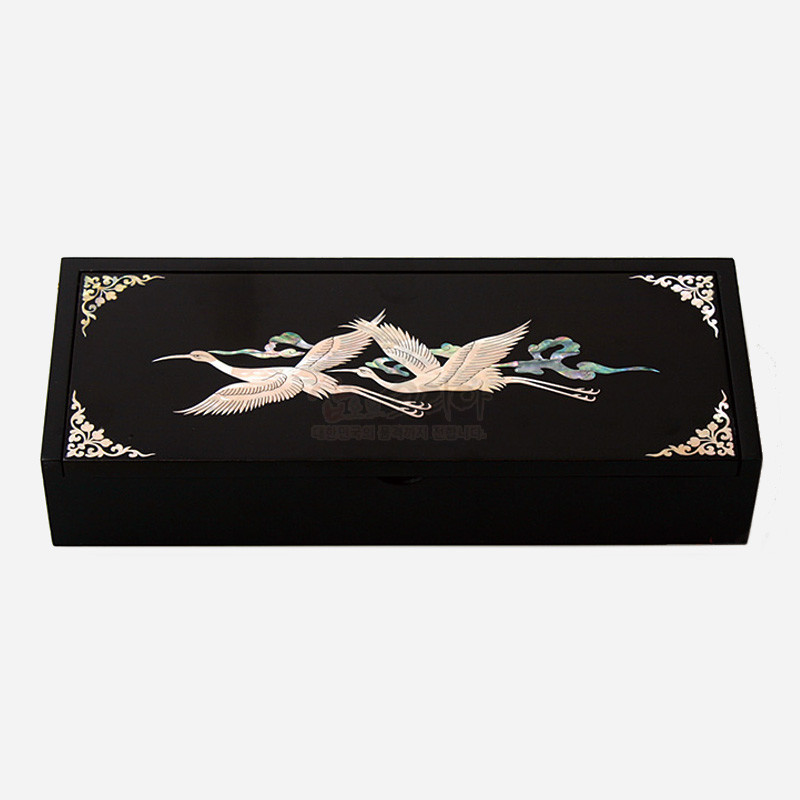
If the professor is finishing a visit to Korea and returning home, or if you are looking for a gift that can be kept in the office for a long time as a lasting memory, types with good keepability—such as a pen holder (pilham) or a small desk object—are appropriate. The key here is whether the item appears to have actual utility on a desk rather than looking purely decorative. Even if a piece has a traditional craft feel, an excessive size or an overly strong color scheme may feel burdensome depending on the space.
A type such as a sanggam (inlaid lacquerwork) automatic pen holder (jadong pilham)—which can hold pens and small stationery items—connects naturally to settings like a study or a research office. The unhak (cloud-and-crane) pattern carries a distinctly Korean impression, but because the item also has a function, it is easier to explain the reason for giving it than with a purely decorative piece.
This pen-holder type of gift is suitable when one wishes to convey a meaning that will last a little longer—such as a commemoration of a visit, an expression of gratitude around the time of retirement, or a return courtesy after the conclusion of a research project. However, if there is air travel involved or the schedule includes a great deal of luggage, the size and packaging stability must also be considered. If the professor needs to carry the gift away immediately, it may be more convenient to choose a smaller and lighter accessory within the same traditional craft category.
A Light Korean Keepsake for Occasions on the Move
In situations where a gift must be carried for an extended period—such as at a conference venue, before departure at an airport, or during a brief campus visit—size and weight become important criteria. In such cases, items that fit easily into a bag, such as a bookmark, ballpoint pen, or postcard-style keepsake, reduce the burden compared to large decorative pieces. For a professor who works closely with books and papers in particular, a bookmark becomes a choice that combines meaning with practicality.
A type such as a gold-foil bookmark (geumjang chaekgalpi) featuring a gwan (crown) motif—a small form that encapsulates a Korean cultural symbol—is well suited to a light return courtesy after a visit to Korea or a research exchange. Even without a lengthy explanation when presenting the gift, it conveys the impression of "a Korean keepsake," and the recipient can actually use it between books or research materials.

The smaller the gift, the more important the wrapping and the message become. Because the object itself is not large, a card with a line of thanks, a word of gratitude, and the context of the occasion should accompany it so that the gift does not appear merely trivial. However, a composition that packs too many cultural symbols into one piece can look cluttered, so it is worth checking whether there is a central element that is easy to explain—such as hangeul, a crown motif, or a traditional pattern.
A Neat Return Gift That Is Comfortable Even in Front of Others
The criteria differ slightly between a gift given quietly to the professor alone and one presented in a setting where members of the research group or institutional representatives are also present. In front of multiple people, traditional-pattern accessories, writing instrument sets, or small decorative keepsakes that are acceptable to anyone are more reliable than overly personal items. Because the meaning of the gift should remain within the bounds of gratitude and commemorating the visit, items that are strongly dependent on personal taste—such as lifestyle goods—are better chosen with care.
Set-type products can help in observing formality, but a large configuration is not always necessary. For an institutional-level return courtesy, options such as a sanggam (inlaid lacquerwork) automatic holder set or a combination of a Korean-culture bookmark and ballpoint pen—types with neat packaging and a clear purpose—can be compared. Conversely, if an individual student is presenting a personal thank-you on their own, too large a set may feel burdensome, so it is more natural to scale down to a smaller configuration of the same character.
When You Want Gratitude to Remain as Something Useful in the Office
Even when you wish to convey a personal feeling of thanks—for guidance, advice, a letter of recommendation, or a research opportunity—it is good to maintain a balance so that the gift does not appear excessively personal. Items that can be used in a research office or workplace, such as a mug, memo holder, bookmark, or ballpoint pen, make it easy to express gratitude while respecting the boundaries of the relationship. When hangeul or a Korean landscape motif is incorporated, a commemorative quality that evokes the recipient's experience in Korea also remains.
In this case, even without knowing the professor's tastes precisely, it is sufficient to use as a criterion whether the occasion for use is clear. For example, a Hunminjeongeum (the document proclaiming the Korean alphabet) mug type can be used in an office, and a small desk accessory such as a map-of-Korea memo holder leaves a light commemorative impression of the visit. However, gifts that are heavily influenced by personal taste or lifestyle habits—such as food, fragrance, or clothing—are better chosen with care unless the relationship is very close.
The related products at the end are not simply a re-listing of the products mentioned in the body; they are candidates that can be compared when conveying gratitude or a visit commemoration to a foreign professor. Rather than deciding on a product name first, checking in order—the nature of the relationship, the place of presentation, whether travel is involved, and the possibility of use in a research office—makes it easier to choose a Korean gift that is neither burdensome nor quickly forgotten.